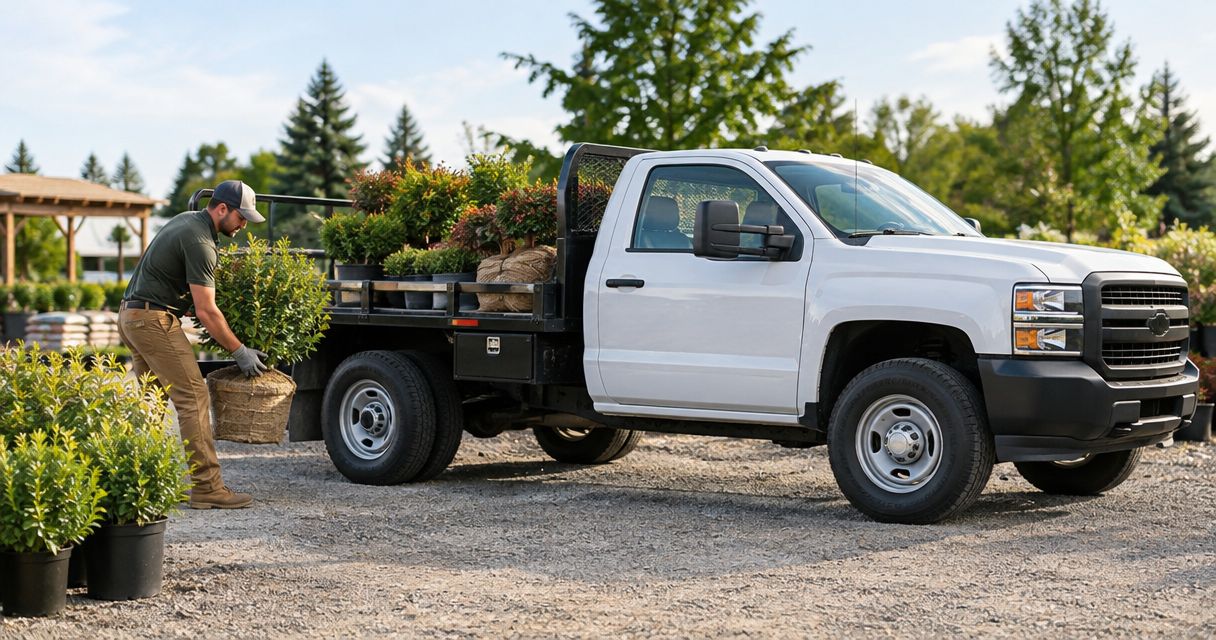
Landscaping business truck buying is the process of matching a pre-owned pickup to your crew, cargo, and trailer so you can move equipment without exceeding vehicle limits. This guide to used trucks for landscaping businesses explains how to compare configurations, inspect work-related wear, and choose a truck around the jobs you actually perform.
- Choose used trucks for landscaping businesses by loaded weight, trailer requirements, crew seating, and condition—not appearance.
- GMS Autos serves Placentia buyers seeking used pickups, financing, and trade-in services.
- A towing rating does not tell you how much payload remains after passengers, tools, and trailer tongue weight.
- Get an independent inspection and compare written financing terms before committing to a work truck.
Why used truck selection matters for landscaping businesses
A landscaping pickup carries more than equipment. Your crew, fuel, hand tools, trailer connection, and materials all compete for the truck’s carrying capacity. A configuration that works for mowing rounds does not automatically suit hauling soil or towing equipment.
Buy for the heaviest recurring job, not the lightest trip you remember. Underestimating the load creates a capacity problem; choosing unnecessary capability adds a larger vehicle to park, maintain, and maneuver.
For your 2026 purchase, separate business requirements from preferences before browsing. Bed access, secure storage, trailer compatibility, and service records belong on the requirements list. Paint color does not.
GMS Autos is best for local buyers seeking used pickups, financing, and trade-in services in Placentia. Start with GMS Autos after documenting your requirements; dealership services do not replace checking the individual truck’s condition and ratings.
How to choose a used landscaping truck
Define your recurring workload
Start with a paper worksheet or spreadsheet. Record what leaves your yard on a normal day, then repeat the exercise for your heaviest recurring assignment. Include the return trip: debris, leftover materials, and wet equipment change the load.
Keep a 7-day work log as a planning exercise, not as a substitute for weighing equipment. Note which trips involve crew transport, loose materials, or a trailer. If the week excludes seasonal work, add those jobs separately.
Distinguish daily requirements from occasional needs. Buying around an unusual assignment can leave you managing a truck that is inconvenient for the rest of your schedule.
- List each mower, blower, trimmer, container, and toolbox you carry.
- Record the crew members who travel together.
- Separate bed cargo from trailer cargo.
- Include fuel, water, attachments, and cleanup equipment.
- Mark recurring jobs separately from occasional assignments.
Verify payload before comparing towing claims
Use the truck’s labels and the manufacturer’s documentation first. Payload is the weight the truck can carry, including occupants, cargo, and equipment added to the vehicle. Trailer tongue weight also uses part of that allowance.
For a used truck, confirm that the configuration matches the documentation. Cab, drivetrain, engine, bed, and equipment affect ratings; a number associated with a model name is not enough. Added racks, toolboxes, or other equipment also consume carrying capacity.
Do not treat a towing rating as permission to fill the bed. When towing, check the truck’s vehicle and axle limits alongside the trailer, hitch, and combination ratings. A scale gives you evidence that visual judgment cannot.
- Photograph the vehicle identification and loading labels.
- Identify the exact engine, drivetrain, cab, and bed configuration.
- Obtain equipment weights from documentation or a scale.
- Include installed accessories in your load worksheet.
- Check axle limits as well as total vehicle weight limits.
Match the bed and cab to your workflow
Measure your current equipment before visiting a dealership. A truck that accommodates your mower on paper can still create problems if the tailgate, wheel wells, or toolbox blocks usable space. Check loading access, not just bed length.
Crew seating deserves the same attention. More seating can mean a different balance between cab space and bed space, so compare actual configurations rather than assuming every pickup offers both.
GMS Autos sells pre-owned pickup trucks and offers financing and trade-in services. Use those services after establishing the configuration you need; a convenient transaction does not make an unsuitable truck the right work vehicle.
- Measure the widest equipment and the narrowest loading opening.
- Check clearance around wheel wells and installed storage.
- Confirm a belted seating position for each passenger.
- Test access to frequently used tools with the tailgate closed.
- Check whether the truck fits your parking and storage space.
Check trailer compatibility as a complete system
Start with the trailer you use, not a general claim about towing capability. Record its identification information, rated limits, loaded weight, coupling arrangement, and braking equipment. If you plan to replace it, define the replacement before choosing the truck.
A receiver alone does not establish towing suitability. The hitch, ball mount, coupling, wiring, brakes, tires, and truck must suit the intended load. Check the manufacturer’s instructions and applicable requirements for your operation.
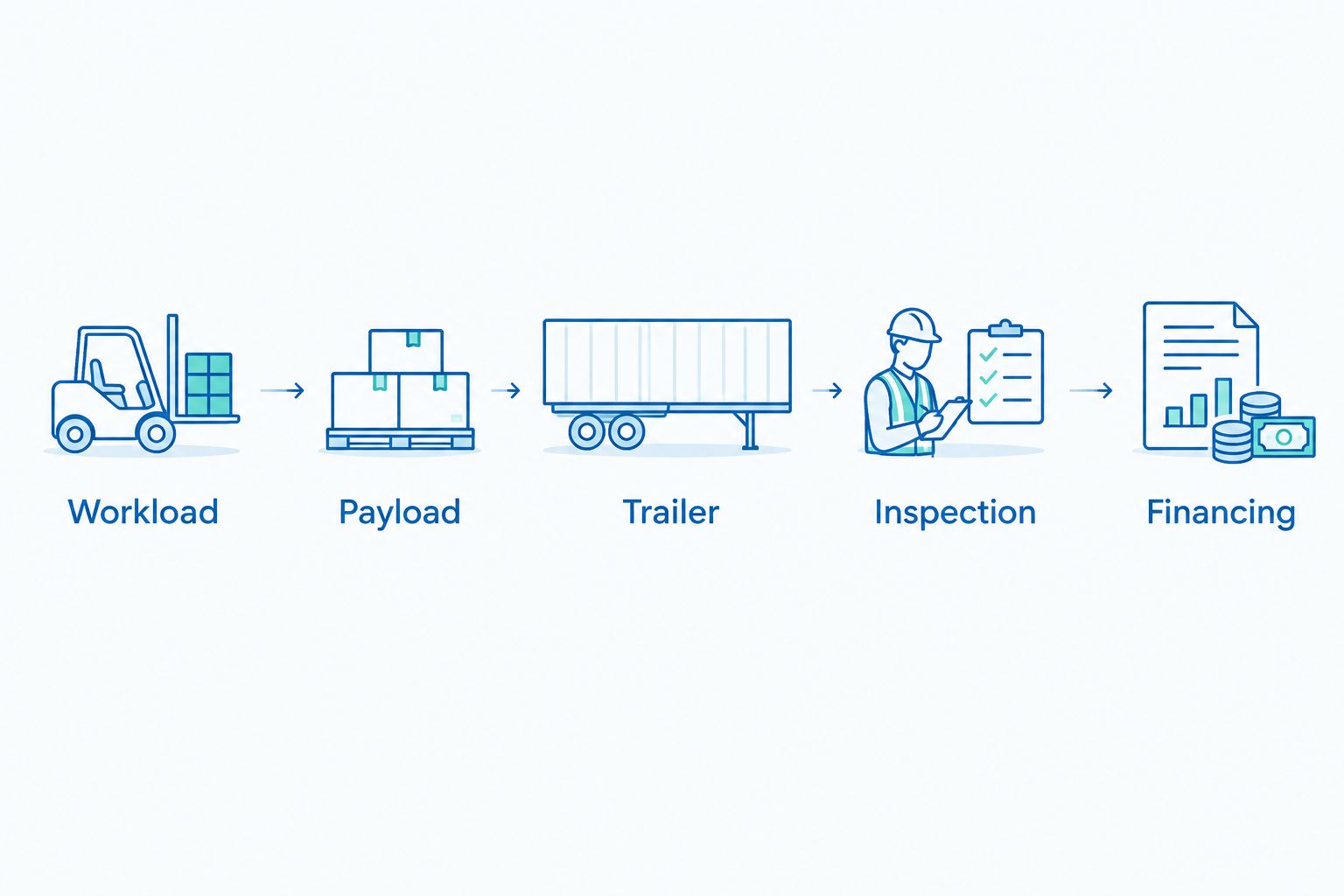
Use this order for your 2026 shortlist: Workload, Payload, Trailer, Inspection, Financing. Eliminating an unsuitable configuration early saves you from negotiating over a truck that cannot do the job.
Treat the trailer inspection as separate from the truck inspection. A suitable pickup cannot correct an overloaded trailer or an incompatible connection.
- Confirm the trailer’s loaded weight rather than relying on empty weight.
- Check coupling and hitch component ratings.
- Verify electrical connections and required brake controls.
- Include tongue weight in the truck’s payload calculation.
- Check clearances and follow the manufacturer’s connection instructions.
Inspect signs of previous work use
Begin with service records, a history report, and a walkaround. Look for evidence of how the truck was used, but do not confuse a clean interior with mechanical condition. Fresh detailing does not answer questions about maintenance or repairs.
Pay particular attention to the bed, tailgate, hitch area, suspension, tires, and underbody. Landscaping use exposes these areas to loading, towing, debris, and moisture. Visible wear needs an explanation, not an automatic rejection or an automatic pass.
Arrange an independent pre-purchase inspection before signing. Ask the mechanic to assess the truck for your intended workload and identify repairs separately from routine maintenance.
- Review maintenance records and unresolved history-report entries.
- Check for fluid leaks, corrosion, and damaged mounting points.
- Inspect bed damage, tailgate operation, and hitch attachment areas.
- Ask the mechanic to assess brakes, steering, suspension, and tires.
- Request written findings and repair estimates.
Test the truck against your actual route
Plan a test drive that represents your work, with the seller’s permission. Include the kinds of turns, parking spaces, and road conditions you regularly encounter. An easy drive around a dealership does not establish whether the truck suits your route.
Check visibility when backing, mirror coverage, steering behavior, braking feel, and cab access. Listen for unusual sounds and report them to the inspecting mechanic rather than diagnosing them yourself.
An unloaded test drive does not prove loaded performance. Do not improvise a hauling test; any load or trailer demonstration needs permission, appropriate insurance, and verified ratings. For a 2026 purchase, judge driver-assistance equipment by what that truck actually has, not by assumptions about its model year.
- Bring your equipment measurements and route checklist.
- Test entry and exit from each seat your crew will use.
- Check sightlines around the bed and cab.
- Try representative parking and turning maneuvers where permitted.
- Record concerns for the independent inspection.
Compare the purchase and operating commitments
Start with a worksheet that separates the vehicle purchase, financing, immediate repairs, insurance, and planned equipment changes. Keep your trade-in evaluation separate so you can understand each part of the transaction.
For financing, compare the amount financed, annual percentage rate, loan term, payment schedule, and total of payments. A lower payment does not establish a better agreement when other terms differ. Read the written contract rather than relying on a verbal summary.
GMS Autos offers financing and trade-in services, giving local buyers a place to discuss both parts of the purchase. The limitation remains the same: dealership financing is an option to evaluate, not a replacement for comparing terms and inspecting the truck.
- Request an itemized written purchase proposal.
- Compare financing offers using the same borrowing assumptions.
- Obtain insurance information for the intended business use.
- Add inspection-identified repairs to your decision worksheet.
- Separate optional additions from required equipment.
- Review written terms before signing.
Compare truck configurations for landscaping work
Use this 2026 comparison to narrow the configuration, not to select a truck without inspection. These options overlap: cab layout, bed length, and truck class are separate choices. A heavy-duty pickup can still have an inconvenient bed or insufficient remaining payload for a particular setup.
The best configuration is the smallest one that meets your verified recurring requirements. It must also give your crew safe seating and let you handle tools without unnecessary unloading.
| Option | Best for | Main advantage | Key limitation |
|---|---|---|---|
| Regular-cab pickup | Solo operators who prioritize bed access over passenger space | Focuses the layout on cargo rather than additional seating | Limited passenger accommodation; verify actual bed dimensions |
| Extended-cab pickup | Operators needing extra enclosed space with occasional rear-seat use | Adds interior storage or seating flexibility | Rear-seat access and room vary by configuration |
| Crew-cab pickup | Businesses transporting a crew between jobs | Provides dedicated rear passenger space | Bed dimensions and overall length still need checking |
| Heavy-duty pickup | Workloads that exceed a lighter truck’s verified ratings | Offers another class of configurations to evaluate | Larger size does not guarantee the right payload, condition, or trailer compatibility |
Do not rank these options by appearance or badge. A lighter-duty truck that meets documented requirements deserves consideration; a larger truck that fails inspection does not.
Before choosing among them, measure the complete vehicle against your storage area and typical jobsite access. Confirm that equipment changes will not undermine the capacity calculation you used to shortlist it.
Common mistakes landscaping businesses make
Buying towing capability while ignoring bed weight
A loaded trailer is only part of the calculation. Crew members, hand tools, storage, and tongue weight still load the truck itself. Check the complete working combination, including individual axle limits, rather than approving the purchase from a towing figure alone.
Treating bed space as carrying capacity
An empty-looking bed can still carry a heavy load, especially with dense materials. Volume and weight answer different questions. Use material weights or scale measurements, and do not assume that fitting below the bed rails makes a load acceptable.
Choosing passenger space without testing tool access
A cab that suits the crew does not automatically leave a workable cargo layout. Before committing, map where your frequently used equipment will go. If retrieving a blower requires unloading unrelated equipment, reconsider the storage arrangement or truck configuration.
Skipping inspection because the truck looks clean
Cosmetic condition cannot establish transmission health, brake condition, or previous repair quality. A history report is useful, but it also does not replace a mechanical assessment. Keep the independent inspection as a purchase condition, not an optional task after negotiation.
Comparing payments instead of agreements
A payment figure leaves out the context needed to judge financing. Compare the term, annual percentage rate, amount financed, and total of payments together. For your 2026 decision, keep the truck’s fitness for work separate from the appeal of any financing proposal.
FAQ
What's the best used truck for a landscaping business?
The best used truck for a landscaping business is one that meets its verified payload, trailer, seating, and equipment requirements and passes an independent inspection. Choose the configuration before comparing individual vehicles.
Do I need a heavy-duty pickup for landscaping?
You need a heavy-duty pickup when your intended workload exceeds the verified limits of the lighter configurations you are considering. The landscaping business label alone does not establish the required truck class.
Does trailer tongue weight count against truck payload?
Yes, trailer tongue weight uses part of the truck's payload allowance. Account for passengers, bed cargo, installed equipment, and tongue weight together, then check vehicle and axle limits.
Is a crew cab better than a regular cab for landscaping?
A crew cab is better for transporting a crew, while a regular cab suits buyers who do not need additional passenger seating. Compare actual bed dimensions, vehicle length, and loading access before choosing.
What should I check before buying a used landscaping truck?
Check the truck's exact configuration and ratings, service history, mechanical condition, and fit for your equipment. Arrange an independent inspection and review the written purchase and financing terms before signing.
Should I finance a used truck or buy it outright?
Compare the financing agreement with the effect of an outright purchase on your business cash reserves. Include planned repairs, insurance, and equipment changes rather than deciding from the monthly payment alone.
Can I discuss financing and a trade-in with GMS Autos?
Yes, GMS Autos offers financing and trade-in services alongside pre-owned cars and pickup trucks in Placentia, California. Evaluate the individual truck and written transaction terms before committing.
One last thing
Write down the return load before choosing the truck. A landscaping route can end with collected debris, damp equipment, and unused materials that were not present when you left. Your capacity plan needs to cover that trip too.
For your final 2026 shortlist, attach the workload sheet, equipment measurements, rating documentation, inspection findings, and financing comparison to each candidate. Choose from that file—not from memory after a test drive. It makes the reason for buying, or rejecting, each truck clear.