Best overall: Toyota Corolla sedan. Best for flexible cargo: Honda Civic hatchback. Best for fuel-focused commuting: Toyota Prius. The best low-mileage used cars in 2026 combine the right body style with documented maintenance and a clean inspection—not just a small odometer reading.
- Toyota Corolla sedan leads the best low-mileage used cars shortlist for straightforward everyday commuting.
- Honda Civic hatchback is the pick for compact-car buyers who need flexible cargo access.
- Toyota Prius suits fuel-focused commuters; inspect the hybrid system before buying.
- GMS Autos serves used-car buyers in Placentia with financing and trade-in services.
- Maintenance records and an independent inspection matter more than low mileage alone.
Why this matters
Low mileage describes distance traveled. It does not establish how a car was maintained, whether it suffered collision damage, or how long it sat unused. Rubber components and fluids still age while a car is parked.
For your 2026 search, treat mileage as a screening tool rather than the final verdict. GMS Autos is a used-car dealership in Placentia, CA, offering pre-owned cars and pickup trucks, financing, and trade-in services. Choose the vehicle first; assess the financing separately.
GMS Autos is a used-car shopping option for Placentia buyers who also need financing or trade-in services. The model recommendations below describe vehicles to evaluate, not specific cars offered by the dealership.
What makes the best low-mileage used cars?
A good shortlist starts with your daily use and ends with the condition of the individual vehicle. Use these criteria before comparing badges:
- Maintenance evidence: Look for dated records that match the manufacturer's time-based and mileage-based service requirements. Low mileage does not cancel scheduled maintenance.
- Condition: Check tires, brakes, fluid leaks, interior wear, warning lights, and evidence of collision repair. Have an independent mechanic inspect the car.
- Useful body style: A sedan separates passengers from the trunk; a hatchback gives you a larger loading opening. Bring the items you regularly carry.
- Powertrain fit: Compare conventional gasoline and hybrid vehicles against your actual routes. Hybrid candidates need a hybrid-system assessment, not just a standard road test.
- Ownership history: Check the title, vehicle-history report, service records, and odometer consistency together. No single document establishes the entire history.
- Daily usability: Test the seat, controls, visibility, parking maneuverability, and passenger space. A good specification sheet cannot fix a poor driving position.
For 2026, prioritize documented condition over a rigid mileage cutoff. An older low-mileage car still needs an age-related maintenance review.
Best low-mileage used cars at a glance
These rankings separate buying needs rather than claim that every example of one model beats every example of another. Body style, trim, equipment, and powertrain vary; confirm the exact vehicle before deciding.
| Rank | Car | Best for | Standout feature | Key limitation |
|---|---|---|---|---|
| 1 | Toyota Corolla sedan | Straightforward everyday commuting | Compact sedan layout | Separate trunk limits loading flexibility |
| 2 | Honda Civic hatchback | Compact-car cargo flexibility | Rear hatch and folding rear seats | Cargo shares space with the passenger cabin |
| 3 | Toyota Camry | Buyers who want a larger sedan | Larger sedan format than Corolla | Larger footprint needs a parking-space check |
| 4 | Honda Accord Hybrid | Larger-sedan buyers choosing a hybrid | Hybrid powertrain in a sedan body | Requires hybrid-system inspection |
| 5 | Mazda3 hatchback | Buyers prioritizing driving position and feel | Compact hatchback format | Rear-seat and sightline fit need careful testing |
| 6 | Toyota Prius | Fuel-focused hybrid commuting | Hybrid powertrain with hatch access | Battery condition cannot be judged from mileage alone |
1. Toyota Corolla sedan: best for everyday commuting
The Toyota Corolla sedan is the default starting point for a buyer who wants a compact car with a separate trunk. It keeps the shortlist focused on commuting rather than extra cargo capacity. Check the exact engine, transmission, and equipment instead of assuming every Corolla has the same specification.
Toyota Corolla sedan pros:
- Compact sedan format suits a straightforward commuting brief.
- A separate trunk keeps stored items outside the passenger compartment.
- You can evaluate comfort and controls against a familiar daily-driving task.
Toyota Corolla sedan cons:
- The trunk opening is less flexible for bulky objects than a hatchback opening.
- A compact rear seat needs a real passenger or child-seat fit check.
- Low mileage does not establish service quality or collision history.
During the inspection, ask the mechanic to assess the transmission, cooling system, brakes, and signs of leaks. Review maintenance by elapsed time as well as distance. A lightly driven car with unexplained gaps in its records deserves more scrutiny, not an automatic pass.
Best for: Buyers whose main job is getting to work, running errands, and parking a compact sedan.
Verdict: Buy a Toyota Corolla sedan when its inspection and maintenance records support the odometer reading.
2. Honda Civic hatchback: best for flexible cargo
The Honda Civic hatchback gives you a rear hatch rather than a separate trunk opening. Folding rear seats let you change the balance between passenger space and cargo space. Confirm the seat-folding arrangement and loading dimensions on the actual car.
Honda Civic hatchback pros:
- The hatch opening helps with loading awkwardly shaped items.
- Folding rear seats provide flexibility when rear passengers are absent.
- A compact body offers an alternative to moving into a larger vehicle.
Honda Civic hatchback cons:
- Cargo and passengers share the same cabin, so secure loose items.
- Folding the rear seats reduces passenger capacity.
- Engine and transmission configurations differ; the model name alone is insufficient.
Bring your stroller, sports equipment, or work bag to the viewing. Check whether it fits with the rear seats upright before accepting a demonstration with everything folded down. Test the hatch operation, cargo cover if fitted, and rear visibility from your normal driving position.
Best for: Buyers who want compact-car dimensions but regularly load items that are awkward for a sedan trunk.
Verdict: Buy a Honda Civic hatchback when its cargo flexibility solves a task your sedan shortlist cannot.
3. Toyota Camry: best for a larger sedan
The Toyota Camry belongs on your shortlist when a compact sedan does not meet your passenger-space needs. It uses a larger sedan format than the Corolla. That makes it a different buying proposition, not an automatic upgrade for every driver.
Toyota Camry pros:
- The larger sedan format gives you another passenger-space option to evaluate.
- A separate trunk keeps luggage outside the seating area.
- You can assess front and rear comfort without switching to an SUV.
Toyota Camry cons:
- The larger footprint needs a driveway and parking-space check.
- A sedan trunk still restricts the shape of cargo you can load.
- Powertrain and equipment vary between examples.
Sit in the rear seat with the front seat adjusted for the person who will drive. Check entry, exit, headroom, and the placement of any child restraints you use. Do not infer usable space from the exterior dimensions or the model's position in the range.
For a 2026 purchase, identify the exact powertrain before comparing maintenance requirements. A gasoline car and a hybrid car need different checks even when they share a model name.
Best for: Buyers who prefer a sedan and need to assess more passenger room than a compact offers.
Verdict: Buy a Toyota Camry when its passenger fit justifies the larger footprint.
4. Honda Accord Hybrid: best for a larger hybrid sedan
The Honda Accord Hybrid combines a hybrid powertrain with a sedan body. It belongs on the shortlist for buyers who want a larger sedan and specifically want to evaluate hybrid ownership. Have the inspection cover both ordinary mechanical condition and the hybrid system.
Honda Accord Hybrid pros:
- It offers a hybrid alternative within a larger-sedan shopping brief.
- The sedan layout keeps trunk contents separate from passengers.
- You can assess passenger comfort and hybrid operation in the same test drive.
Honda Accord Hybrid cons:
- The hybrid system requires checks beyond visual battery inspection.
- A separate trunk offers less loading flexibility than a hatchback.
- Low mileage does not establish the remaining condition of the traction battery.
Ask a qualified technician to check stored fault codes and assess the hybrid system using procedures appropriate to the vehicle. Review any available maintenance documentation. During the drive, pay attention to warning lights, braking behavior, and transitions between operating modes; ask the technician about anything you cannot explain.
Best for: Buyers committed to a larger sedan who also want a hybrid powertrain.
Verdict: Buy a Honda Accord Hybrid only after both the mechanical and hybrid-system checks are complete.
5. Mazda3 hatchback: best for driving-fit priorities
The Mazda3 hatchback is a useful candidate when your seat position, control layout, and driving experience carry more weight than maximizing passenger space. Its hatchback format also gives you rear cargo access. Make the choice through a direct test drive rather than a styling preference.
Mazda3 hatchback pros:
- The hatch gives you an alternative to a separate trunk opening.
- Folding rear seats provide another way to arrange cargo.
- It is a compact option to compare directly against your driving-position requirements.
Mazda3 hatchback cons:
- Rear-seat comfort needs testing with the people who will use it.
- Check rear-quarter visibility rather than relying on mirrors alone.
- Engine, drivetrain, and equipment specifications differ between vehicles.
Adjust the seat fully before driving. Then check whether you can reach the controls without changing posture, see clearly at junctions, and reverse comfortably. Test any fitted driver-assistance features without treating them as substitutes for an unobstructed view.
Best for: Buyers who will choose a compact hatchback primarily on driving position and road feel.
Verdict: Buy a Mazda3 hatchback when the test drive confirms its fit; skip it if visibility or rear-seat access is uncomfortable.
6. Toyota Prius: best for fuel-focused commuting
The Toyota Prius puts a hybrid powertrain and hatchback loading into the same shopping brief. It is the candidate here for buyers who specifically want to evaluate a commuter hybrid with cargo flexibility. Confirm whether the example is a conventional hybrid or a plug-in variant before comparing ownership requirements.
Toyota Prius pros:
- The hybrid powertrain makes it a relevant fuel-focused commuting candidate.
- Rear hatch access helps with loading larger objects.
- Folding rear seats let you adapt the cargo area.
Toyota Prius cons:
- Battery condition requires assessment beyond reading the odometer.
- Cargo and passengers share the cabin, so loads need securing.
- Different variants require different checks and ownership planning.
Check the hybrid system, cooling components, warning lights, and service history. If you consider a plug-in variant, assess your charging arrangements separately. Do not assume that every Prius has the same charging capability or equipment.
Best for: Commuters who specifically want a hybrid hatchback and will complete the relevant inspection.
Verdict: Buy a Toyota Prius when its hybrid-system condition and daily-use fit are verified.
Inspect the car before choosing the badge
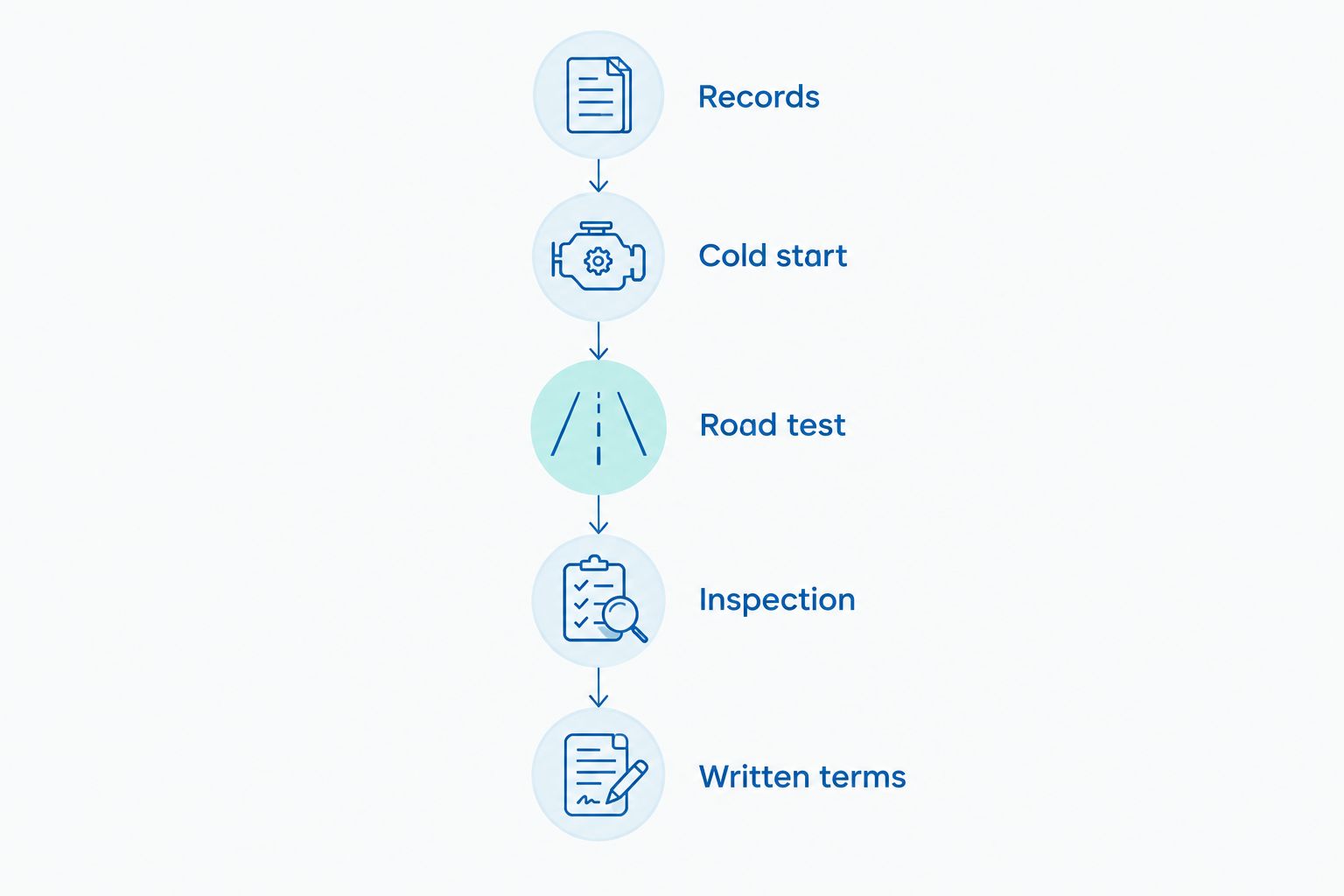
Use this sequence for every shortlisted car. Reserve at least 20 minutes for the test drive as a practical planning allowance, and arrange the independent inspection separately. A brief trip around the block is not the inspection.
- Records: Match the VIN across the vehicle and paperwork. Review the title, odometer history, maintenance records, and vehicle-history report together.
- Cold start: Arrange to hear the car start before it has been warmed up. Ask the mechanic to investigate abnormal noises or warning lights.
- Road test: Include ordinary acceleration, braking, turns, parking, and the kinds of roads you regularly use.
- Inspection: Have an independent mechanic assess the vehicle, including the hybrid system where applicable.
- Written terms: Review the vehicle details, financing terms, trade-in treatment, and any promises in writing before signing.
For your 2026 comparison, ask about 2 keys and account for any replacement requirement before deciding. Also inspect the date codes on all 4 road tires; tread depth alone does not establish tire age. These are checks to perform, not claims about a particular car.
GMS Autos offers financing and trade-in services. Compare the written financing terms separately from the vehicle assessment so a payment discussion does not replace a condition check.
Start your used-car search
Explore GMS Autos for used cars, pickup trucks, financing, and trade-in services in Placentia.
How the shortlist is ranked
The ranking uses body style, intended use, maintenance evidence, and inspection requirements. Toyota Corolla sedan takes the default slot for a straightforward compact-sedan brief; the remaining choices address different needs.
This is a model shortlist, not a ranking of individual vehicles. A car that fails the condition checks loses its place regardless of badge, mileage, or position in the table.
Which low-mileage used car should you choose?
Start with a Toyota Corolla sedan if you want a compact everyday car without a specialized cargo or hybrid requirement. Choose Honda Civic hatchback for loading flexibility, Toyota Camry for a larger sedan, and Honda Accord Hybrid for a larger hybrid sedan.
Choose Mazda3 hatchback when driving fit decides the purchase. Choose Toyota Prius when your brief specifically calls for a hybrid commuter with hatch access. In 2026, the final winner is the individual car that passes inspection and fits your routine.
FAQ
What's the best low-mileage used car for everyday driving?
Toyota Corolla sedan is the default choice on this shortlist for straightforward everyday commuting. Buy the individual car only after checking its maintenance records, history, and independent inspection.
Is lower mileage always better when buying a used car?
No, lower mileage does not establish better condition. Maintenance, age, storage, collision history, and inspection results matter alongside the odometer reading.
What's the best low-mileage used car for carrying bulky items?
Honda Civic hatchback is the cargo-flexibility choice on this shortlist. Test your actual items with the rear seats upright and folded before deciding.
Should I choose a Toyota Camry or a Toyota Corolla?
Choose Toyota Camry when its larger sedan format meets a passenger-space need; start with Toyota Corolla sedan for a compact commuting brief. Test passenger fit and parking space rather than assuming larger is better.
Is a low-mileage used hybrid a good choice?
A low-mileage used hybrid is a candidate when it fits your driving needs and passes a hybrid-system inspection. Mileage alone cannot establish traction-battery condition.
How much mileage is too much for a used car?
There is no mileage cutoff that establishes whether every used car is a good purchase. Compare mileage with vehicle age, maintenance requirements, documented history, and mechanical condition.
Does GMS Autos offer financing and trade-ins?
GMS Autos offers financing and trade-in services for used-car buyers in Placentia, CA. Review the specific written terms separately from the vehicle's condition assessment.
One last thing
Check time-based maintenance even when mileage is low. A service requirement expressed in months or years still applies to a car that spends most of its life parked. Before your 2026 purchase, compare the maintenance records with the manufacturer's schedule—not just the next odometer milestone.