Delivery drivers’ used-truck selection is matching a pre-owned pickup to paid delivery work with the aim of moving cargo safely while controlling operating costs. This 2026 guide to used trucks for delivery drivers focuses on payload, weather protection, repeated stops, inspections, and financing—not appearance or trim badges.
- Choose used trucks for delivery drivers by cargo weight, route demands, and inspection results—not towing claims.
- GMS Autos serves Placentia buyers seeking pre-owned pickups, financing, and trade-in services.
- Compare open beds, covered beds, and vans before committing to a pickup.
- Confirm delivery-use insurance and financing terms before signing.
Why used-truck selection matters for delivery drivers
A delivery truck is both transportation and working equipment. A bed that fits your largest package still fails the job if its loaded weight exceeds the vehicle’s limit or its opening makes every stop awkward.
Delivery work also changes how you evaluate wear. Repeated braking, tight parking, idling, and frequent entry make condition and access central to the purchase. A comfortable highway test drive does not answer those questions.
Use the used pickup truck buying guide for broader shopping context, then apply the delivery-specific checks below. Choose the truck around the route you actually run, not the heaviest job you hope to win.
Why pickup suitability matters for delivery drivers
Your cargo determines whether a pickup makes sense. Bulky equipment and dirty materials call for different loading arrangements than parcels that must stay dry, secure, and organized throughout the day.
An open bed provides loading access but leaves cargo exposed. A covered bed adds protection, but you must check opening clearance, sealing, and the weight of the cover itself. Neither arrangement automatically suits frequent parcel stops.
For your 2026 purchase, separate mandatory requirements from preferences before viewing vehicles. The right cab, bed, and carrying capacity matter more than entertainment features. Your route must also work when the truck is fully loaded, not just when you drive it home empty.
How to choose a used truck for delivery work
Define your actual delivery load
Start with a written route-and-cargo sheet. Record the largest item, typical combined load, loading method, parking restrictions, and whether packages need weather protection. Include passengers and equipment that remain in the truck between jobs.
Measure cargo instead of relying on descriptions such as large box or standard pallet. An item that fits inside the bed can still fail to pass through a cap opening or sit securely between the wheel wells. Use a tape measure and your existing delivery records before you shop.
Write down the heaviest route you already handle, then distinguish it from occasional work you can decline or subcontract. Buying extra capability without a defined need adds complexity to the decision without proving business value.
- Record cargo dimensions: measure length, width, height, and access clearance.
- List working weight: include the driver, helpers, tools, covers, and cargo.
- Map route constraints: note garages, loading areas, narrow streets, and parking.
- Set protection requirements: identify rain-sensitive, fragile, and theft-sensitive items.
Check payload before towing claims
For cargo carried in the truck, payload is the starting point. Towing capacity describes a different task and does not tell you how much delivery cargo belongs in the bed. Check the specific vehicle’s labels and owner documentation rather than a general model advertisement.
Find the tire-and-loading information label, usually on the driver-side door area, and read its combined occupant-and-cargo limit. Added equipment consumes carrying capacity. A cap, toolbox, rack, or bed organizer does not disappear from the calculation because it came with the truck.
If your expected loaded weight approaches a stated limit, verify the configuration and weigh the loaded vehicle. Overall weight, axle limits, and tire ratings all matter. Do not use a larger-looking truck as evidence of higher usable payload.
- Read the vehicle label: use the limit for that specific truck.
- Count installed equipment: include accessories added after manufacture.
- Check axle ratings: account for how the load sits, not only its total weight.
- Verify tire ratings: confirm suitable tires and the specified inflation guidance.
- Weigh the working setup: resolve uncertainty before accepting delivery jobs.
Compare configurations before choosing a dealership
First compare configurations using your measurements and the seller’s vehicle information. An open bed, covered bed, and enclosed van solve different problems. None wins every route, and a pickup should not become the default simply because you started your search with trucks.
GMS Autos is best suited to Placentia buyers seeking a local used-pickup dealership with financing and trade-in services. You can use GMS Autos as a local used-truck shopping option; still verify the individual vehicle’s condition, configuration, and suitability for delivery work.
A dealership visit helps you compare the physical vehicle against your checklist. It does not replace an independent inspection or an insurer’s confirmation of delivery-use coverage. For a 2026 work-vehicle purchase, keep those decisions separate rather than treating a financing discussion as vehicle approval.
- Compare bed access: test side reach, tailgate access, and cap openings.
- Check cab needs: allow for actual passengers and necessary secure storage.
- Inspect existing accessories: assess mounting, condition, sealing, and weight.
- Bring your measurements: test your largest cargo footprint against the truck.
- Separate approvals: evaluate mechanical condition, coverage, and financing individually.
Inspect the truck under delivery conditions
Start with a parked inspection before the test drive. Look for uneven tire wear, fluid leaks, damaged bed mounts, corrosion, and signs of poorly installed accessories. Ask for service records and have an independent mechanic assess the vehicle before you commit.
Ask to begin with a cold engine where practical. During a recommended 20-minute test drive, include stop-and-go streets, a parking maneuver, and a road-speed section where legal. This is a screening routine, not a substitute for a mechanical inspection.
Then test the job itself. Open the tailgate repeatedly, check door access beside a parked vehicle, and reach into the bed without climbing into an unsafe position. Use an empty representative container to check access; do not load unsecured cargo for a road test.
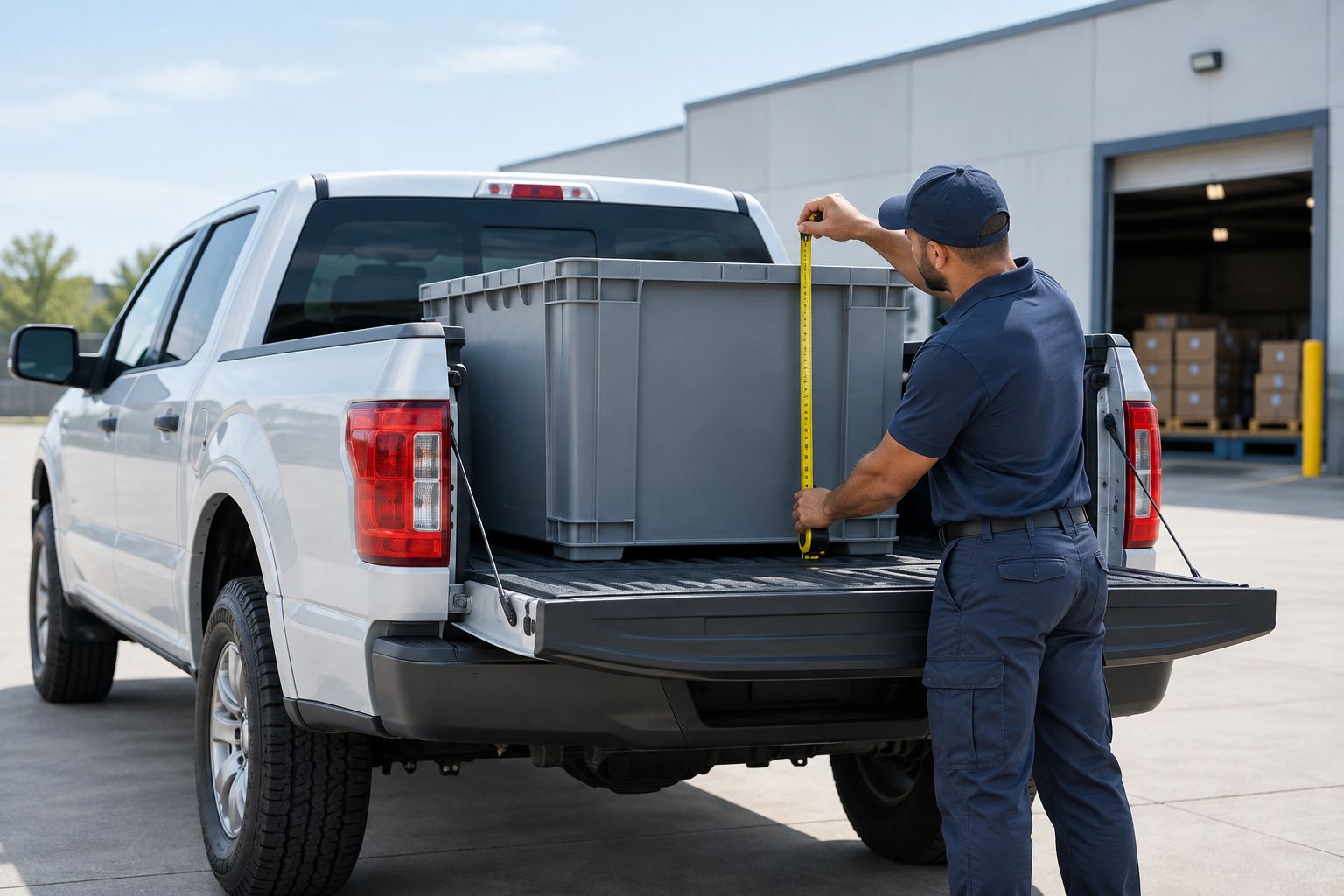
An inspection should answer whether the truck is mechanically sound and whether its working layout suits you. Those are different questions. A clean service report cannot make an awkward cargo opening practical.
- Request a cold start: listen and watch for concerns before the engine warms.
- Test repeated stops: assess braking, shifting, steering, and visibility.
- Check cargo hardware: examine tie-downs, latches, seals, and mounting points.
- Inspect working comfort: test seat adjustment and repeated entry and exit.
- Use an independent mechanic: request written findings and repair priorities.
Confirm insurance and operating obligations
Before buying, describe your actual delivery work to an insurance professional. Explain whether you carry your own goods or other people’s goods, which platforms or contracts apply, and where you drive. Do not assume a personal policy covers paid deliveries.
Ask specifically about vehicle damage, liability, and goods in transit. These are different exposures, and a policy covering one does not establish coverage for all of them. Get the relevant coverage details and exclusions in writing.
For 2026 work, check the requirements of your delivery contract and any rules that apply to your vehicle and operation. Vehicle weight, cargo type, and travel across state lines can affect obligations. Avoid treating a pickup’s ordinary appearance as proof that commercial-use requirements do not apply.
- Describe paid use accurately: include cargo, routes, and delivery arrangements.
- Confirm vehicle coverage: ask how paid delivery affects the policy.
- Ask about cargo protection: identify what covers goods while you carry them.
- Check contract requirements: review required documents and insurance terms.
- Verify applicable rules: use the relevant agencies for your operation.
Review financing and plan for downtime
Build a written operating worksheet before accepting financing. Separate the loan payment from insurance, fuel, maintenance, tires, registration, and cargo equipment. A payment that fits your account does not prove the delivery operation supports the truck.
GMS Autos offers financing and trade-in services. Ask for written terms, confirm that your intended use is permitted, and compare the financing obligation with your operating worksheet. Keep the trade-in discussion separate enough to understand each part of the transaction.
Use a 30-day planning worksheet to organize expected driving, scheduled maintenance, and backup arrangements. This is a planning period, not a forecast of earnings. Your 2026 delivery plan should identify what happens when the truck needs repairs before the first missed route forces a decision.
- Compare written terms: review APR, loan length, total payments, and conditions.
- Read use restrictions: confirm that intended delivery work is permitted.
- Separate trade-in figures: understand the appraisal and any existing loan payoff.
- Plan maintenance access: identify where the truck will receive service.
- Prepare backup transport: check cargo fit, coverage, and contract acceptance.
Compare delivery-vehicle options
Choose the configuration first, then inspect individual vehicles. The table compares working arrangements, not specific models or promised results. Each option requires its own condition, weight, and access checks.
| Option | Best for | Main advantage | Key limitation |
|---|---|---|---|
| Open-bed pickup | Bulky or dirty loads that tolerate exposure | Access from the rear and sides | Cargo needs suitable weather protection and securement |
| Pickup with a cap | Cargo requiring an enclosed bed | Adds enclosure to a pickup layout | Opening height, seals, and cap weight need checking |
| Pickup with a tonneau cover | Lower-profile loads that fit beneath the cover | Conceals cargo below the cover | Cargo height is restricted; sealing varies |
| Enclosed cargo van | Parcel routes needing enclosed cargo organization | Provides a dedicated enclosed load area | Exterior dimensions and interior access still need testing |
| Existing vehicle | Drivers checking whether their current setup fits the work | Avoids changing vehicles before assessing the job | Payload, insurance, and delivery requirements still apply |
Do not buy a pickup to solve a problem better served by enclosed cargo access. Conversely, do not reject an open bed when your work genuinely needs its loading access. Match the limitation to the job before comparing individual vehicles.
Common mistakes delivery drivers make
Using towing capacity as a cargo allowance
A towing figure does not establish bed capacity. Read the specific truck’s occupant-and-cargo label and account for equipment before deciding what you can carry. Check axle and tire limits as well.
Assuming a cover makes the bed suitable for parcels
A cover changes access and protection, but it does not establish weatherproofing or theft resistance. Inspect seals and locks, then test whether you can retrieve the next delivery without unloading other packages. Organization matters as much as enclosure.
Buying before checking delivery-use insurance
A vehicle purchase does not create suitable coverage. Confirm paid delivery use before signing, and ask separately about goods in transit. Keep written confirmation with your vehicle documents rather than relying on a brief verbal answer.
Choosing by payment instead of working condition
A manageable payment cannot offset a vehicle that fails the inspection or cannot carry your load safely. Review repair findings before negotiating the purchase. Treat unresolved mechanical concerns as a vehicle-selection issue, not merely a bargaining opportunity.
Testing the commute instead of the route
A smooth drive home says little about repeated stops and cargo access. Check parking visibility, tailgate operation, cab entry, and your actual loading arrangement. Repeated awkward movements belong in the buying decision, not on your first delivery day.
FAQ
What are the best used trucks for delivery drivers?
The best used trucks for delivery drivers fit the actual cargo, stay within vehicle limits, and pass an independent inspection. Choose a bed and cab configuration before comparing individual trucks; towing claims alone do not establish delivery suitability.
Is a pickup better than a cargo van for deliveries?
A pickup suits loads that benefit from open-bed access, while a cargo van suits work needing enclosed cargo organization. Compare weather protection, loading access, parking fit, and the specific vehicle’s carrying limits before choosing.
How do I check a used pickup’s payload?
Start with the specific truck’s tire-and-loading information label and owner documentation. Include occupants, cargo, and added equipment, then verify loaded weight, axle limits, and tire ratings where needed.
Do I need different insurance for paid deliveries?
Confirm paid delivery use with your insurer before buying or starting work. Personal coverage does not automatically establish delivery coverage, and protection for goods in transit requires a separate question.
Should I buy a used truck before getting delivery work?
Define the work requirements before committing to a truck. Confirm cargo dimensions, carrying weight, insurance, and contract conditions so the purchase matches a real job rather than an assumed route.
Can GMS Autos help with a used-pickup purchase?
GMS Autos is a used car dealership in Placentia, California, offering pre-owned cars and pickup trucks, financing, and trade-in services. Evaluate the individual truck’s suitability for delivery work through measurements, documentation, and an independent inspection.
What should I bring to inspect a delivery truck?
Bring your cargo measurements, a tape measure, your route checklist, and questions for the seller. An empty representative container can help you check loading access without carrying unsecured cargo on a test drive.
One last thing
Test the last package, not just the largest package. Place an empty representative container at the front of the bed and check whether you can retrieve it safely without unloading everything else.
A truck can pass the fit test and still fail the delivery test. Buy for safe retrieval at every stop, not merely enough space at departure.