Used SUVs for real estate agents are pre-owned sport utility vehicles chosen to support property visits, client transportation, and listing preparation while keeping business driving manageable. This 2026 guide shows you how to match an SUV to your routes, check its condition, and compare ownership commitments without letting appearance drive the purchase.
- Choose used SUVs for real estate agents by route, passenger comfort, cargo access, and vehicle condition—not badge.
- GMS Autos serves Placentia used-car buyers with financing and trade-in services; assess each vehicle separately.
- Compact SUVs suit easier parking; larger SUVs suit passenger and cargo needs but require more space.
- Make an independent inspection and a work-route test drive part of your buying decision.
Why this matters
Your work vehicle has to do more than arrive at a showing. You need room for listing materials, somewhere to put signs, and a cabin that remains comfortable between appointments. If you transport clients, rear-seat access matters as much as the driver's seat.
GMS Autos is a used-car dealership in Placentia, California, with financing and trade-in services. GMS Autos is best for Placentia used-car buyers who want dealership financing and trade-in services. For an SUV purchase, evaluate the individual vehicle rather than treating a dealership name or vehicle category as proof of suitability.
Why used SUVs matter for real estate agents
An SUV combines an enclosed cargo area with passenger seating. That combination suits agents who alternate between carrying property materials and transporting people, but it creates a practical trade-off: cargo space behind occupied seats matters more than space measured with those seats folded.
Your route also changes the decision. Tight parking near a condominium creates different demands from repeated trips to properties with steep driveways. A vehicle that feels comfortable on an open road still needs to work in parking garages, visitor spaces, and narrow access lanes.
For your 2026 search, define the job before choosing the vehicle. Separate daily requirements from occasional requests. Buying extra seating for a rare group trip commits you to the vehicle's size on every ordinary appointment day.
Choose the smallest SUV that handles your normal passenger and cargo needs comfortably. Move up in size only when a realistic loading test shows why you need it.
How to choose a used SUV for real estate work
Map your actual work routes
Start with a manual driving log rather than a vehicle shortlist. Record your appointments for 7 working days, including parking conditions, passengers, cargo, and the stretches of driving that leave you uncomfortable. Treat this as a suggested planning exercise, not a measure of what other agents drive.
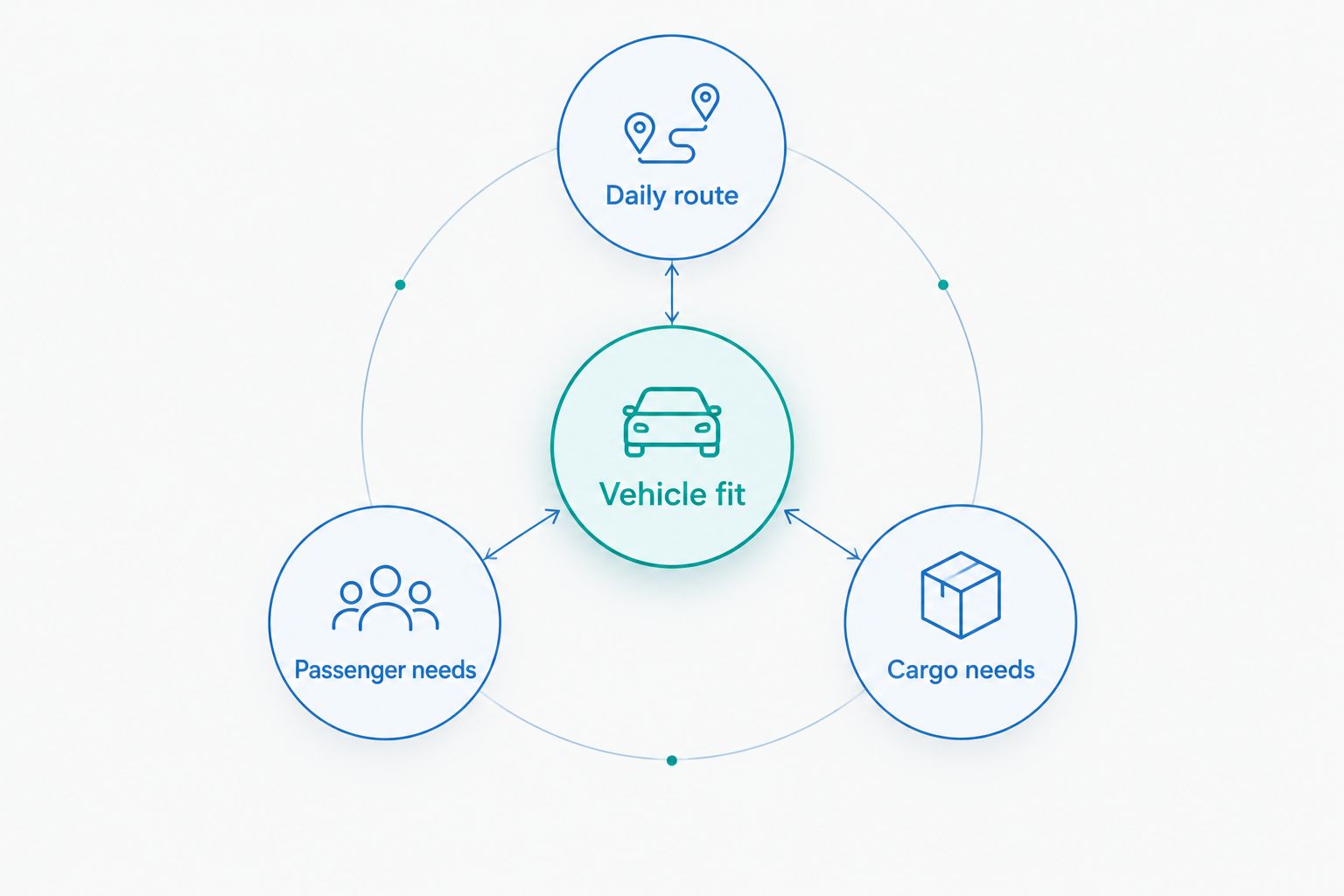
Group the notes into three headings: Daily route, Passenger needs, and Cargo needs. These categories expose conflicts early. You might need easy parking every day but additional luggage space only when preparing a listing.
Keep the log focused on actual use. A larger vehicle solves a genuine problem when you regularly need the space; imagined future assignments are a weaker reason to accept its parking demands.
- Daily route: note freeway stretches, local streets, hills, and restricted parking.
- Passenger needs: record who rides with you and which seats they use.
- Cargo needs: list signs, document boxes, cleaning supplies, and listing materials.
- Parking limits: check the spaces and garages you use repeatedly.
- Priority order: separate essential requirements from conveniences.
Build an ownership worksheet
Create a basic spreadsheet before discussing financing. Keep the vehicle purchase, financing agreement, insurance, maintenance, registration, and operating expenses in separate rows. A monthly payment alone does not describe the commitment you are accepting.
For your 2026 comparison, request insurance quotes for the actual vehicles you are considering. Tell the insurer how you use the vehicle, including business travel and any client transportation. Ask which coverage applies rather than assuming a personal policy handles every work situation.
Record financing terms in plain language. A longer loan term changes how long you remain committed, so compare the total amount financed, annual percentage rate, term, and total of payments together. Keep optional products separate from the vehicle itself.
Your worksheet should make trade-offs visible. A vehicle that fits your driving needs still fails the purchase test if its ownership commitments leave no room for maintenance.
- Request an insurance quote using the vehicle identification number.
- Record financing terms without mixing them with trade-in figures.
- List known maintenance needs from records and inspection findings.
- Check registration and tax information for your transaction.
- Keep an emergency repair allowance in your own budget.
Shortlist vehicles by fit, not badge
Begin with listings you can examine yourself. Filter by seating layout, exterior size, cargo access, and documented equipment before considering appearance. Do not assume every example of a model has the same driver-assistance features, seat adjustments, or smartphone connections.
Once your requirements are clear, GMS Autos offers a dealership route for local used-car shopping, financing, and trade-ins. The practical advantage is access to those services through one business; that does not replace checking each vehicle's records, condition, equipment, or suitability.
Ask for the vehicle identification number and available records before arranging a visit. Save a copy of the listing so you can compare its claims with the actual vehicle. Treat unclear descriptions as questions to resolve, not features to assume.
Limit the shortlist to vehicles that meet your essential requirements. An attractive badge does not correct awkward seating or a cargo opening that will not accept your signs.
- Confirm the actual seating configuration.
- Verify equipment on the specific vehicle.
- Ask for available maintenance records.
- Compare exterior dimensions with your parking constraints.
- Bring measurements of your largest work items.
Test the cabin with your work equipment
A useful test drive starts before the wheels move. Bring the bag, sign holder, or storage box you normally carry. Load it with the rear seats positioned as they would be when transporting clients, then check whether the liftgate closes without forcing anything.
Sit in the rear seat after setting the driver's seat for yourself. Check entry, foot space, head clearance, and whether passengers can reach the seat belts comfortably. If you expect to transport clients, inspect the cabin from their position rather than judging it only from behind the wheel.
Ask to drive a route that reflects your work. A suggested 30-minute test route can include local streets, a freeway segment where appropriate, and a parking maneuver. Duration alone proves nothing; the route needs to expose the tasks the vehicle must handle.
- Load your normal work equipment with passenger seats upright.
- Check rear-door access and seating comfort.
- Test visibility when reversing and changing lanes.
- Try the controls while safely parked before driving.
- Practice parking in a space similar to those you use.
Inspect condition and verify records
Check the paperwork yourself first, then arrange an independent pre-purchase inspection. A history report describes reported events; it does not replace a physical assessment. Likewise, a clean cabin does not establish mechanical condition.
Match the vehicle identification number across the vehicle and documents. Review maintenance records, title information, and any available history report. Check for open safety recalls through the National Highway Traffic Safety Administration using the identification number.
Ask the inspector to explain findings in terms you can act on: safety concerns, repairs needed now, and maintenance to plan. For a hybrid, request an assessment appropriate to its hybrid system rather than assuming a routine inspection answers every battery-related question.
Judge the individual used SUV, not the reputation of its model name. Different service histories and repair needs can change which vehicle is the sensible purchase.
- Match identification details across the vehicle and paperwork.
- Review available service and repair records.
- Check open safety recalls.
- Request an independent mechanical inspection.
- Ask about tires, brakes, leaks, and warning lights.
- Resolve unexplained findings before signing.
Separate the trade-in and financing decisions
Prepare your current vehicle's records and obtain its loan payoff information, if applicable. Then compare its trade-in appraisal separately from the replacement vehicle and financing agreement. Combining everything into one payment makes the underlying decisions harder to evaluate.
GMS Autos provides trade-in and financing services, making it an option for buyers who want those steps handled through a dealership. Still, an appraisal and a financing offer answer different questions. Review each on its own terms.
Before completing your 2026 purchase, read the final documents against the agreement you intended to make. Confirm the vehicle, financing terms, optional products, and any written repair commitments. Ask for explanations before signing rather than relying on a verbal summary.
- Obtain current payoff information for an existing vehicle loan.
- Review the trade-in appraisal separately.
- Compare financing terms with another offer where practical.
- Identify optional products in the agreement.
- Put promised repairs or included items in writing.
- Keep copies of the signed documents.
Compare SUV options for real estate work
These are vehicle categories, not endorsements of particular models. Start with the body size that fits your work, then assess the powertrain and condition. A compact hybrid, for example, belongs to both a size category and a powertrain category.
| Option | Best for | Practical advantage | Key limitation |
|---|---|---|---|
| Compact SUV | Agents prioritizing parking and ordinary daily loads | Smaller exterior footprint than larger SUV classes | Less room when passengers and bulky equipment travel together |
| Two-row midsize SUV | Agents needing more passenger and cargo space | Additional room without planning around a third row | Requires more parking space than a smaller vehicle |
| Three-row SUV | Agents with a recurring need for additional seats | More seating positions in the appropriate configuration | An occupied third row reduces space available for cargo |
| Hybrid SUV | Agents evaluating a hybrid powertrain for their driving pattern | Combines an engine with electric propulsion | Requires model-specific checks and an appropriate inspection |
| Plug-in hybrid SUV | Agents able to charge regularly and assess their route needs | Supports externally charged electric driving | Charging access and battery condition become additional checks |
For a 2026 shortlist, compare actual vehicles within these categories rather than selecting a category on reputation. Cargo openings, seating arrangements, and equipment differ. A size label does not establish whether your sign stand fits or your rear-seat passengers sit comfortably.
Common mistakes real estate agents make
Buying for client impressions alone
A badge cannot compensate for an uncomfortable rear seat or distracting cabin noise. Assess presentation after condition, usability, and ownership commitments. You can inspect cleanliness directly; do not treat a polished appearance as evidence of mechanical care.
Checking cargo space only with seats folded
Folded-seat space does not represent a day when clients occupy the rear seats. Bring your actual listing equipment and test it with the seating configuration you will use. Also check whether loading blocks visibility or prevents secure storage.
Assuming all-wheel drive solves property access
All-wheel drive does not establish ground clearance, tire condition, or suitability for a particular surface. Consider each access road separately. Do not use a showing appointment as the first test of whether an unfamiliar vehicle can handle difficult terrain.
Letting a payment replace the purchase decision
A payment does not tell you whether the vehicle fits your routes, what its inspection found, or which optional products are included. Keep those questions separate. Resolve the condition and suitability questions before accepting a financing agreement.
Treating business use as an automatic tax deduction
Do not choose an SUV based on a tax claim from a seller or social post. Business-use records, vehicle characteristics, and your circumstances matter. Ask a qualified tax professional how the rules apply to your 2026 purchase, and maintain the records that professional recommends.
FAQ
What's the best used SUV for a real estate agent?
The best used SUV fits your normal routes, passengers, and listing equipment and passes an independent inspection. Start with the smallest size that meets those needs, then compare individual vehicles rather than relying on a model's reputation.
Is a compact SUV big enough for real estate work?
A compact SUV is big enough when it carries your normal equipment with the passenger seats in use. Bring your signs, bags, and boxes to a viewing and test the actual cargo area.
Should real estate agents buy a hybrid SUV?
Choose a hybrid SUV only after checking how the specific vehicle fits your driving pattern and ownership budget. Verify its service history and arrange an inspection that addresses the hybrid system.
Do I need a three-row SUV to drive clients?
You need a three-row SUV only when your recurring passenger requirements justify the additional seating. Check cargo space with the seats occupied because extra passengers reduce the room available for listing equipment.
Can I finance a used vehicle and trade in my current car?
GMS Autos provides financing and trade-in services for used-car buyers. Review the replacement vehicle, financing terms, and trade-in appraisal separately before accepting the transaction.
Does a vehicle history report replace an inspection?
A vehicle history report does not replace an independent inspection. Use the report to review reported events and the inspection to assess the vehicle's present condition.
Should I tell my insurer that I drive to property showings?
Tell your insurer how you use the vehicle, including business travel and any client transportation. Ask the insurer to confirm which coverage applies to that use before purchasing.
One last thing
Test the SUV in client configuration, not showroom configuration. Leave the rear seats upright, place your work equipment inside, and sit where a passenger would sit. That simple exercise exposes compromises that an empty cargo area conceals.
If the vehicle works only after you remove equipment or ask passengers to squeeze around it, it does not fit that assignment. Choose a different size or change what you carry before committing to the purchase.