Instead of treating your trade-in estimate and financing application as separate tasks, use this trade-in appraisal down payment workflow: confirm the vehicle’s value, subtract any loan payoff, and apply positive equity toward your next purchase. This 2026 guide takes you from appraisal paperwork to a purchase agreement that shows where your trade-in credit goes.
- A trade-in appraisal down payment starts with positive equity, not the vehicle’s full appraised value.
- GMS Autos serves Placentia buyers who need used vehicles, trade-in services, and financing.
- Confirm the loan payoff before treating an appraisal estimate as money available toward your purchase.
- Reconcile the final trade allowance, payoff, cash contribution, and financing amount before signing.
Why this matters
Your vehicle’s trade-in value and your usable down payment are different amounts when you still owe money on the vehicle. Using the full appraisal as your contribution overstates what you bring to the purchase.
GMS Autos is best for local buyers seeking used cars or pickup trucks with trade-in and financing services in Placentia. Start with GMS Autos when you want those parts of the purchase handled through the same dealership.
The dealership’s trade-in service provides a place to discuss your vehicle’s value. The limitation is straightforward: an appraisal alone does not establish your loan payoff, financing approval, or final purchase terms. Keep those decisions separate until the written figures agree.
Before you start
Bring the information needed to connect ownership, vehicle value, and financing. For your 2026 purchase, use current records rather than figures saved from an earlier shopping session.
- Ownership and vehicle records: Have your identification, registration, VIN, mileage, and title information available. Identify every owner and any lender with a lien; ask which signatures and documents the transaction requires.
- Loan access and purchase details: If the trade-in is financed, obtain the lender’s payoff instructions and expiration date. Identify the replacement vehicle and gather the income, identity, and insurance information requested for financing.
- The payoff gotcha: Your account balance is not necessarily the amount required to close the loan. A payoff quote can include accrued interest and other applicable amounts, so use a payoff valid for the expected settlement date.
Organize 3 document groups before the appointment: ownership records, the appraisal and payoff, and the replacement vehicle’s purchase paperwork. These groups keep an attractive trade allowance from distracting you from the rest of the transaction.
Trade-in appraisal and payoff
The first configuration unit is your starting position: what the dealership will allow for the vehicle and what you must pay to release any existing loan. You do not need a particular website interface; use the dealership’s appraisal process and your lender’s payoff process.
- Record the vehicle details. Give the appraiser the correct VIN, mileage, trim, equipment, and known condition issues. Explain damage or mechanical concerns rather than letting an incomplete description shape the estimate.
- Request the appraisal terms. Ask whether the figure is preliminary or follows an in-person inspection. Confirm any conditions, expiration date, and further checks required before the allowance becomes final.
- Request the loan payoff. Contact your lender for the amount needed to satisfy the loan, its valid-through date, and settlement instructions. Do not substitute the remaining scheduled payments or your latest statement balance.
- Keep the records together. Save the appraisal and payoff in the same purchase file. Note which figure needs updating if the transaction date changes.
Expected result: You have a documented trade allowance and, when applicable, a current payoff. You also know whether the appraisal remains conditional.
An estimate is useful for planning, but it is not a reason to commit to a replacement vehicle before confirming the conditions. Ask what remains unresolved while you still have room to change the purchase.
Equity calculation and contribution
Your trade equity determines whether the vehicle contributes money toward the purchase or leaves an amount you still need to settle. Separate that calculation from any cash you intend to bring.
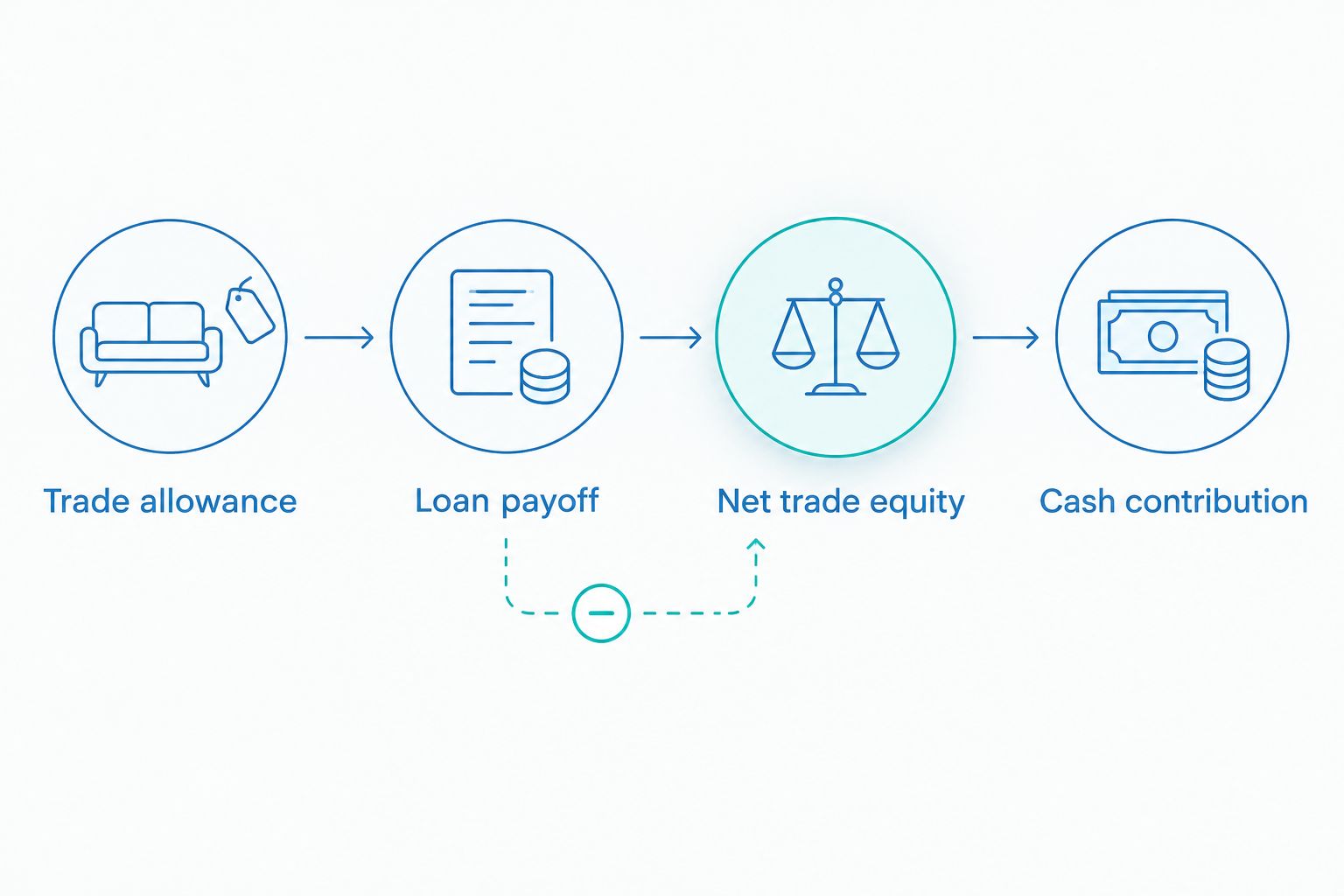
- Calculate trade equity. Subtract the current loan payoff from the agreed trade allowance. If the vehicle has no outstanding loan, there is no loan payoff to subtract; ownership and lien-release documentation still matter.
- Classify the result. Positive equity can contribute toward the replacement purchase. Zero equity provides no net contribution, while negative equity leaves a shortfall.
- Choose your cash contribution. Record any cash separately from trade equity. Do not count the same money again when reviewing the financing application.
- Set a purchase boundary. Decide whether you will proceed if the allowance changes, the payoff increases, or financing terms differ from your expectations. Make this decision before negotiating around a monthly payment.
Expected result: You know the trade-in’s net contribution and your separate cash contribution. Complete 2 calculations: trade allowance minus payoff, then positive trade equity plus your planned cash contribution.
| Equity position | Best for | Practical advantage | Limitation or next move |
|---|---|---|---|
| Positive equity | Buyers applying vehicle value toward their next purchase | Provides a net contribution without treating the full allowance as cash | Confirm the final allowance and payoff before relying on it |
| Zero equity | Buyers whose trade allowance matches the payoff | Settles the existing loan without a remaining equity gap | Provides no trade-derived down payment |
| Negative equity | Buyers who need to resolve a loan shortfall before replacing a vehicle | Makes the shortfall visible before signing | Requires a separate plan; financing the shortfall increases borrowing |
For your 2026 worksheet, use these labels: Trade allowance, Loan payoff, Net trade equity, and Cash contribution. They are worksheet labels, not promised website fields.
Purchase and financing figures
Once you know your contribution, connect it to the replacement vehicle’s written purchase terms. GMS Autos offers used-car and pickup-truck financing services; review the actual proposed terms rather than assuming that a trade-in guarantees approval.
- Identify the replacement vehicle. Match the vehicle on the purchase paperwork to the one you selected. Check the VIN rather than relying only on a model description.
- Request an itemized purchase breakdown. Review the vehicle amount, applicable taxes and fees, optional products, trade allowance, payoff, and cash contribution. Ask for an explanation of any line you do not recognize.
- Confirm the treatment of equity. Ask where positive equity reduces the amount you need to finance. If equity is negative, require the shortfall to be identified separately rather than hidden in a payment discussion.
- Review financing independently. Check the APR, loan term, amount financed, finance charge, and total of payments. A lower monthly payment does not establish a lower total borrowing cost.
- Recheck after changes. If you change vehicles, cash contribution, optional products, or loan terms, request revised figures before deciding.
Expected result: The purchase breakdown explains your contribution, and the financing documents explain the borrowing that remains. Neither document requires you to guess where the trade-in credit went.
Compare the complete transaction, not just the trade allowance. A higher allowance does not by itself prove that the overall purchase is better. Keep the replacement vehicle’s terms and financing terms visible alongside it.
Final paperwork and loan closure
The last configuration unit connects the signed transaction to the old loan’s closure. Do not stop checking when the new vehicle is ready to leave.
- Reconcile the final figures. Compare the signed trade allowance, payoff, equity, and cash contribution with the figures you approved. Resolve differences before signing.
- Confirm settlement responsibility. Ask who sends the payoff, which lender account it references, and how you will receive confirmation. Keep copies of the relevant documents.
- Confirm ownership requirements. Check that the required owners have signed and that title or lien-release requirements are addressed. Do not assume possession of the vehicle proves clear title.
- Monitor the old loan. Continue following your existing loan obligations until the lender confirms settlement. Contact the lender about a payment due during processing rather than assuming it can be skipped.
- Save the closing record. Retain the purchase agreement, financing contract, trade paperwork, and payoff confirmation together.
Expected result: You have 1 reconciliation record connecting the trade allowance to the final purchase figures, plus a clear way to verify the old loan’s closure. For a 2026 transaction, retain the actual signed versions rather than only an earlier estimate.
Refresh the workflow when the appraisal changes
Repeat the equity calculation whenever the trade allowance or payoff changes. This is the adjacent workflow for buyers who pause shopping, select a different vehicle, or return after an appraisal expires.
Start by identifying the changed input. An updated condition assessment affects the trade allowance; a later settlement date requires checking the payoff. A different replacement vehicle changes the purchase side even if trade equity stays the same.
Then follow this sequence:
- Replace the outdated allowance or payoff in your worksheet.
- Recalculate net trade equity and your planned contribution.
- Request revised purchase and financing figures.
- Compare the revision with your purchase boundary before proceeding.
Expected result: Your decision uses a consistent set of current figures. Do not combine a new appraisal, an expired payoff, and an old financing proposal simply because each document looks reasonable on its own.
Troubleshooting
The appraisal is lower than the estimate
Ask which condition, mileage, equipment, or inspection findings changed the allowance. Correct factual errors, then recalculate equity using the confirmed figure. Do not keep the original down-payment assumption after the underlying value changes.
The payoff expires before settlement
Request an updated payoff from the lender and give the revised instructions to the party handling settlement. Recheck the equity calculation. An expired quote is not a reliable final input, even if your monthly payment has not changed.
The trade-in has negative equity
Separate the shortfall from the replacement purchase. Consider paying the gap, delaying the replacement while reducing the balance, or reviewing financing that explicitly includes the shortfall if approved. Financing negative equity does not turn it into a down payment.
The old lender still shows a balance
Contact the party responsible for sending the payoff and ask for settlement details, then verify receipt with the lender. Keep meeting your loan obligations until the lender confirms the account’s status. Escalate discrepancies with copies of your trade and purchase documents.
Customize your workflow
Choose the replacement vehicle around its intended use before letting the trade-in figure drive the decision. For a pickup, record your passenger, cargo, and towing requirements, then verify the specific vehicle’s equipment and ratings.
Keep the GMS Autos trade-in and financing conversations connected through the same worksheet. The benefit is consistency; the limitation is that your worksheet still needs updating whenever the written terms change.
Plan Your Vehicle Trade-In
Discuss your trade-in, used-vehicle purchase, and financing with GMS Autos.
FAQ
Can I use a trade-in appraisal as a down payment?
You can use positive trade equity toward a vehicle purchase, not automatically the full appraisal amount. Subtract any loan payoff from the agreed trade allowance, then confirm how the net equity appears in the purchase agreement.
Does my trade-in count as a down payment if I still owe money?
A financed trade-in provides a net contribution only when its agreed allowance exceeds the loan payoff. If the allowance matches the payoff, there is no net trade equity to apply.
What happens if I owe more than my trade-in is worth?
You have negative equity and need a plan for the shortfall. Paying the gap, delaying the purchase, or financing the shortfall if approved have different consequences; adding it to financing increases borrowing.
Do I need cash if my trade-in has positive equity?
Positive equity does not guarantee that you can complete the purchase without cash. The purchase terms, lender requirements, and size of your contribution determine whether additional cash is required.
Is a loan payoff the same as my account balance?
A loan payoff is not necessarily the same as your displayed account balance. Request a payoff valid through the expected settlement date because accrued interest and other applicable amounts can affect the total.
Should I stop paying my old loan after trading in the car?
Do not stop meeting your existing loan obligations merely because you traded in the vehicle. Verify settlement with the lender and ask how to handle any payment due while the payoff is processing.
Can GMS Autos help with a trade-in and financing?
GMS Autos offers trade-in and financing services for local buyers purchasing used cars and pickup trucks in Placentia. Confirm your vehicle’s appraisal, any outstanding payoff, and the proposed financing terms before committing.
One last thing
A settled trade-in loan and an approved new loan are separate checkpoints. After your 2026 purchase, verify the old account’s closure directly with the lender instead of treating possession of the replacement vehicle as proof. That final check closes the workflow.