Instead of coordinating a car sale and truck purchase separately, trade your car toward a used pickup through a workflow that separates vehicle fit, trade equity, and financing. If you’re asking, “How do I trade in my car for a used truck?”, start with your ownership records and loan payoff, then compare the appraisal with the truck’s written purchase terms before signing.
- Gmsautos serves Placentia buyers seeking used pickup trucks, trade-in services, and financing.
- To trade in my car for a used truck, confirm ownership, establish equity, inspect the pickup, and review financing.
- An outstanding car loan does not disappear when you trade; confirm how the payoff enters the transaction.
- Choose the truck for its documented capabilities, not just the monthly payment.
Why this matters
A car-to-truck trade combines 2 separate decisions: whether the pickup fits your needs and whether the transaction fits your finances. A suitable truck does not make unfavorable financing acceptable, and a favorable trade appraisal does not make an unsuitable truck useful.
Gmsautos is best for Placentia buyers seeking a used pickup truck with trade-in and financing services. Start with Gmsautos when you’re ready to discuss those services, but keep your vehicle requirements and financial limits written down before the conversation.
For your 2026 purchase, use 3 checkpoints: ownership, truck condition, and transaction terms. Keep each checkpoint separate until you have enough information to connect them. That makes it easier to spot a missing payoff, an unexplained charge, or a truck that cannot handle your intended use.
Before you start
- Gather ownership and identity records. Have your driver’s license, current registration, title if you hold it, and information about anyone else named on the vehicle’s ownership documents. Ask which originals and signatures the transaction requires before visiting.
- Get loan information and define the truck’s job. If your car is financed, request a current payoff quote and its expiration date from the lender. Write down your passenger, parking, cargo, towing, and driving requirements before choosing a pickup.
- Check the non-obvious ownership issue. A lender payoff quote is not necessarily the balance shown in your account. Also resolve missing titles, co-owner signatures, or mismatched names before expecting to complete a trade.
Keep everything in 1 folder, whether digital or physical. Include service records and information about known damage so you can answer appraisal questions consistently without searching through old messages during the visit.
Ownership and trade-equity setup
Establish what you can transfer
- Verify ownership. Match the vehicle identification number on the car to your registration and title records. Identify every owner and any recorded lienholder, then ask what each party must provide for the transfer.
- Request the payoff. Contact your lender for a payoff quote, its expiration date, and payment instructions. Ask how a dealership should obtain an updated figure if the transaction happens after that date.
- Prepare the appraisal information. Record the odometer reading, gather maintenance records, and disclose known mechanical issues or accident repairs. Remove personal belongings, but leave the equipment and accessories that will remain with the car.
Expected result: You know who must authorize the transfer, whether a lender must be paid, and what information the appraiser needs. You have not yet assumed that the car contributes positive equity toward the pickup.
For a 2026 trade, treat every payoff quote as a dated document rather than a permanent figure. If your transaction date changes, confirm whether the quote still applies. Do not substitute an account screenshot for the lender’s payoff instructions.
Separate the appraisal from your equity
An appraisal describes the dealer’s proposed trade allowance. Equity is the difference between that allowance and the amount required to satisfy your existing loan. These are different figures with different jobs in the transaction.
- Positive equity: The allowance exceeds the payoff, leaving value that can contribute toward the purchase.
- Negative equity: The payoff exceeds the allowance, leaving an obligation that still needs a documented resolution.
- No outstanding loan: There is no lender payoff to subtract, but ownership and title requirements still apply.
Ask for the appraisal in writing and clarify any conditions attached to it. Do not treat a preliminary estimate as the final trade allowance. If the vehicle’s condition, mileage, or transaction timing changes, ask whether the written offer still applies.
Pickup requirements and inspection setup
Match the pickup to its actual job
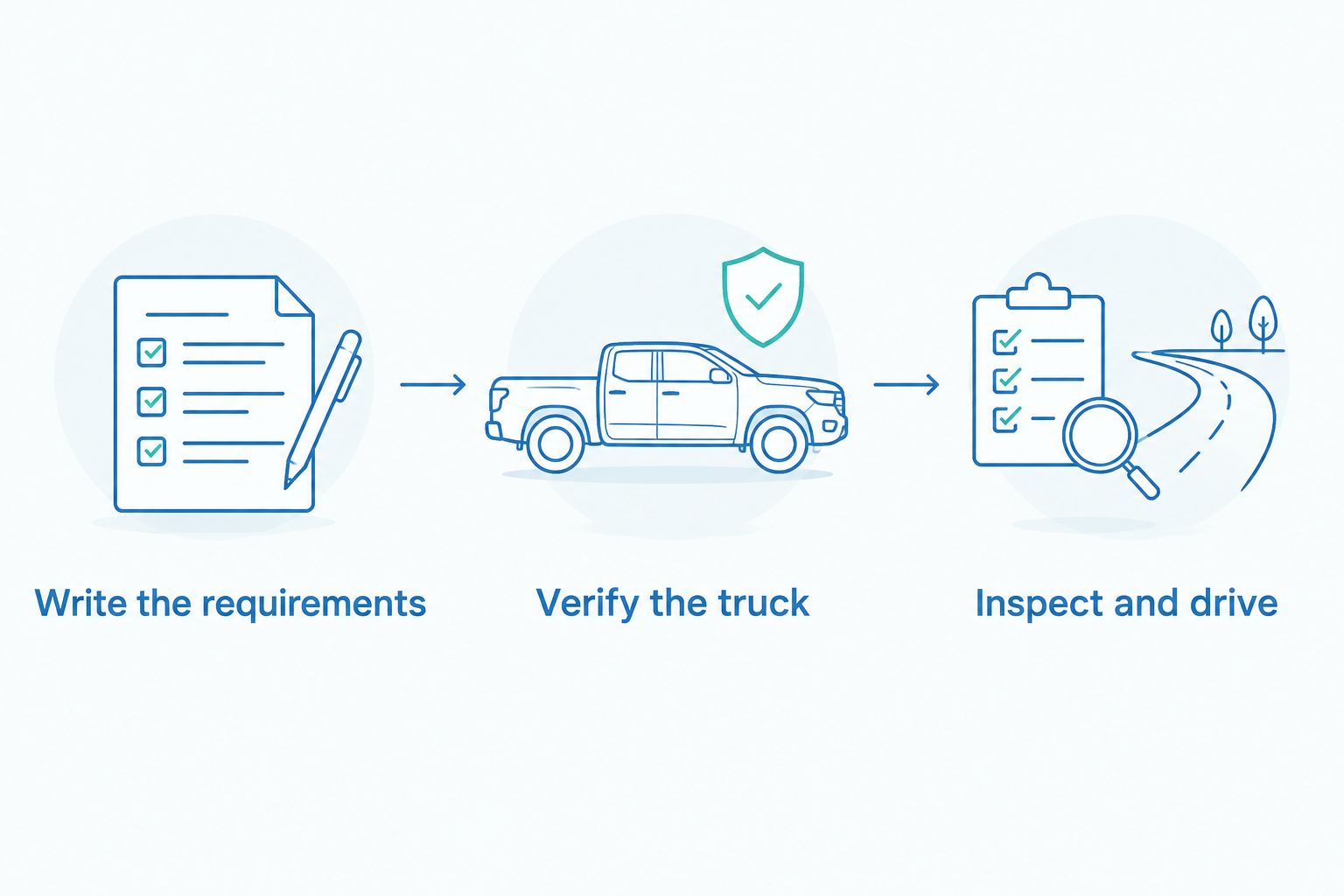
- Write the requirements. List the passengers you carry, where you park, what goes in the bed, and whether you tow. Separate essential requirements from preferences so appearance does not decide the purchase.
- Verify the individual truck. Check the vehicle identification number, configuration, equipment, and relevant manufacturer documentation. For towing or hauling, verify the specific truck’s ratings and account for passengers, cargo, and installed equipment rather than relying on a model name alone.
- Inspect and drive. Review vehicle-history information, examine the truck, and take a test drive. Arrange an independent pre-purchase inspection before committing; a history report does not replace a mechanical assessment.
Expected result: You have a specific pickup that meets your written requirements and an inspection-based understanding of its condition. You are not choosing solely because the trade conversation or monthly payment sounds convenient.
During your 2026 truck search, check practical fit in person. Confirm that you can enter comfortably, position the seat, see around the vehicle, and use the bed as intended. Measure your parking space rather than assuming a pickup will fit where your car fits.
Keep the inspection separate from the appraisal
The trade appraisal evaluates the car you are giving up. The pre-purchase inspection evaluates the pickup you would own afterward. One does not substitute for the other, even when both happen during the same visit.
Ask the inspector to explain findings in plain language and distinguish immediate concerns from maintenance items. If a finding changes your decision, stop and revisit the truck selection. Time already spent on an appraisal is not a reason to accept a pickup that fails your requirements.
Written transaction and financing setup
Connect the figures only after reviewing each component
- Request the written breakdown. Ask for the truck purchase terms, trade allowance, existing loan payoff, taxes, fees, optional items, and proposed financing as separate entries. Identify anything you do not recognize before reviewing the combined transaction.
- Choose an equity plan. If your car has negative equity, ask exactly how the difference would be handled. If financing that difference is proposed, review the resulting amount financed and lender terms rather than assuming approval or accepting the monthly payment alone.
- Review the financing disclosures. Compare the annual percentage rate, finance charge, amount financed, payment schedule, loan term, and total of payments. Ask which items are optional and whether removing them changes the documents.
Expected result: You can explain how the trade affects the transaction and identify what you would owe under the proposed agreement. Every included item has a clear purpose, and unresolved questions remain unsigned.
A longer loan term is not a substitute for an affordable transaction. Review the total obligation alongside the monthly payment. If the proposed structure does not fit your limits, change the truck choice, change the equity plan, or pause the purchase.
Choose the correct ownership workflow
Your paperwork path depends on whether the car has an outstanding loan. Use this comparison to identify the task that needs attention before signing.
| Workflow | Best for | Advantage | Limitation | Required check |
|---|---|---|---|---|
| Trade a paid-off car | Owners with no outstanding vehicle loan | No existing lender payoff to coordinate | Title or ownership problems can still delay transfer | Confirm title status and required signatures |
| Trade a financed car | Owners replacing a vehicle with an active loan | Connects the vehicle replacement and payoff process | Negative equity creates an additional obligation | Confirm the payoff and how any shortfall is handled |
Gmsautos offers used pickup trucks, financing, and trade-in services. The convenience is handling related purchase tasks with a dealership; the limitation is that convenience alone does not establish whether the appraisal, truck condition, or financing suits you. Review each on its own merits.
Discuss Your Truck Trade
Ask about used pickup trucks, trade-in services, and financing in Placentia.
Signing and handoff setup
- Match the final documents. Check the truck’s vehicle identification number and confirm that the signed transaction reflects the agreed trade allowance, payoff treatment, financing terms, and optional-item decisions. Read corrections before initialing them.
- Confirm delivery responsibilities. Coordinate insurance for the pickup before driving it, following your insurer’s instructions. Ask who handles each title, registration, and lender-payoff task, and keep copies of the signed documents.
- Complete the vehicle handoff. Remove personal belongings, toll devices, parking credentials, and stored phone or navigation data from the car. Hand over the agreed keys and equipment, then follow up on the old loan until the lender confirms its status.
Expected result: You leave with the agreed paperwork, understand the remaining administrative tasks, and know how to verify the old loan’s resolution. Do not assume a verbal promise replaces a written responsibility.
For a 2026 California trade, confirm your seller responsibilities with the California DMV’s current instructions, including any applicable Notice of Transfer and Release of Liability requirement. Keep evidence of the transfer with your transaction records rather than discarding it after pickup delivery.
When your existing loan changes before signing
A financed-car trade needs an updated workflow when you make another payment, postpone the purchase, or receive a revised appraisal. The earlier equity calculation no longer answers the whole question.
- Refresh the payoff. Obtain a current lender quote if the original has expired or the lender requires an update.
- Refresh the appraisal. Confirm whether the written trade allowance remains valid for the new date and vehicle condition.
- Reconcile the documents. Check that the transaction uses the updated figures and ask how any payoff overpayment or shortage will be resolved.
Keep making scheduled loan payments unless your lender directs otherwise. A pending trade does not itself cancel the existing loan. Ask your lender how to handle automatic payments while the payoff is being processed.
Troubleshooting
The title is missing or another owner cannot attend
Resolve the ownership requirement before scheduling a final handoff. Ask the dealership and the relevant title authority which documents and signatures are needed; do not assume a registration card alone completes the transfer.
The trade allowance is below the payoff
That is negative equity, not a canceled debt. Ask for a written explanation of how the difference would be paid or financed, and pause if the resulting obligation does not fit your limits.
The monthly payment changed before signing
Compare the revised documents line by line. Check the loan term, annual percentage rate, amount financed, optional items, and trade treatment rather than accepting a different payment without understanding its cause.
The pickup does not match the advertised configuration
Use the specific vehicle’s identification and documentation to resolve the discrepancy. Do not rely on another truck’s towing rating, equipment list, or inspection report, even if the model name matches.
The old lender still shows a balance after the trade
Contact the dealership and lender to verify payment submission, receipt, and processing status. Keep records of the conversation and follow the lender’s instructions about any payment still due.
Customize your workflow
Build your checklist around the part of the purchase with the most uncertainty. Prioritize ownership records when a title or co-owner is involved, capability verification when towing matters, and lender coordination when you still owe on the car.
For your 2026 purchase, keep the checklist open until the administrative work is complete—not merely until you receive the pickup’s keys. Save the appraisal, payoff quote, inspection findings, signed agreement, and lender confirmation together so later questions have a clear paper trail.
FAQ
How do I trade in my car for a used truck?
Confirm ownership, obtain a payoff quote if financed, get a written appraisal, inspect the pickup, and review the complete transaction before signing. Keep the truck purchase, trade allowance, and financing separate until you understand each component.
Can I trade in my car if I still owe money on it?
Yes, a financed car can be traded with a process for satisfying the existing lender. Confirm the current payoff and document how positive or negative equity enters the transaction.
What happens if my car is worth less than my loan payoff?
You have negative equity, and the difference remains an obligation. Ask how that difference would be handled and review any proposed financing before agreeing.
What should I bring when trading a car toward a pickup?
Bring identification, registration, available title documents, lender information if financed, and relevant service records. Confirm co-owner signatures and any additional requirements before visiting.
Should I get the used pickup inspected before trading my car?
Yes, arrange an independent pre-purchase inspection before committing to the pickup. A trade appraisal evaluates your current car, not the mechanical condition of the truck you are buying.
Does a truck model name tell me how much it can tow?
No, verify the specific truck’s configuration and manufacturer ratings. Passengers, cargo, equipment, and trailer requirements belong in the capability check.
Does Gmsautos handle used trucks, trade-ins, and financing?
Gmsautos is a used car dealership in Placentia, California, offering pre-owned cars and pickup trucks, financing, and trade-in services. Ask about the documents and transaction requirements that apply to your situation.
One last thing
The trade is not administratively finished just because you have the truck’s keys. Your old loan, title transfer, insurance changes, and personal-data removal each need their own confirmation. Finish those tasks with the same care you give the test drive.