Instead of applying for financing after you find a car, get pre-approved financing for a used car before shopping so you can match vehicles to a lender-approved borrowing limit. This 2026 workflow takes you from document preparation to comparing loan terms and confirming that a specific vehicle qualifies.
- Get pre-approved financing for a used car before shopping; confirm vehicle eligibility before committing.
- GMS Autos serves Placentia used-car buyers seeking financing and trade-in services.
- Compare APR, loan term, and total payments—not just the monthly payment.
- Preapproval is conditional; final approval depends on the lender’s checks and the selected vehicle.
Why this matters
A monthly payment alone does not tell you whether a loan fits your budget. The repayment period, amount borrowed, interest rate, and optional products all affect what you agree to repay.
Preapproval sets a shopping boundary; it does not replace the final loan review. A lender can approve your application conditionally while still requiring income verification or a qualifying vehicle.
GMS Autos sells pre-owned cars and pickup trucks in Placentia and provides financing and trade-in services. For your 2026 search, keep those decisions separate: establish your borrowing limit, evaluate the vehicle, then review the completed financing agreement.
Before you start
- Prepare your records. Gather identification, address and employment information, income records, and details of your existing auto loan if you plan to trade in a financed vehicle. Submit sensitive documents only through a verified lender or dealership process.
- Set your own budget. Decide what payment fits after insurance, fuel, maintenance, and other obligations. Set a down-payment limit without using money you need for routine expenses or emergencies.
- Check the vehicle restrictions first. Ask about eligible model years, mileage, title status, seller types, minimum borrowing requirements, and approval expiration. A preapproval that excludes your intended vehicle or dealership cannot fund that purchase.
Do not assume that every preliminary financing result means the same thing. A prequalification can be an estimate based on limited information; a preapproval can involve a more detailed review. The lender’s written explanation controls—not the heading on an advertisement.
Borrower file and application route
- Review your credit reports. Check the reports from the three nationwide credit bureaus: Equifax, Experian, and TransUnion. Look for unfamiliar accounts, incorrect balances, or identity information that needs correction before a lender evaluates your application.
- Choose your application route. Contact a bank or credit union directly, ask a dealership about its financing process, or compare both routes. Confirm whether the application involves a hard credit inquiry before authorizing it.
- Ask what the result means. Request a clear explanation of whether you are receiving an estimate, conditional preapproval, or final credit decision. Ask what further checks remain.
- Enter accurate borrower information. Use your legal name and current details. Follow the application’s instructions for income, employment, housing obligations, and any co-applicant information; do not substitute hoped-for income for documented income.
- Save the submission record. Keep the application confirmation, lender contact information, and instructions for supplying additional documents. Record the date you applied so you can track the approval period.
Expected result: You know who is reviewing your application, what credit check you authorized, and what documents remain outstanding.
Which application route fits your situation?
Neither route removes the need to compare the final agreement. Use the route that fits your shopping process, then check the terms independently.
| Application route | Best for | Main advantage | Main limitation |
|---|---|---|---|
| Direct lender application | Buyers who want a financing reference before visiting a dealership | Separates the initial credit decision from vehicle selection | The lender’s seller and vehicle restrictions still apply |
| Dealership-arranged financing | Buyers who want help coordinating the vehicle purchase and financing | Connects the financing discussion to the selected vehicle | You still need to review lender terms and distinguish required charges from optional products |
GMS Autos offers financing services alongside used-car and pickup sales. Ask how its application process works and what a financing result actually authorizes before treating it as permission to buy.
Approval terms and shopping limits
- Obtain the terms in writing. Request the approved borrowing limit, proposed repayment period, rate information, required down payment, conditions, and expiration date. Keep the full notice rather than relying on a screenshot of the payment alone.
- Separate your limit from your target. The maximum a lender approves is not a spending recommendation. Use your household budget to choose a lower borrowing target when the approved payment would crowd out other obligations.
- Compare matching scenarios. Compare offers using the same vehicle, amount borrowed, down payment, and repayment period. If one offer changes those inputs, ask for an explanation before deciding which financing is preferable.
- Read the disclosure labels. On the applicable closed-end credit disclosures, review Annual Percentage Rate, Finance Charge, Amount Financed, and Total of Payments. These identify different parts of the obligation; none is interchangeable with the monthly payment.
- Record every condition. Note required income verification, vehicle restrictions, co-applicant requirements, and any instructions for dealership payment. Ask whether changing the vehicle or purchase structure requires another review.
Expected result: You have a written borrowing boundary, a personal payment target, and a checklist of conditions to satisfy before signing.
For illustration, a 60-month repayment period spreads payments over more months than a 48-month period. With the same principal and positive interest rate, the longer period lowers the scheduled payment but increases total interest. These are comparison examples, not loan terms offered by a particular lender.
For a 2026 application, record the actual expiration date from your approval notice. Do not assume that approval remains valid until you finish shopping.
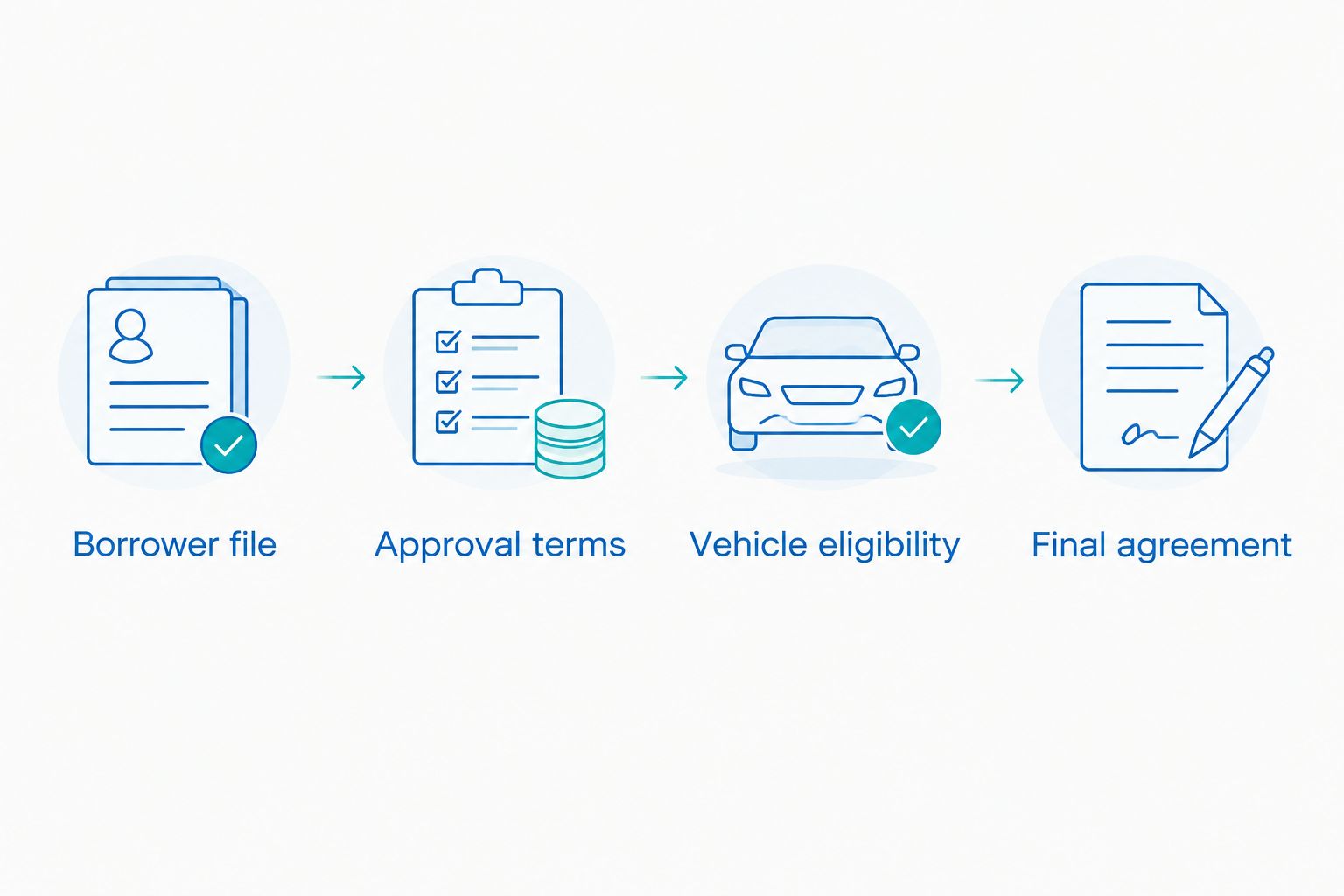
The sequence matters: establish the borrower limit, check the vehicle, then review the contract. Reversing that order leaves you negotiating around a car your financing might not cover.
Vehicle eligibility and purchase details
- Build a shortlist within both limits. Select vehicles that fit your budget and the lender’s written eligibility rules. Do not use the borrowing limit as a reason to overlook condition, suitability, or ownership expenses.
- Send the vehicle identifier. Give the lender the selected vehicle’s 17-character VIN and the seller information it requests. The VIN identifies the particular vehicle; the model name alone does not.
- Request an itemized purchase breakdown. Separate the vehicle transaction, taxes and government fees, dealer charges, optional products, down payment, and trade-in treatment. Ask for an updated breakdown whenever an item changes.
- Resolve the trade-in separately. If you owe money on the trade-in, obtain the current payoff amount and its valid-through date. Compare that obligation with the trade-in allowance before deciding how the difference will be handled.
- Confirm eligibility in writing. Ask the lender whether the selected vehicle, seller, and proposed amount financed satisfy the approval. Resolve restrictions before signing purchase or financing documents.
Expected result: The lender has reviewed the actual vehicle and purchase structure—not just your borrower profile.
An eligible vehicle is not automatically a suitable vehicle. Arrange a condition assessment and review the vehicle’s history separately from financing. A credit decision evaluates the loan; it does not certify mechanical condition or replace an inspection.
Ask an insurer about coverage for the exact vehicle before finalizing your budget. A payment that fits on its own still needs room for insurance and ongoing ownership expenses.
Final agreement and funding confirmation
- Match the agreement to the approved scenario. Check the borrower names, VIN, down payment, trade-in figures, amount financed, APR, payment schedule, and repayment period. Investigate differences rather than assuming they are administrative details.
- Review optional products individually. Ask what each product covers, whether it is optional, and how including it affects the financing. Remove products you do not want before signing the revised documents.
- Confirm all conditions are satisfied. Ask whether the credit approval is final, whether anything remains subject to verification, and what must happen before funding. Read any separate conditional-delivery agreement carefully.
- Verify payment instructions. Confirm the lender’s identity, first payment due date, payment method, and account-access instructions through a verified channel. Do not send payment or identity documents in response to an unexpected message without checking it.
- Keep the completed records. Save signed agreements, disclosures, receipts, and written explanations of any changes. Keep the final versions separate from earlier estimates so you can find the controlling documents.
Expected result: Your signed paperwork matches the vehicle and financing you accepted, and you know who receives your payments.
Do not sign a different agreement just because the payment looks familiar. A similar payment can conceal a changed term, amount financed, or optional-product balance. Review the structure again whenever the paperwork changes.
When your vehicle or trade-in changes
A vehicle change does not mean you must abandon the entire workflow. Return to the eligibility check and ask the lender which parts of the approval need updating.
For a different vehicle, submit the replacement VIN and purchase breakdown. Ask whether its age, mileage, title status, or loan amount changes eligibility or terms. Keep the original approval until the lender confirms what replaces it.
For a trade-in change, update the allowance, payoff information, and proposed down payment. Negative equity means the payoff exceeds the trade-in value; including that difference in a new loan increases the amount borrowed. Confirm that the lender accepts the revised structure.
For an expired approval, contact the lender before submitting another application. Ask whether updated documents or another credit inquiry are required. In your 2026 shopping file, keep only the current approval marked as active.
GMS Autos provides trade-in services as well as financing. Bring the current loan information when discussing a financed trade-in, and check how the final agreement accounts for it.
Troubleshooting
- The application asks for more income documents. Ask which document and reporting period the lender requires. Submit complete, readable records through the verified channel; do not repeatedly send unrelated files.
- The chosen car fails the lender’s rules. Ask which restriction applies. Select a qualifying vehicle or compare another financing route without assuming the original approval transfers unchanged.
- The contract payment differs from the estimate. Compare the amount financed, APR, repayment period, and optional products line by line. Request corrected paperwork or a written explanation before signing.
- The trade-in payoff has changed. Obtain an updated payoff statement and purchase breakdown. Check whether accrued interest or another account change explains the difference.
- The lender declines the application. Read the adverse action notice and follow its instructions for obtaining relevant credit information. Address specific errors or documented requirements rather than submitting repeated applications without a plan.
Customize your workflow
Create a single folder for your approval notice, vehicle information, itemized purchase breakdown, trade-in payoff, insurance quote, and final agreement. Use clear filenames that distinguish estimates from signed documents.
Set reminders around the approval expiration and any requested-document deadlines. If your income, employment, down payment, or vehicle choice changes, tell the lender before relying on the earlier decision.
Shopping for a pickup adds another decision before financing: whether the truck suits your actual use. Establish the capability you need, verify the particular vehicle’s specifications, and then apply the financing workflow to that shortlist.
FAQ
How do I get pre-approved financing for a used car before shopping?
Apply through a lender or a dealership’s financing process, provide the requested borrower information, and obtain the conditional terms in writing. Confirm the borrowing limit, expiration date, credit inquiry, and vehicle restrictions before building your shortlist.
Does preapproval guarantee that I can buy any used car?
No. Preapproval remains subject to the lender’s conditions, including its review of the selected vehicle and final purchase structure. Confirm the specific VIN and seller before committing.
Will getting pre-approved affect my credit score?
A financing application can involve a hard credit inquiry, which can affect your credit score. Ask whether the particular application uses a soft or hard inquiry before authorizing it.
Is a bank better than dealership financing for a used car?
Neither route is automatically better. Compare written terms for the same vehicle, amount borrowed, down payment, and repayment period, then review the final disclosures.
What documents do I need for used-car preapproval?
Prepare identification, address and employment information, and income records, then follow the lender’s specific document requirements. If you have a financed trade-in, also obtain current loan and payoff information.
Can I change cars after receiving preapproval?
Yes, but the lender must confirm that the replacement vehicle qualifies. Submit the new VIN and updated purchase details, and ask whether the change affects the approved terms.
Can I use a trade-in with pre-approved financing?
Yes, subject to the lender accepting the final transaction structure. Check the trade-in allowance against any existing loan payoff and confirm how the difference affects your down payment or amount financed.
One last thing
The most useful preapproval is the one you can explain without mentioning the monthly payment. You should know the amount financed, APR, repayment period, remaining conditions, and expiration date.
Before signing in 2026, compare the final agreement with that written baseline. If something changed, stop and identify why. A preapproval helps only when the completed transaction still fits the limits you set.