Financing a used car in 2026 has no single dollar cost: your finance charge depends on the amount financed, interest rate, repayment term, and applicable loan fees. Your monthly payment is not the financing cost, and your loan disclosures—not a payment estimate alone—show what you are agreeing to pay.
- How much does financing a used car cost? Compare the finance charge, APR, and total of payments—not just monthly payments.
- A longer repayment term lowers payments on an otherwise identical loan but increases total interest.
- GMS Autos serves Placentia used-car buyers who need financing and trade-in services.
- Separate vehicle charges, optional add-ons, and borrowing costs before signing a used-car loan.
Why this matters
A payment that fits your budget can still come with an expensive loan. Extending repayment spreads the balance across more months, but it also leaves that balance accruing interest longer.
For your 2026 purchase, compare the vehicle transaction and the financing separately. A favorable vehicle deal does not cancel out unfavorable borrowing terms, and a low payment does not prove either part is competitive.
GMS Autos is a fit for local used-car buyers in Placentia who want financing and trade-in services. If that matches your search, start with GMS Autos, then evaluate the written vehicle and loan terms using the same checks you would apply anywhere.
How much does financing a used car cost in 2026?
The clearest disclosed measure of borrowing cost is the finance charge. On a closed-end auto credit disclosure, it represents the dollar cost of credit under the payment schedule, including interest and applicable finance charges.
The federal Truth in Lending Act disclosure framework distinguishes the amount financed, finance charge, APR, and total of payments. These figures answer different questions; treating them as interchangeable hides the difference between borrowing money and repaying principal.
| Disclosure or document item | What it tells you | What it does not tell you alone |
|---|---|---|
| Amount financed | The credit provided to you or on your behalf | The full cost of borrowing |
| Interest rate | The rate used to calculate contractual interest | All applicable financing fees |
| Annual percentage rate, or APR | The annualized cost of credit, including applicable fees | The dollar cost across the entire repayment schedule |
| Finance charge | The disclosed dollar cost of credit | Every expense of owning the vehicle |
| Total of payments | The sum of scheduled loan payments | All cash paid outside the loan |
| Cash due at signing | The money you must provide upfront | The remaining loan obligation |
Use APR to compare credit terms and the finance charge to understand the disclosed dollar cost. Review both alongside the repayment term and amount financed.
A lower APR does not automatically produce a lower finance charge when you borrow more or repay over a longer period. Keep the comparison consistent before choosing an offer.
How do I calculate the total cost of my used-car loan?
Use the actual written offer rather than a rate advertised without your loan terms. For a 2026 purchase, keep the buyer's order and financing disclosures together so you can reconcile the vehicle transaction with the credit agreement.
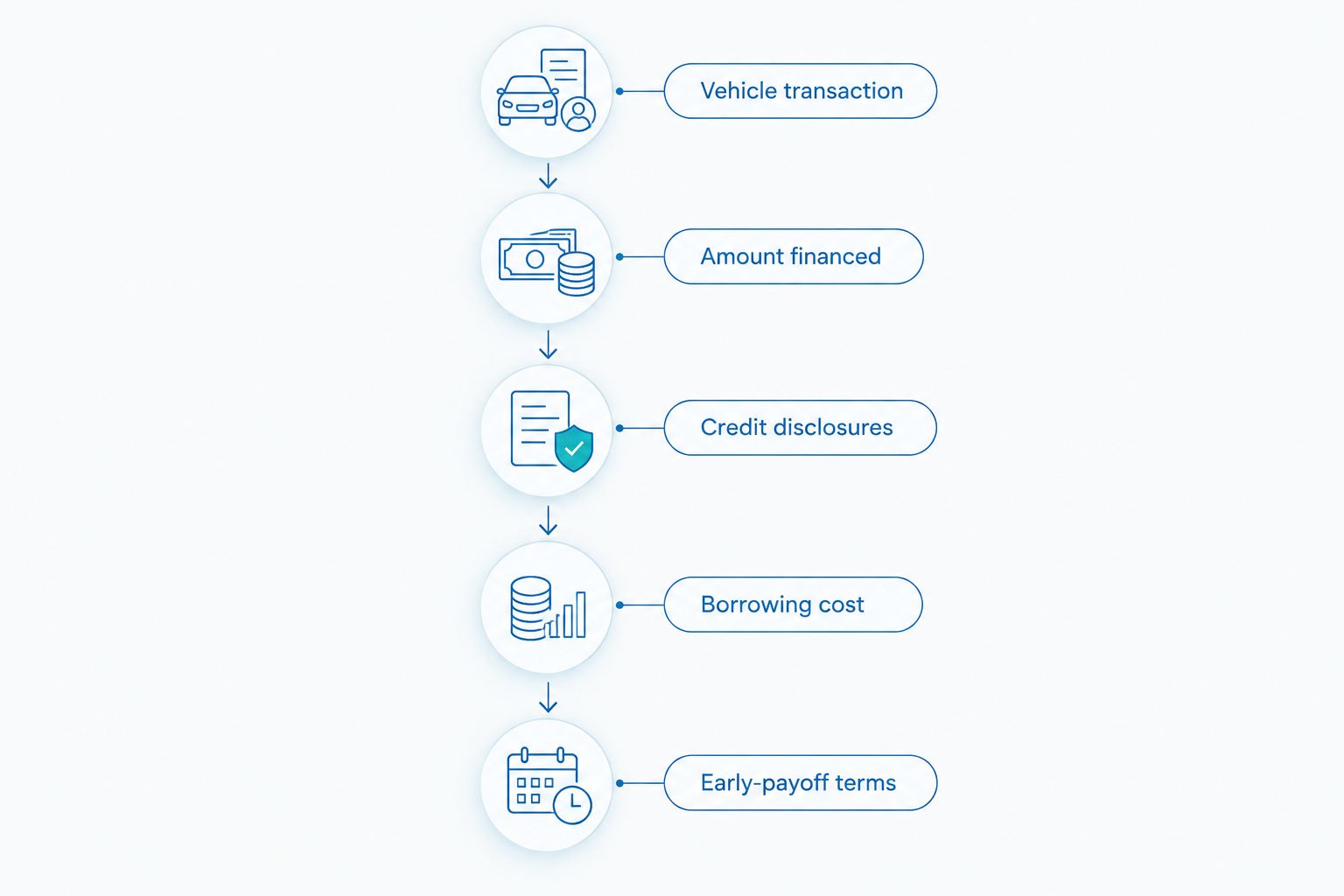
1. Confirm the vehicle transaction
Ask for an itemized written breakdown showing the vehicle amount, taxes, registration-related charges, dealer charges, and any optional products. Check which items you selected and which amounts are being financed.
An optional product added to the loan increases the principal you repay. If the balance accrues interest, that addition also affects your borrowing cost.
2. Confirm the amount financed
Find the amount financed on the credit disclosure and review its itemization. Reconcile it with your cash contribution, trade-in credit, existing trade-in loan payoff, and charges included in the transaction.
Do not assume the amount financed equals the vehicle amount minus your down payment. Other transaction items can change that balance, including negative equity carried over from a trade-in.
3. Read the credit disclosures
Locate the APR, finance charge, total of payments, and payment schedule. Check whether the payment schedule includes a different final payment rather than assuming every installment is identical.
For a schedule of equal monthly installments, multiplying the payment by the number of installments gives the scheduled payment total. Use the disclosed total when rounding or a different final installment changes that calculation.
4. Separate borrowing cost from repayment
Under the disclosed payment schedule, subtracting the amount financed from the total of payments gives the finance charge. Principal repayment is not itself a borrowing fee; it is the return of the money advanced.
Your broader purchase budget also needs to account for cash paid at signing. Avoid counting a down payment twice if you have already included it in your cash-outlay calculation.
5. Check early-payoff terms
Read the contract for prepayment provisions and ask how the payoff amount is calculated. A scheduled finance charge describes the agreed payment schedule, not necessarily the exact interest paid if you settle the loan early.
For a simple-interest loan, reducing principal sooner reduces subsequent interest accrual. Nonrefundable fees and any contractually applicable prepayment charges still need separate attention.
Why used-car financing costs vary
Your financing cost changes when the loan terms or the amount borrowed change. These are the main inputs to check before accepting a 2026 offer:
- Amount financed: A larger balance creates more interest on an otherwise identical loan. Taxes, financed charges, optional products, and carried-over debt can all affect that balance.
- Interest rate and applicable fees: The interest rate drives interest accrual. APR also reflects applicable credit fees, which makes it useful when comparing offers.
- Repayment term: More time to repay lowers the payment on an otherwise identical amortizing loan, but increases scheduled interest.
- Credit and lender underwriting: Lenders evaluate credit information and repayment ability when deciding the terms they offer. An advertised rate is not a substitute for your written approval terms.
- Down payment and trade-in equity: Cash down and positive trade equity reduce what you need to finance. Negative trade equity increases borrowing when it is included in the new loan.
- Payment timing and payoff: On a simple-interest loan, when principal is paid affects interest accrual. Late-payment charges and early-payoff provisions require their own contract review.
You control some of these inputs immediately. Removing unwanted financed products or changing the vehicle budget changes the transaction itself; stretching repayment mainly changes when you pay.
Is a shorter or longer used-car loan better?
Choose the shortest repayment term that fits a workable budget without exhausting your financial cushion. A shorter loan generally trades a higher scheduled payment for less total interest when the balance and interest rate are otherwise identical.
A longer loan addresses monthly cash flow, not necessarily total cost. It also leaves you owing money on the vehicle for longer, which matters if you expect to replace it before repayment ends.
| Loan structure | Best for | Main advantage | Main drawback |
|---|---|---|---|
| Shorter repayment term | Buyers prioritizing lower total interest | Faster principal repayment and less scheduled interest on otherwise identical terms | Higher required monthly payment |
| Longer repayment term | Buyers prioritizing a lower required payment | Spreads repayment across more months | More scheduled interest on otherwise identical terms |
| Larger down payment | Buyers with cash beyond their necessary reserves | Reduces the amount borrowed | Uses cash that would otherwise remain accessible |
For a calendar check, 60 months equals five years, while 72 months equals six years. Those are term conversions, not recommended offers or statements about what any dealership provides.
Compare the loan end date with your intended ownership period. If you plan to sell before the loan ends, the remaining balance will matter alongside the vehicle's value at that time.
Does a down payment reduce financing costs?
A down payment reduces the amount you need to borrow when the rest of the transaction stays the same. At the same interest rate and repayment term, a smaller financed balance produces less interest.
The trade-off is liquidity. Do not evaluate the interest savings without also checking whether you retain enough cash for insurance, registration, maintenance, and unexpected repairs.
Trade-in equity serves a similar role in the transaction, but only after accounting for any existing loan payoff. A trade-in allowance is not the same as usable equity. Ask for the allowance and payoff to appear separately so you can see whether the trade reduces or increases your new borrowing.
If the payoff exceeds the trade-in allowance, adding that difference to the new loan means financing debt from the previous vehicle as well as the replacement.
Is APR the same as the interest rate?
APR and the interest rate are not interchangeable. The interest rate determines contractual interest calculations; APR expresses the annualized cost of credit with applicable financing fees included.
APR is annualized over a 12-month year, not a charge applied once to the original balance. You cannot calculate the total interest on an amortizing loan simply by multiplying the original principal by APR and the number of years.
Use the payment schedule and finance charge for the scheduled dollar cost. For a fair 2026 comparison, align the amount financed and repayment term, then inspect any differences in fees and cash due upfront.
What should I ask before signing a used-car loan?
Ask questions that produce written answers, not another monthly-payment estimate. The goal is to identify what you are buying, what you are borrowing, and what the contract requires.
- What is the itemized vehicle transaction? Separate the vehicle amount from taxes, charges, and optional products.
- What is the amount financed? Confirm how your cash contribution and trade-in payoff affect it.
- What are the APR and finance charge? Read the annualized comparison measure and the scheduled dollar borrowing cost together.
- What is the complete payment schedule? Check the number of payments, due dates, and any different final installment.
- Which products are optional? Review the amount financed with and without products you do not want.
- What happens if I pay early or late? Review payoff provisions, payment application, and applicable late-payment charges.
Keep copies of the signed documents. A verbal explanation does not replace the figures and obligations in the agreement.
FAQ
How much does financing a used car cost in 2026?
The cost depends on your amount financed, interest rate, repayment term, and applicable financing fees. Use the finance charge to identify the disclosed dollar cost of credit, then review APR and the total of payments alongside it.
Is my monthly car payment the cost of financing?
No. A monthly car payment generally includes both principal repayment and interest, so it is not the borrowing cost alone. Compare the finance charge and full payment schedule instead of judging the loan only by its monthly payment.
Is a 60-month used-car loan cheaper than a 72-month loan?
A 60-month loan produces less total interest than a 72-month loan when the amount financed, interest rate, fees, and payment behavior are otherwise identical. The shorter term also requires a higher monthly payment.
Does putting more money down lower the APR?
A larger down payment reduces the amount borrowed, but it does not guarantee a lower APR. Compare the lender's actual written terms rather than assuming the rate changes with your cash contribution.
Can I save interest by paying off a used-car loan early?
Paying principal earlier on a simple-interest loan reduces subsequent interest accrual. Check the agreement for prepayment provisions and ask for a payoff amount that includes accrued interest and applicable charges.
Can I include negative trade-in equity in a used-car loan?
Including negative equity depends on lender approval and the transaction terms. If it is included, you borrow money to cover the previous vehicle's unpaid balance as well as the replacement transaction.
Does GMS Autos offer financing and trade-in services?
GMS Autos offers financing and trade-in services for local used-car and pickup-truck buyers in Placentia, California. Evaluate the written loan terms, trade-in allowance, and existing loan payoff separately before signing.
One last thing
Ask for the same vehicle transaction calculated without optional financed products. That comparison separates the decision to buy the vehicle from the decision to borrow for extras.
A lower monthly payment can hide a larger balance when the repayment term also changes. Keep the amount financed, APR, term, and finance charge visible on the same page; if one changes, compare the whole offer again.