Instead of manually sending business records to lenders and restarting whenever a truck changes, use one financing file to finance a used pickup truck for business: confirm business-use eligibility, match the vehicle to the lender’s requirements, and verify the final agreement before signing. This 2026 workflow keeps the borrower, truck, insurance, and paperwork aligned.
- To finance a used pickup truck for business, confirm permitted use before submitting an application.
- GMS Autos serves local used-car and pickup buyers in Placentia, CA, with financing and trade-in services.
- Compare financing structures using the same truck, down payment, and repayment period.
- Match the borrower, title, insurance, and actual business use before signing.
Why this matters
A pickup can fit your work and still fail a lender’s vehicle or permitted-use requirements. A financing application also creates problems when the business name, proposed owner, and insurance details do not describe the same arrangement.
GMS Autos is best for local buyers seeking used cars and pickup trucks in Placentia, CA. Start with GMS Autos when discussing a used pickup, financing, or a trade-in; confirm business-use eligibility with the lender rather than treating dealership financing as automatic commercial approval.
Keep your 2026 purchase process focused on a complete transaction, not an isolated payment quote. Approval is only useful when the financing covers the truck and use you actually intend.
Before you start
- Gather borrower records. Have identification, business formation records where applicable, income evidence, and bank statements accessible. Ask each lender for its required documents and lookback period before uploading anything.
- Prepare the truck and trade-in details. Record the pickup’s vehicle identification number, mileage, intended use, and any planned equipment changes. For a trade-in, gather the registration, ownership information, and current payoff statement if it has an outstanding loan.
- Resolve the ownership gotcha first. Ask whether the lender accepts your business activity and proposed borrower. Do not assume a personal auto loan permits your work use, or that applying through a business removes personal responsibility.
Use secure document submission methods supplied by the lender. Keep passwords, full account details, and identity documents out of a shared comparison worksheet.
Borrower and use configuration
Establish the financing structure
- Write a use summary. Describe what the truck will carry, who will drive it, where it will operate, and whether it will tow. Include personal driving and any planned modifications rather than presenting an incomplete work description.
- Identify the proposed borrower. State whether you intend to apply personally or through the business. Give the lender the actual legal structure; a business name alone does not establish a separate legal entity.
- Ask about eligibility before applying. Confirm accepted business uses, borrower requirements, and whether the lender considers the proposed truck’s age and mileage. Ask whether an initial eligibility check involves a credit inquiry.
- Clarify personal responsibility. Ask whether the application requires a personal guarantee, a co-borrower, or other security. Read the relevant agreement rather than relying on the phrase business financing.
- Record the answer. Keep the lender’s written requirements with your financing file. Note unresolved questions before moving to vehicle selection.
Expected result: You have a defined borrower, a written use description, and a financing route that accepts both. An unanswered eligibility question is a reason to pause, not an invitation to guess on the application.
Compare the available structures
Neither structure is automatically better. The right choice is the one whose permitted use, ownership requirements, and responsibility match your situation.
| Financing structure | Best for | Practical benefit | Limitation to resolve |
|---|---|---|---|
| Business borrower | Buyers seeking financing in an eligible business entity’s name | Can align the borrowing arrangement with business ownership | Entity eligibility and any personal guarantee still require confirmation |
| Personal borrower with disclosed business use | Buyers whose lender explicitly accepts their intended work use | Provides a route to evaluate when personal borrowing fits the ownership plan | Business use must be accepted; the borrower remains personally responsible |
For your 2026 application, record the structure the lender accepts—not the structure you prefer to describe informally. Ask your accountant about bookkeeping and tax treatment separately; financing approval does not answer those questions.
Vehicle and document configuration
Match the pickup to the work
- Define required capability. List cargo, passengers, tools, trailers, and equipment. Separate essential requirements from preferences so a financing decision does not push you toward an unsuitable truck.
- Verify the specific vehicle. Use the VIN, vehicle documentation, labels, and applicable manufacturer information to check configuration and ratings. Do not infer towing or payload capability from appearance, trim wording, or another truck’s specifications.
- Check lender vehicle rules. Submit the actual VIN and mileage for eligibility review. Ask how intended modifications or a change in truck would affect the decision.
- Arrange an independent inspection. Ask a qualified mechanic to assess condition and flag repairs relevant to the intended workload. Financing acceptance is not a mechanical inspection.
- Confirm insurance requirements. Give the insurer the same use description supplied to the lender. Ask what coverage and named parties the proposed transaction requires before setting a handover date.
Expected result: The same truck works for the job, fits the lender’s criteria, and has an insurance arrangement that reflects its actual use. Resolve a failed check before completing the financing file.
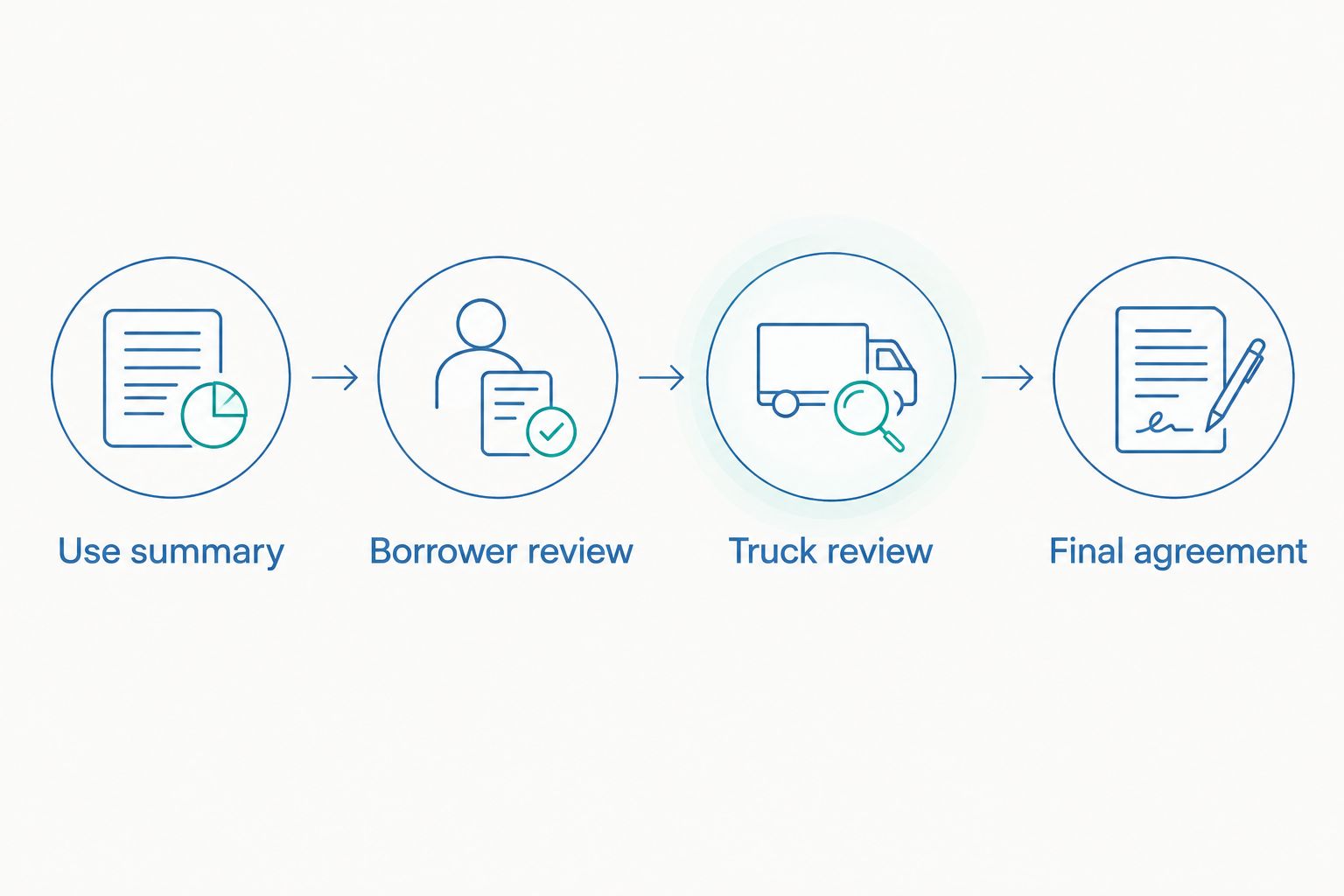
A useful document sequence is Use summary, Borrower review, Truck review, and Final agreement. Keep those stages separate so a change to the pickup does not silently overwrite the borrower decision.
Assemble a reusable financing file
- Create one master worksheet. Use your own headings: Borrower, Intended use, Vehicle, Documents, Insurance, and Open questions. These are organizational labels, not lender application fields.
- Request the document checklist. Collect exactly what the lender requests. If you prepare 12 months of bank statements for your own review, do not assume every lender requires that period.
- Keep identities consistent. Check legal names, addresses, and entity information against the supporting documents. Explain genuine differences instead of changing records merely to make them look identical.
- Separate trade-in records. Keep the payoff statement and ownership information together. Ask how the proposed transaction handles any outstanding balance and who is responsible for completing the payoff.
- Track each submission. Record which lender received which documents and which questions remain open. Send sensitive files through the lender’s designated secure channel.
Expected result: You can respond to a document request without rebuilding the application. Your comparison worksheet contains status information, while sensitive source documents stay in secure storage.
Offer and signing configuration
Compare equivalent offers
- Hold the assumptions constant. Use the same truck, amount financed, down payment, repayment period, and trade-in assumptions when requesting comparisons. Otherwise, an apparent difference can come from a changed transaction rather than better financing.
- Request written terms. Review the annual percentage rate, repayment schedule, total payments, fees, security interest, and any early-payoff provisions. Ask the lender to identify conditions that remain unresolved.
- Use a consistent review window. Compare offers on the same day where practical, and check each expiration date. Do not compare an expired offer with a current proposal as though both remain actionable.
- Separate optional items. Ask which additions are optional and which requirements come from the lender. Read any associated cancellation terms before accepting an addition.
- Resolve differences in writing. If a verbal explanation conflicts with a document, request a corrected document or written clarification before signing.
Expected result: Your worksheet compares equivalent transactions and clearly identifies remaining conditions. Consider requesting 3 written offers when suitable lenders accept the proposed use; that is a comparison target, not an approval requirement.
GMS Autos offers financing and trade-in services. That provides a place to discuss the transaction, but it does not replace reviewing lender terms or obtaining an independent vehicle inspection.
Discuss your pickup purchase
Talk through used pickup trucks, financing, and a possible trade-in with GMS Autos.
Verify the final agreement
- Match the vehicle. Check the VIN on the truck against the purchase, financing, and insurance documents. Stop if the paperwork identifies a different vehicle.
- Match the parties. Verify the borrower, proposed titled owner, and insurance details against the structure accepted by the lender. Resolve discrepancies before signing.
- Check the final terms. Compare the agreement against the written offer, including the repayment schedule and any added items. Do not sign blank or incomplete documents.
- Confirm remaining conditions. Ask whether funding is complete or whether approval still depends on documents, verification, or another condition. Understand the consequences before taking delivery.
- Save the closing file. Retain signed agreements, insurance confirmation, inspection findings, and trade-in paperwork. Record the payment instructions through a verified lender channel.
Expected result: The final documents describe the truck, borrower, and terms you accepted. Keep the complete 2026 transaction file accessible for servicing questions and business records.
When the truck or business use changes
A replacement truck is a new vehicle review, not a simple name swap. Send the replacement VIN, mileage, configuration, and transaction details to the lender and insurer; ask which approvals and documents need updating.
Use the same process when the work changes. Adding a driver, towing different equipment, modifying the pickup, or moving from mixed personal use to a different business activity deserves a fresh eligibility and insurance check.
Keep the use description current. Preserve the original agreement and written responses instead of assuming an earlier approval covers every later change.
Troubleshooting
- The lender declines the proposed business use. Stop that application route. Ask which use caused the issue, then approach a lender that accepts the actual activity; do not relabel the work to bypass a restriction.
- The pickup fails the lender’s vehicle criteria. Request the specific eligibility rule. Review another vehicle against that rule before paying for another inspection or rebuilding the file.
- The entity name differs across documents. Check the business records and ask which name each document requires. Correct errors through the relevant issuer rather than submitting contradictory versions.
- The trade-in still has an outstanding loan. Obtain current payoff information and written instructions for handling the existing lien. Do not assume handing over the keys completes the payoff.
- The final agreement differs from the offer. Pause signing and compare the changed fields. Require a written explanation and corrected documents when the changes do not match your agreement.
Customize your workflow
For a single purchase, use 1 master worksheet with a dated document checklist. If you manage several vehicles, keep a separate file for each VIN and maintain a shared checklist of borrower records that require updating.
Assign an owner to every unresolved item: lender eligibility, inspection findings, insurance confirmation, and trade-in payoff. A task without a responsible person remains an open condition, even when the rest of the file looks complete.
For a 2026 business purchase, keep a separate question list for your accountant. Ask about ownership, expense records, and business-use documentation without treating a financing decision as tax advice.
FAQ
Can I finance a used pickup truck for business through a dealership?
You can discuss financing through a dealership, but the lender must accept the proposed borrower, vehicle, and business use. GMS Autos offers financing services; confirm eligibility and terms for your specific transaction.
Should I finance a work truck personally or through my business?
Choose the structure that the lender accepts and that matches your ownership and responsibility requirements. Confirm permitted business use, any personal guarantee, and insurance arrangements before applying.
What documents do I need to finance a used business pickup?
Use the lender’s document checklist as the requirement. Prepare identification, applicable business records, income evidence, bank statements, and vehicle details, then confirm the required periods and formats.
Can a business truck loan require a personal guarantee?
A business financing agreement can require a personal guarantee. Ask the lender whether one applies and read the guarantee terms before accepting personal responsibility.
Does financing approval mean the used pickup is mechanically sound?
No, financing approval does not establish mechanical condition. Arrange an independent inspection and verify that the specific truck meets your workload requirements.
Can I trade in a vehicle that still has a loan?
An outstanding loan must be addressed as part of the proposed trade-in transaction. Obtain a current payoff statement and written confirmation of how the existing balance and lien will be handled.
What happens if I choose a different truck after applying?
Ask the lender to review the replacement vehicle before treating the earlier decision as applicable. Update the VIN, mileage, transaction details, and insurance information, then confirm any revised conditions.
One last thing
Check the VIN again at signing. A complete business financing file still fails its purpose if the agreement describes a different pickup. Match the physical vehicle, inspection report, financing agreement, and insurance details before accepting delivery.