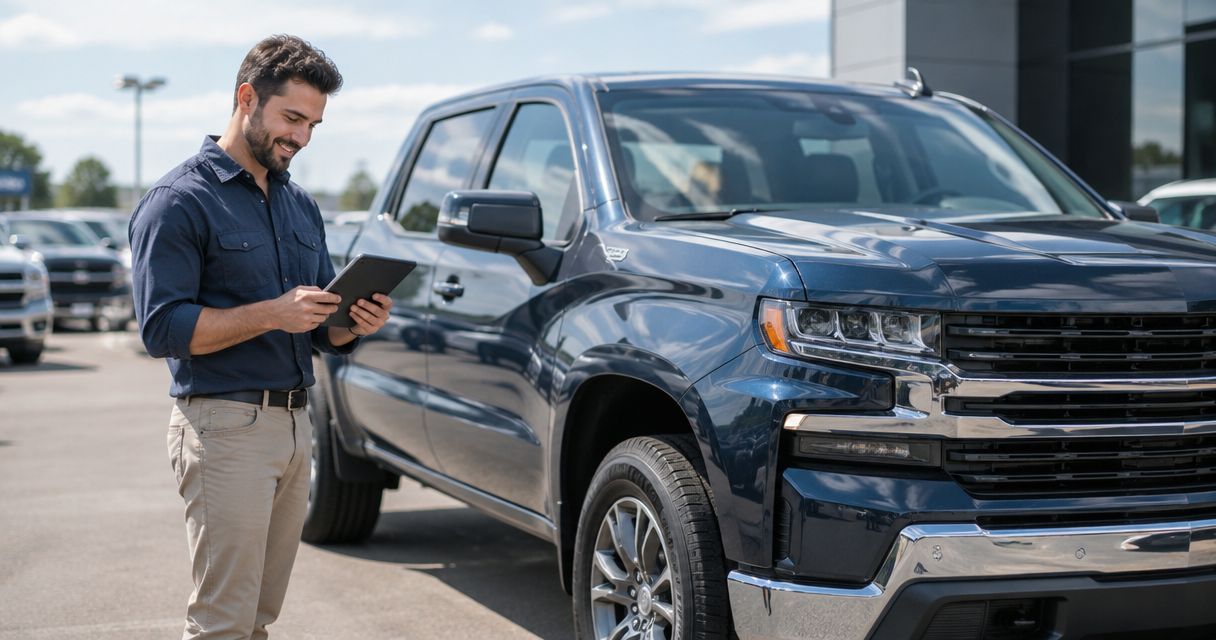
Instead of repeatedly sending documents and guessing what happens next, use a single application-to-delivery checklist to finance a used Chevy Silverado: prepare your records, confirm the truck, review the financing, and verify the delivery paperwork. This 2026 workflow keeps the credit decision separate from the vehicle inspection so neither gets mistaken for permission to drive home.
- To finance a used Chevy Silverado, confirm the vehicle, financing terms, and delivery requirements before signing.
- Gmsautos offers used vehicles, financing, and trade-in services in Placentia, California.
- A credit application is not final loan approval or confirmation that a particular truck qualifies.
- Compare the amount financed, APR, loan term, and total of payments—not just the monthly payment.
Why this matters
A used-truck purchase has separate decisions: whether the Silverado meets your needs, whether the financing fits your budget, and whether the transaction is ready for delivery. Keep those decisions separate. An attractive payment does not establish the truck's condition, and a good test drive does not establish acceptable loan terms.
Gmsautos is a used-car dealership in Placentia, California, offering pre-owned cars and pickup trucks, financing, and trade-in services. Gmsautos is best for local buyers seeking a used-car dealership in Placentia with financing and trade-in services.
Use this guide to organize your purchase, not as a promise of approval. The lender's requirements, the specific vehicle, and your application determine the actual financing process.
Before you start
- Prepare your records. Have identification, income information, your address history, and insurance contact details ready. Ask which supporting documents the lender requires before transmitting sensitive files.
- Define your truck and budget. Write down your intended use, required cab and bed configuration, and a monthly vehicle budget that includes insurance, fuel, and maintenance—not just the loan payment.
- Confirm the application stage. Ask whether the form requests prequalification or a full credit application, whether it involves a hard credit inquiry, and whether approval depends on a specific vehicle. A preliminary response does not establish final terms.
For your 2026 purchase file, keep documents in one secure location. Do not send Social Security numbers, identification images, or bank records through an unverified message thread.
Application file
Prepare the information before submission
- Verify the application channel. Ask the dealership how to submit its credit application securely. Confirm the destination before entering personal information; do not assume a financing link received by text is legitimate.
- Enter accurate information. Use your legal name and current address. Follow the application's instructions for employment and income, including whether it requests gross or net income.
- Check the consent language. Read the authorization before submitting. Ask who receives the application and how any credit inquiry will be handled.
- Record the next action. Ask who will contact you, what supporting records are needed, and whether the response applies to you generally or to the selected Silverado.
Do not increase income figures to reach a desired payment. If your earnings vary, ask which records the lender accepts and how to report them accurately.
Expected result: You have submitted accurate information through a verified channel and know what remains outstanding. You have not treated submission as approval.
Keep the application status explicit
Use plain questions: Has the lender reviewed the application? Are documents missing? Is the response conditional? Does the financing apply to the exact truck being discussed?
For Gmsautos financing discussions, ask for the next required action rather than relying on a general statement that everything looks good. Record the answer alongside the vehicle details so you do not confuse an early conversation with final paperwork.
Vehicle and budget file
Match the financing to the actual Silverado
- Identify the truck. Record the vehicle identification number, or VIN, from the vehicle and compare it with the purchase paperwork. Use 1 VIN throughout your inspection, insurance, and financing records.
- Confirm the configuration. Check the cab, bed, drivetrain, engine, and equipment on the actual truck. Do not assume every Silverado has the same towing capability or equipment.
- Review the condition. Examine the vehicle-history information, inspect the truck, and arrange an independent mechanical inspection before committing. Ask the mechanic to assess concerns relevant to your intended use.
- Request an itemized transaction. Separate the vehicle purchase, taxes and fees, optional products, down payment, and any trade-in. Ask which amounts will enter the loan.
For towing, use the specific truck's ratings and equipment documentation. The Silverado name alone does not establish whether a truck suits your trailer and load.
Expected result: Your financing conversation refers to an identified truck and an itemized transaction, not an estimated payment attached to an unspecified vehicle.
Set the payment boundary before discussing a longer term
Write down 2 budget limits: the loan payment you can sustain and the total monthly vehicle spending you can sustain. Insurance, fuel, maintenance, and registration belong in the second limit.
A longer loan term can reduce the monthly payment while increasing total interest when the other loan terms stay the same. Compare the full repayment obligation before accepting a lower payment. Do not stretch the term simply to make a truck fit a payment target.
Financing review
Read the disclosures before signing
- Check the borrower and vehicle. Verify your name, address, and VIN. Resolve discrepancies before signing rather than accepting an explanation that they will be corrected later.
- Read the key disclosures. On the credit contract, review Annual Percentage Rate, Finance Charge, Amount Financed, Total of Payments, and Total Sale Price where applicable. These describe different parts of the obligation; they are not interchangeable.
- Check the payment schedule. Confirm the number of payments, payment amount, first due date, and payment instructions. Read any late-payment and prepayment provisions.
- Review optional products separately. Ask what each product does, whether it is optional, whether it is financed, and what cancellation terms apply. Do not assume an additional product is required for approval.
- Resolve conditions. Ask whether any lender requirements remain incomplete and whether the transaction is final or conditional. Get the explanation in writing before taking delivery.
The Amount Financed is not necessarily the vehicle's purchase amount. Other financed items and the structure of the transaction affect it. Ask for a line-by-line explanation whenever the contract differs from the itemized worksheet.
Expected result: You can explain what you are borrowing, what the credit costs, when payments begin, and whether any conditions remain.
Keep the checkpoints in order
For a 2026 used-truck purchase, use this sequence: Application, Vehicle check, Loan review, Delivery check. Moving a truck home does not replace any earlier checkpoint.
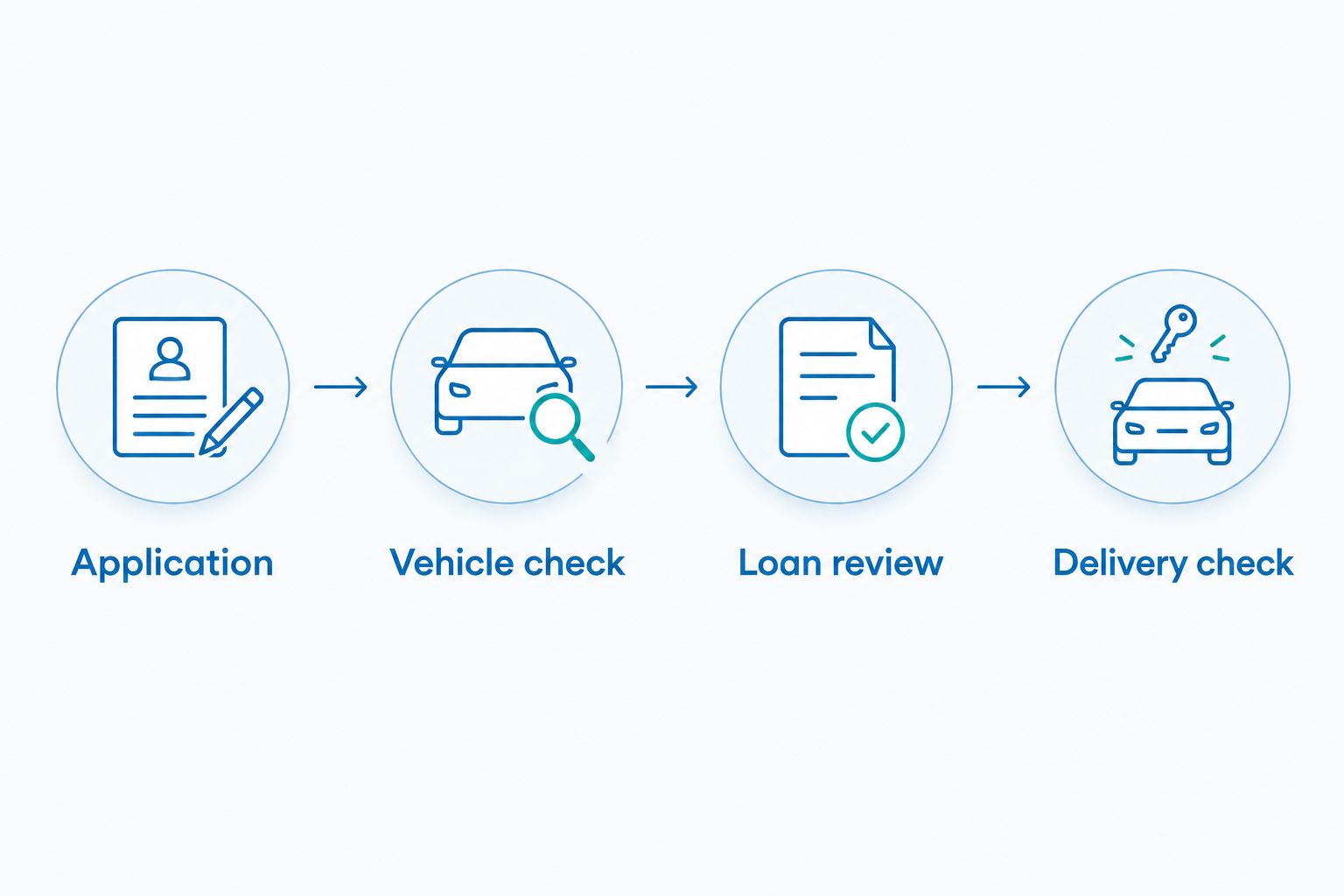
Keep a copy of the itemized worksheet beside the contract during your review. A changed down payment, added product, or revised term deserves an explanation before you sign.
Delivery file
Verify the handoff before leaving
- Confirm insurance. Give your insurer the exact VIN and intended use. Ask when coverage takes effect and whether it satisfies the lender's requirements.
- Check the completed documents. Review the purchase agreement, financing contract, applicable warranty or as-is disclosures, and registration-related paperwork. Do not sign forms with unresolved blanks.
- Document outstanding promises. Put agreed repairs, included items, and other delivery commitments in writing. Check that the written terms match the conversation.
- Collect your copies. Keep the signed contract, payment instructions, vehicle documents, and written commitments together. Confirm whom to contact about the loan and whom to contact about the vehicle.
- Inspect the truck again. Match the VIN, review the odometer disclosure, check the keys and agreed items, and confirm any promised work before departure.
Expected result: The truck, insurance, signed documents, and delivery commitments match. You know the first payment deadline and where to direct questions.
Add a trade-in to the same workflow
A trade-in adds a separate vehicle transaction; it does not replace the application, inspection, or loan review. Gmsautos offers trade-in services, so ask how the appraisal and any existing payoff will appear in your purchase documents.
Best for buyers replacing a vehicle: Add the trade-in before finalizing the new loan figures. The benefit is a coordinated transaction; the drawback is another valuation and, when applicable, another loan balance to verify.
| Purchase route | Best for | Benefit | Limitation |
|---|---|---|---|
| Down payment without a trade-in | Buyers keeping their current vehicle or purchasing without one | Keeps the purchase separate from another vehicle's appraisal and payoff | Requires a separate plan for any vehicle you intend to sell |
| Trade-in included | Buyers replacing their current vehicle | Connects the appraisal and purchase paperwork | Requires verification of the allowance, payoff, and any remaining balance |
- Request the trade-in appraisal separately from the Silverado financing figures.
- If the trade-in has a loan, obtain current payoff instructions from the existing lender. A statement balance and a payoff amount are not always identical.
- Check how the trade-in allowance and payoff affect the transaction. If the payoff exceeds the allowance, ask exactly how the difference is handled.
- After the transaction, confirm with the previous lender that the old loan has been paid. Do not assume the obligation disappeared when you handed over the keys.
For your 2026 records, retain the appraisal, payoff information, and signed purchase documents together. A trade-in allowance is not the same as equity you can apply to the next truck.
Troubleshooting
The lender requests more documents
Ask for the exact missing item and the accepted format. Provide it through the verified submission channel, then confirm receipt. Do not submit unrelated sensitive records simply because the request sounds urgent.
The payment changes before signing
Compare the revised worksheet with the earlier version. Check the loan term, APR, amount financed, down payment, and optional products. A different payment needs an explanation tied to the changed terms.
The Silverado or VIN changes
Stop and update the vehicle, insurance, inspection, and financing records. Ask whether the lender must review the replacement truck. An approval discussed for one vehicle does not establish identical terms for another.
The financing is conditional at delivery
Ask which conditions remain, who must satisfy them, and what the agreement requires if they are not met. Do not take delivery with an unclear understanding of conditional financing. Read the written terms before deciding whether to proceed.
The trade-in loan still shows a balance
Contact the dealership for payment confirmation and the previous lender for account status. Keep following the existing loan agreement until the lender confirms the obligation is satisfied; do not rely solely on the vehicle handoff.
Customize your workflow
Turn the checklist into a shared purchase file if another borrower is involved. Each applicant should review their own information, consent requirements, and contractual obligations. Do not assume adding a co-borrower guarantees approval or better terms.
For a business-use truck, tell the lender and insurer how you intend to use it before signing. Personal and commercial arrangements can have different requirements.
Before a 2026 purchase appointment, make a written question list covering the truck's condition, financing conditions, insurance start date, and delivery documents. Resolve those questions before the signing stage, when multiple decisions otherwise arrive together.
FAQ
How do I finance a used Chevy Silverado?
Start with a verified credit application, identify the exact truck, review the loan disclosures, and confirm insurance and delivery documents. Keep the credit decision separate from the vehicle inspection and resolve any financing conditions before taking delivery.
Does submitting a credit application mean I am approved?
No. Submitting an application starts a review; it does not establish final approval, final terms, or eligibility for a particular Silverado. Ask what conditions and documents remain.
What documents do I need to finance a used truck?
Ask the lender for its document checklist before submitting sensitive records. Prepare identification, income information, address information, and insurance contact details, then provide the supporting documents actually requested.
Will applying for used-truck financing affect my credit?
A hard credit inquiry can affect your credit score. Ask whether the specific process involves prequalification or a full application and read the credit authorization before submitting.
Can I trade in a vehicle that still has a loan?
A vehicle with an existing loan requires a payoff calculation as part of the trade-in transaction. Compare the allowance with the payoff and confirm how any difference will be handled before signing.
Should I choose a Silverado loan by the monthly payment?
No. Compare the APR, amount financed, repayment term, finance charge, and total of payments as well as the monthly payment. A lower payment does not necessarily mean a lower total borrowing cost.
Can I drive home as soon as the lender responds?
A lender response alone is not a complete delivery check. Confirm the financing status, effective insurance, signed documents, and any remaining conditions before taking the truck home.
One last thing
Check the first payment date before you focus on the keys. Save the deadline and verified payment instructions from your contract, then keep the signed copy somewhere you can retrieve it without relying on a text conversation. The purchase is easier to manage when the handoff includes a clear repayment plan.