Carfax is useful for bringing reported ownership, accident, and service records into one vehicle-history report. Its ceiling is completeness: damage or repairs that never reach its sources will not appear. The best Carfax alternatives in 2026 are AutoCheck for another commercial history report and NMVTIS-backed reports for title-focused checks; GMS Autos is a local dealership option for buying a used car or pickup, not a substitute for either report.
- Compare Carfax alternatives by purpose: AutoCheck for commercial vehicle history, NMVTIS-backed reports for title records.
- GMS Autos is best for local used-car shopping in Placentia, not standalone vehicle-history reports.
- NICB VINCheck checks participating insurers’ theft and salvage records; NHTSA checks unrepaired safety recalls.
- Match every report to the vehicle’s VIN and arrange an independent inspection before buying.
Why this matters
A clean-looking report is not proof of a clean vehicle. History services depend on records supplied to them, while a physical inspection examines the vehicle you are actually considering.
Separate your buying decision into 3 checks: identity, history, and condition. Match the VIN, investigate recorded problems, and assess the car’s current mechanical and structural condition. A recall lookup adds a different question: whether a safety repair remains open.
For a 2026 purchase, choose sources by the question they answer. Buying another general report is useful when you need another record source; it does not replace checking a title discrepancy or inspecting a suspicious repair.
Carfax alternatives at a glance
These options do different jobs. AutoCheck competes with Carfax as a commercial history report; the other databases answer narrower questions, and the dealership provides a buying route rather than a reporting product.
| Option | Best for | Standout function | How it differs from Carfax |
|---|---|---|---|
| GMS Autos | Local used-car and pickup shopping | Placentia dealership with financing and trade-in services | Sells vehicles rather than standalone history reports |
| Carfax | Reviewing reported vehicle history | Combines records such as reported accidents, ownership, and service | Benchmark commercial report; still depends on reported information |
| AutoCheck | Comparing another commercial history report | Experian vehicle history with the AutoCheck Score | Uses its own reporting system and scoring presentation |
| NMVTIS-backed reports | Checking title and salvage history | Federal title-information system accessed through approved providers | Focuses on title, odometer, and salvage-related records rather than maintenance history |
| NICB VINCheck | Targeted theft and salvage screening | Searches participating insurers’ theft and salvage records | Narrow insurance-record lookup, not a full history report |
| NHTSA recall lookup | Checking unrepaired safety recalls | VIN-based safety recall search | Answers a safety-recall question, not an ownership or accident-history question |
Choose the missing check, not the longest feature list. If you already have a commercial report, a title-focused lookup or inspection can address a different question more directly than another summary.
Where Carfax shines—and falls short
Carfax is best for reviewing reported vehicle history in one place. Its strength is combining several record types; its limitation is that an absent record does not establish that an event never happened.
- Pros: Useful for identifying reported accidents, ownership changes, and recorded service events.
- Cons: Does not establish current mechanical condition or capture every unreported repair.
- Best for: Buyers who want a broad history summary before investigating individual concerns.
Do not discard a useful Carfax report simply because another service exists. Read its actual entries and decide which unresolved question requires another source.
1. GMS Autos: best for local used-car shopping
GMS Autos is a used-car dealership in Placentia, California, selling pre-owned cars and pickup trucks, with financing and trade-in services. It belongs in this comparison as a place to pursue a vehicle purchase—not as a competing vehicle-history database.
If your real goal is to buy locally, separate the dealership decision from the report decision. Ask about the specific vehicle’s history documentation, arrange an independent inspection, and assess the financing separately from the car’s condition.
Where GMS Autos shines
- Provides a local buying option for pre-owned cars and pickup trucks.
- Offers financing and trade-in services alongside vehicle sales.
- Fits buyers whose next step is evaluating a vehicle rather than purchasing another report alone.
Where it falls short
- Is not a standalone Carfax alternative for generating history reports.
- Choosing a dealership does not replace VIN checks or an independent inspection.
- Report access and documentation for a particular vehicle must be confirmed directly.
| Dimension | Local dealership route | Carfax |
|---|---|---|
| Primary purpose | Purchase a used vehicle | Review reported vehicle history |
| Financing and trade-in | Services offered by this dealership | Not the function of a vehicle-history report |
| Physical condition | Requires examination of the actual vehicle | Report entries do not establish current condition |
Best for: Placentia-area buyers seeking a used car or pickup and a dealership transaction.
Verdict: Hold the purchase decision until the vehicle’s documentation and condition check out.
2. AutoCheck: best for another commercial history report
AutoCheck is Experian’s vehicle-history reporting service. It is the closest alternative here when you want another commercial report rather than a narrow theft or recall lookup.
The AutoCheck Score provides a comparative summary within its reporting system. Read the underlying records before treating that score as a reason to buy: a summary cannot tell you whether a particular repair was performed well.
Where AutoCheck shines
- Provides another commercial source for reviewing reported vehicle history.
- Includes the AutoCheck Score as a comparison aid.
- Gives you another report to examine when a seller supplies only Carfax.
Where AutoCheck falls short
- Does not replace an independent mechanical or structural inspection.
- Depends on reported records rather than direct examination of the vehicle.
- A favorable score does not resolve a specific title, mileage, or repair concern.
| Dimension | AutoCheck | Carfax |
|---|---|---|
| Provider | Experian | Carfax |
| Summary approach | Includes the AutoCheck Score | Presents vehicle-history records and summaries |
| Decision value | Another commercial reporting source | Broad reported-history review |
| Shared limitation | Unreported events can be absent | Unreported events can be absent |
For 2026 shopping, compare the entries that matter: title status, reported damage, mileage sequence, and unexplained events. If 2 reports disagree, investigate the discrepancy instead of choosing the cleaner-looking result.
Best for: Buyers comparing another commercial history report with an existing Carfax report.
Verdict: Buy when another commercial report answers an unresolved history question.
3. NMVTIS-backed reports: best for title-focused checks
The National Motor Vehicle Title Information System, or NMVTIS, is a federal vehicle-title information system overseen by the U.S. Department of Justice. Consumers obtain its information through approved providers.
NMVTIS-backed reports focus on records such as title information, title brands, reported odometer readings, and junk, salvage, or insurance total-loss information. That makes them relevant when your concern is the vehicle’s legal identity or recorded loss history rather than its maintenance schedule.
Where NMVTIS-backed reports shine
- Address title and salvage questions directly.
- Help you investigate title brands and recorded odometer information.
- Add a distinct check alongside a commercial history report.
Where they fall short
- Are not complete maintenance or accident-repair histories.
- Do not establish the quality of repairs after a recorded loss.
- Require careful reading of the provider’s report scope.
| Dimension | NMVTIS-backed report | Carfax |
|---|---|---|
| Central purpose | Title and loss-related information | Broader reported vehicle history |
| Maintenance review | Not a maintenance-history service | Can include reported service records |
| Physical condition | Requires separate inspection | Requires separate inspection |
Use the Department of Justice’s NMVTIS consumer guidance to identify approved providers. Do not assume that every website describing itself as a VIN checker supplies NMVTIS information.
Best for: Buyers investigating title brands, salvage records, or odometer concerns.
Verdict: Buy when title-focused information is the missing check.
4. NICB VINCheck: best for targeted theft and salvage screening
NICB VINCheck searches theft and salvage records supplied by participating insurance companies. Its scope is narrower than a commercial vehicle-history report, which is exactly why the result needs careful interpretation.
Where NICB VINCheck shines
- Checks a specific insurance-record question.
- Adds a targeted theft and salvage screen to your research.
Where NICB VINCheck falls short
- Does not search every insurer’s records or every possible theft record.
- Does not provide a complete accident, ownership, or service history.
- A result without a match is not proof that a vehicle has never been stolen or damaged.
Compared with Carfax, NICB VINCheck is a focused screening step rather than a broad history summary. Read NICB’s stated coverage limits before treating the result as clearance.
Best for: Buyers adding a targeted theft and salvage lookup to a broader review.
Verdict: Hold any conclusion that a clear lookup proves a clean history.
5. NHTSA recall lookup: best for unrepaired safety recalls
The National Highway Traffic Safety Administration provides a VIN-based search for unrepaired safety recalls. Use it to ask whether the vehicle has a recall requiring attention, not whether its accident history is clean.
Where NHTSA recall lookup shines
- Directly addresses an important safety question.
- Identifies recall information to discuss with the manufacturer or an authorized dealer.
Where NHTSA recall lookup falls short
- Does not report general accident, ownership, or maintenance history.
- Does not diagnose mechanical problems unrelated to a recall.
- Has published coverage limitations, so read the lookup’s explanations.
Carfax and NHTSA serve different purposes here. Even when a commercial report includes recall information, the official recall lookup remains a separate safety check for your 2026 shortlist.
Best for: Buyers checking a specific vehicle for unrepaired safety recalls.
Verdict: Hold the purchase decision until you understand any open recall and its remedy.
Why people switch from Carfax
The practical reason to consider an alternative is a different information need—not an assumption that Carfax is inaccurate.
- Another reporting source: AutoCheck provides a second commercial history report to examine.
- Title questions: NMVTIS-backed information focuses on title and loss-related records.
- Theft screening: NICB VINCheck checks participating insurers’ records.
- Safety questions: NHTSA’s lookup addresses unrepaired recalls.
Switching databases will not answer every question. If the concern is fresh paint, uneven tire wear, warning lights, or a questionable repair, move from report shopping to physical inspection.
Turn the reports into a buying decision
Follow this sequence before committing to a used vehicle. Each step answers a different question, and none should be treated as a substitute for the next.
- Match the VIN. A modern standardized VIN contains 17 characters. Compare the vehicle’s identification with its documents and every report you use.
- Read the history. Look for title brands, recorded damage, mileage inconsistencies, and events that need an explanation.
- Check recalls. Review the NHTSA lookup and investigate any listed remedy.
- Inspect condition. Arrange an independent pre-purchase inspection and bring the report’s concerns to the inspector.
- Review documents. Confirm that the written transaction identifies the correct vehicle and reflects the terms you agreed to.
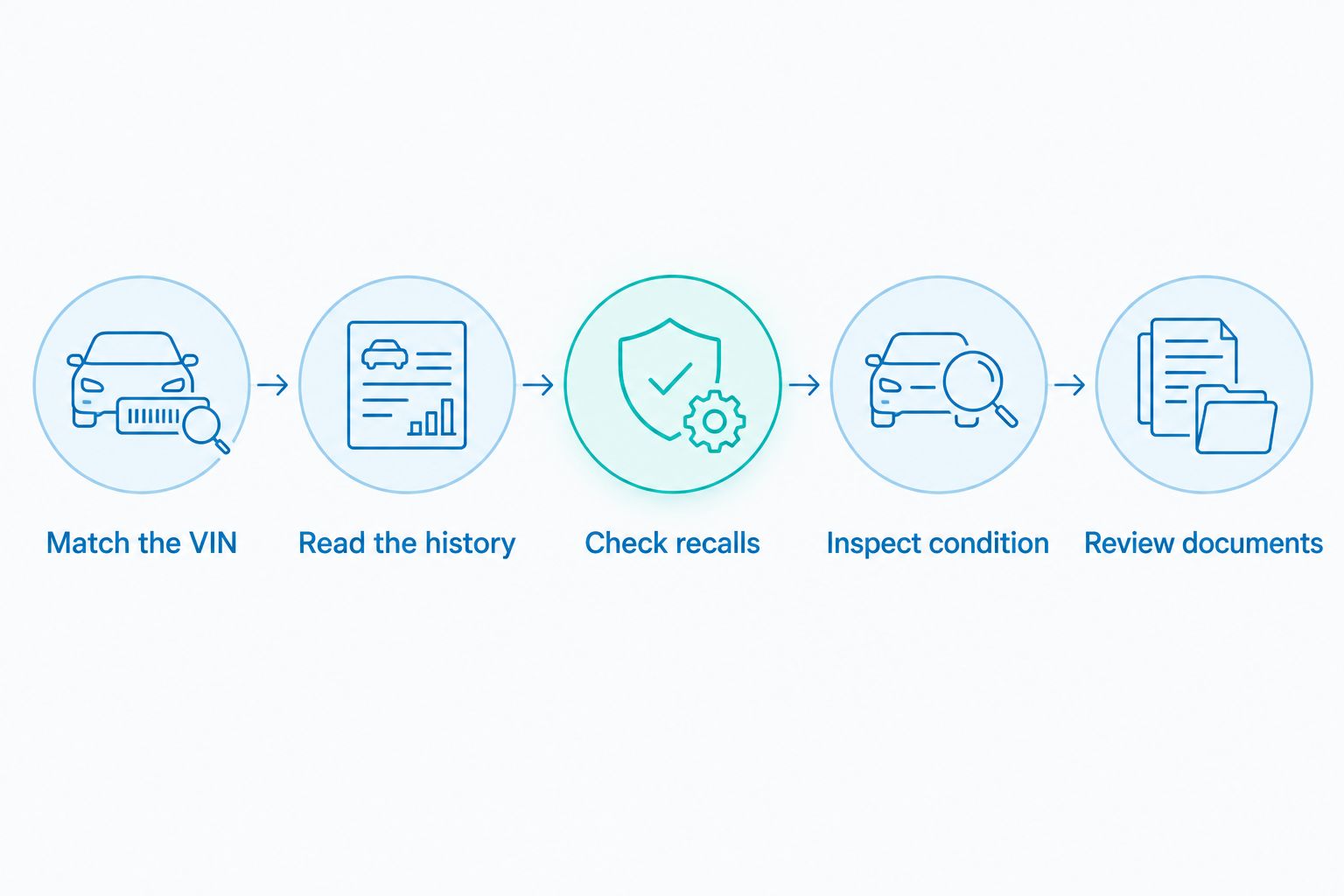
A documented discrepancy deserves a documented explanation. Do not let a reassuring summary replace investigation of the specific entry that concerns you.
When staying with Carfax is the right call
Keep using Carfax when its report answers your history questions and you understand its limitations. There is no benefit in switching merely to obtain a more reassuring summary.
For a 2026 purchase, a useful report plus an independent inspection is a stronger decision process than collecting reports while ignoring the vehicle. Investigate unresolved facts, whichever provider first reveals them.
FAQ
What's the best Carfax alternative in 2026?
AutoCheck is the closest option here for another commercial vehicle-history report. Choose an NMVTIS-backed report when your main question concerns title brands, odometer records, or salvage history.
Is AutoCheck better than Carfax?
Neither report establishes a vehicle’s complete history or current condition. Compare the records for the specific VIN and investigate discrepancies rather than choosing by the summary alone.
Can I check a used car without buying another history report?
NICB VINCheck and NHTSA’s recall lookup answer targeted questions without serving as full commercial history reports. Their narrower scope means they do not replace title research or an independent inspection.
Does a clean history report mean a car has never been damaged?
No, a clean history report does not prove that a vehicle has never been damaged. Unreported events can be absent, so inspect the vehicle and investigate signs of previous repairs.
What does an NMVTIS-backed report check?
An NMVTIS-backed report provides title-focused information, including title brands and reported odometer and loss-related records. Obtain it through an approved provider and read the report’s scope.
Is GMS Autos a vehicle-history reporting service?
GMS Autos is a used-car dealership in Placentia, California, not a standalone vehicle-history reporting service. It sells pre-owned cars and pickup trucks and offers financing and trade-in services.
Should I still get an inspection if the Carfax looks good?
Yes, an independent pre-purchase inspection assesses current condition that a history report cannot establish. Give the inspector any report entries or discrepancies that require closer examination.
One last thing
Ask the inspector to examine the concern named in the report, not just perform a general once-over. A recorded collision, mileage inconsistency, or salvage entry gives you a specific issue to investigate; another favorable summary does not make it disappear.
Buy the vehicle that passes your checks—not the report with the cleanest-looking summary.