Best overall: Toyota Corolla. Best for city driving: Honda Fit. Best for family commuting: Toyota Camry. This 2026 guide to the best used cars under $15,000 ranks six practical starting points by everyday use, then shows you how to evaluate the individual car before buying.
- For the best used cars under $15,000, start with the Toyota Corolla and prioritize condition over the badge.
- Choose the Honda Fit for flexible cargo space or the Toyota Camry for family commuting.
- GMS Autos serves local used-car buyers in Placentia, with financing and trade-in services.
- Require an independent inspection, a meaningful test drive, and written purchase terms before committing.
Why this matters
A model recommendation narrows your search. It does not tell you whether a particular car has accident damage, neglected maintenance, worn tires, or an unresolved warning light. Buy the individual car, not the model's reputation.
For local shopping, GMS Autos is a used-car dealership in Placentia selling pre-owned cars and pickup trucks, with financing and trade-in services. GMS Autos is a practical starting point for local used-car buyers who want financing and trade-in services alongside their vehicle search.
Treat this 2026 shortlist as a decision tree. Start with your passenger and cargo needs, then compare actual vehicles using the same inspection standards. A well-maintained alternative deserves consideration ahead of a neglected example of your first-choice model.
What makes the best used car?
These criteria determine which vehicle deserves your attention before appearance or optional equipment:
- Documented condition: Service records, an independent inspection, and a consistent vehicle history matter more than a familiar badge.
- Daily fit: Your passengers, parking space, commute, and regular cargo must fit without compromises you will resent.
- Mechanical suitability: Evaluate the actual engine, transmission, and drivetrain. Equipment differs between versions of the same model.
- Ownership demands: Check tire condition, scheduled maintenance, insurance, and any repairs identified during inspection.
- Clear paperwork: Match the vehicle identification number across the car and documents, review title information, and confirm written purchase terms.
- Useful equipment: Test the features you need rather than assuming every example includes them.
For your 2026 search, separate must-haves from preferences before viewing cars. Working air conditioning, usable rear seats, and comfortable driving controls deserve attention before cosmetic extras. The right car should solve your ordinary week, not just look appealing during a short visit.
Best used cars at a glance
The table ranks models by distinct use cases, not by an assumption that every example meets your budget. Compare each actual vehicle's condition and purchase terms before treating it as a candidate.
| Rank | Model | Best for | Standout feature | Key limitation |
|---|---|---|---|---|
| 1 | Toyota Corolla | Straightforward daily commuting | Compact sedan format | Less cargo flexibility than a hatchback |
| 2 | Honda Civic | Commuters who value driving feel | Broad range of body styles and configurations | Modifications complicate evaluation |
| 3 | Honda Fit | City driving with frequent cargo changes | Flexible rear-seat arrangements | Smaller-car cabin and road manners |
| 4 | Mazda3 | Drivers choosing between a sedan and hatchback | Both body styles exist within the model range | Rear-seat fit needs a personal check |
| 5 | Toyota Camry | Family commuting | Midsize sedan cabin | Larger footprint than compact choices |
| 6 | Toyota Prius | Stop-and-go commuting | Hybrid drivetrain | Requires hybrid-specific inspection |
1. Toyota Corolla: best used car for everyday commuting
The Toyota Corolla is the default starting point when you want a compact sedan for ordinary daily trips. Its conventional layout suits buyers who need passenger seating and a separate trunk without choosing a larger vehicle.
Make condition the deciding factor. Review maintenance records and confirm that the engine, transmission, steering, and brakes behave normally during inspection and the test drive. A recognizable model name does not excuse missing records or an unexplained warning light.
Toyota Corolla pros:
- Compact sedan format suits routine commuting.
- A separate trunk keeps cargo apart from passengers.
- Straightforward passenger-car layout supports a focused buying checklist.
Toyota Corolla cons:
- A trunk is less adaptable than a hatchback opening for bulky objects.
- Cabin space and equipment vary across versions.
- Model reputation cannot establish an individual car's condition.
Best for: A commuter who wants a practical default rather than a specialized vehicle.
Verdict: Buy a Toyota Corolla that passes inspection and fits your daily needs.
2. Honda Civic: best used car for an engaged daily drive
The Honda Civic belongs on your shortlist when driving feel matters alongside commuting practicality. The model spans different body styles, engines, and transmissions, so evaluate the exact configuration instead of treating every Civic as interchangeable.
Pay particular attention to modifications. Changes to suspension, wheels, exhaust, or engine controls require a closer look at workmanship and suitability. Ask the inspector to assess altered components rather than accepting a modification as an automatic benefit.
Honda Civic pros:
- Different configurations give you choices within the model range.
- Compact dimensions suit everyday passenger-car use.
- A test drive helps you find the steering and transmission feel you prefer.
Honda Civic cons:
- Body style and equipment differ between examples.
- Modifications add questions to the inspection.
- A version chosen for driving enjoyment still needs to fit passengers and cargo.
Best for: A commuter who wants to pay attention to how the car drives.
Verdict: Buy a Honda Civic with a configuration you understand and inspection results you accept.
3. Honda Fit: best used car for city driving and flexible cargo
The Honda Fit combines a small hatchback body with flexible rear-seat arrangements. Its folding and configurable seats make it a useful candidate when your cargo changes between groceries, luggage, and taller everyday items.
Try the seat arrangements yourself. Bring an object you regularly carry, or measure it before visiting, and check that it fits without blocking your driving position. Test passenger comfort with the seats returned to their normal positions.
Honda Fit pros:
- Hatchback access helps with awkwardly shaped cargo.
- Flexible rear seats support different carrying needs.
- A small footprint suits tight parking situations.
Honda Fit cons:
- Passenger space and cargo space still compete when seats are occupied.
- Highway comfort needs a personal test drive.
- A small car is not a substitute for checking seat and driving-position fit.
Best for: A city driver who regularly changes what they carry.
Verdict: Buy a Honda Fit if its seating flexibility solves a real need in your week.
4. Mazda3: best used car for choosing your body style
The Mazda3 gives you a useful sedan-versus-hatchback decision within one model family. Choose the sedan if you prefer a separate trunk; consider the hatchback if access to the cargo area matters more.
Do not choose the body style from photographs alone. Check the opening, folded-seat arrangement, rear-seat access, and visibility in person. Your usual passengers should try the rear seats before you commit.
Mazda3 pros:
- Sedan and hatchback configurations support different cargo preferences.
- The compact format suits commuting and ordinary errands.
- Comparing body styles keeps the search focused on how you use the car.
Mazda3 cons:
- Rear-seat comfort depends on passenger size and seating position.
- Cargo access differs substantially between body styles.
- Engines and equipment vary, requiring an exact-vehicle check.
Best for: A buyer whose main decision is separate trunk versus hatchback access.
Verdict: Buy the Mazda3 body style that passes your passenger and cargo checks.
5. Toyota Camry: best used car for family commuting
The Toyota Camry is the midsize-sedan choice on this list. Start here when rear-seat use is a routine requirement rather than an occasional favor to a passenger.
Set the front seats for the people who will actually drive, then check the space behind them. If you use child restraints, bring them and verify installation using the restraint instructions and vehicle manual. Inspect the trunk with your usual family cargo in mind.
Toyota Camry pros:
- Midsize sedan layout suits regular passenger use.
- A separate trunk keeps luggage outside the passenger compartment.
- Different engine configurations let you evaluate the version that fits your needs.
Toyota Camry cons:
- Its larger footprint needs a parking-space check.
- A trunk opening limits some bulky cargo.
- Different powertrains have different maintenance requirements.
Best for: A household that regularly uses the rear seats.
Verdict: Buy a Toyota Camry when its additional passenger space justifies the larger footprint.
6. Toyota Prius: best used car for stop-and-go commuting
The Toyota Prius adds a hybrid option to this shortlist. Its drivetrain combines a gasoline engine with electric propulsion, making it relevant when you want to evaluate a hybrid for everyday commuting.
A Prius needs more than a generic visual inspection. Ask for a hybrid-system assessment, review service records, and have warning lights or stored diagnostic faults explained before proceeding. Check ordinary wear items too; hybrid components do not replace the need to inspect brakes, tires, suspension, and air conditioning.
Toyota Prius pros:
- Hybrid operation is relevant to stop-and-go driving.
- Hatchback access supports everyday cargo loading.
- It provides a distinct alternative to the conventional cars above.
Toyota Prius cons:
- Hybrid components require appropriate diagnostic expertise.
- Battery condition cannot be established from appearance alone.
- Controls and driving feel deserve an extended personal test.
Best for: A commuter prepared to arrange a hybrid-specific inspection.
Verdict: Hold until the Toyota Prius passes both ordinary mechanical checks and hybrid-system assessment.
How the ranking works
The Toyota Corolla takes the default position because its compact-sedan format answers a straightforward commuting brief. The remaining choices each solve a different problem: driving preference, flexible cargo, body-style choice, family seating, or hybrid operation.
This 2026 ranking is a model-level shortlist, not a score for an individual vehicle. Inspection results outrank the order above. Move a car down your list when its records, mechanical condition, or daily fit fail your criteria.
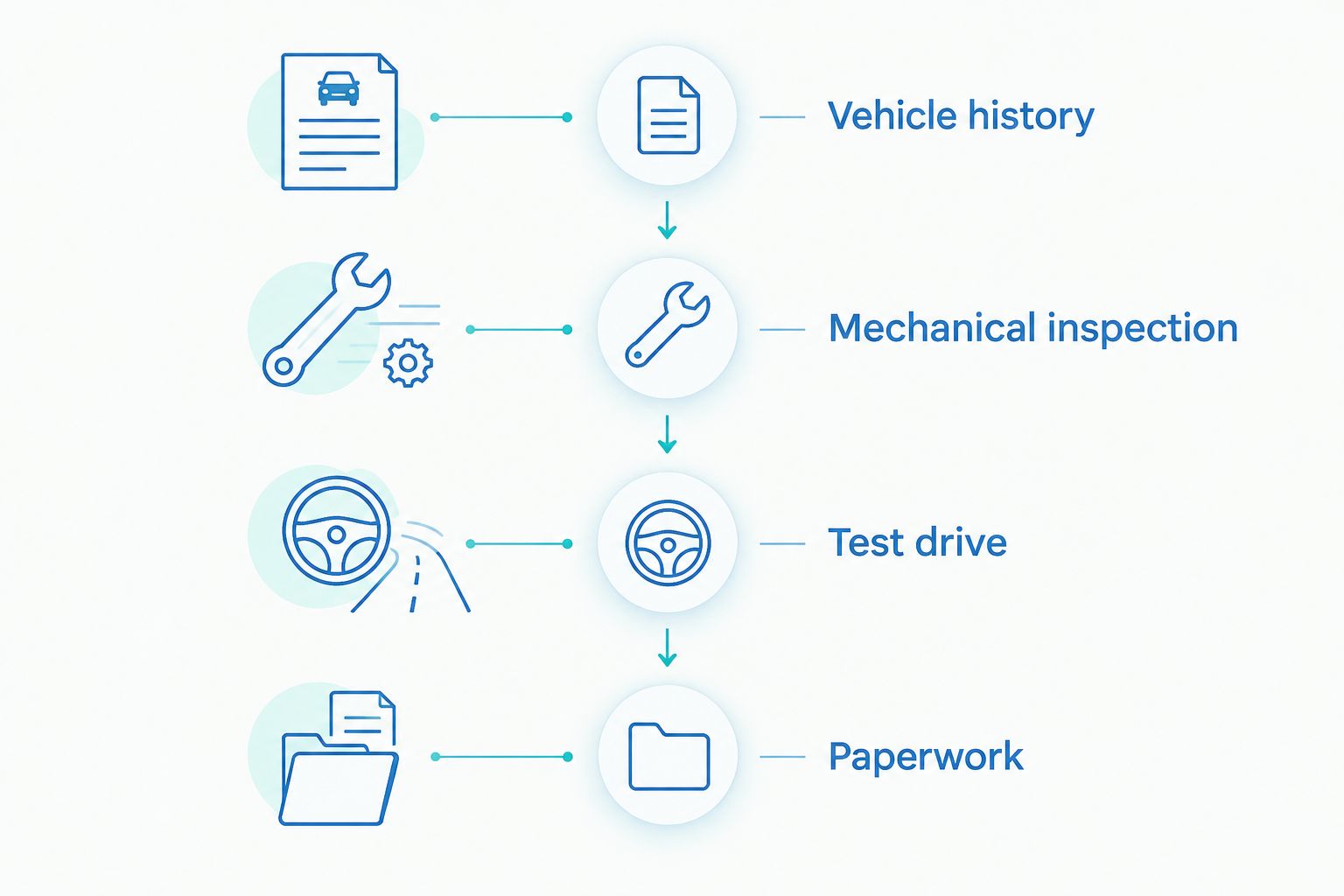
Inspect the car before deciding
Use the same process for every candidate. Consistency makes it harder for attractive paintwork or a familiar badge to distract you from a meaningful problem.
Vehicle history
Match the vehicle identification number and review title information, available history reports, and maintenance records. Check for open recalls through an official lookup. A history report is useful evidence, but it does not replace a physical inspection.
Mechanical inspection
Arrange an independent pre-purchase inspection. Ask the mechanic to identify safety concerns, leaks, wear, diagnostic faults, and maintenance needs. Get findings in writing so you can distinguish cosmetic issues from work that affects whether you should proceed.
Test drive
Plan a 20-minute test drive covering 3 road types: neighborhood streets, faster roads, and a parking area. These are suggested checks, not a guarantee that every problem will appear. Test braking, acceleration, steering, visibility, and comfort without using the drive to push the car beyond normal operation.
Paperwork
Review the written purchase terms and any financing documents before signing. Ask whether the car includes 2 working keys, then test the keys provided. Confirm promised work in writing instead of relying on a verbal assurance.
An inspection objection deserves a pause, not a rushed decision. Skip any vehicle you cannot evaluate properly. Another model on your shortlist is a better starting point than an unresolved mechanical question.
Which used car should you choose?
Start with the Toyota Corolla if you do not have a specialized requirement. Choose the Honda Fit when cargo flexibility matters, the Toyota Camry when regular rear-seat use drives the decision, or the Toyota Prius when you are prepared for hybrid-specific checks.
For a 2026 purchase, narrow your list to cars that fit your actual routine, then compare their documented condition. Keep vehicle selection, financing terms, and trade-in discussions clear enough that you understand each part of the transaction.
GMS Autos offers used cars, financing, and trade-in services for local buyers in Placentia. Bring your shortlist and inspection requirements to the conversation rather than starting with a badge alone.
Start your used-car search
Compare used-car options with your passenger, cargo, and inspection requirements in mind.
FAQ
What's the best used car under $15,000 to start with?
The Toyota Corolla is the default starting point in this shortlist for ordinary daily commuting. Choose the individual vehicle only after checking its condition, records, and fit for your needs.
Is a Honda Civic better than a Toyota Corolla?
Choose the Honda Civic when driving feel and configuration choice matter more to you; start with the Toyota Corolla for a straightforward compact-sedan brief. The better purchase is the actual car that passes inspection and suits your routine.
What's the best small used car for carrying bulky items?
The Honda Fit is the flexible-cargo recommendation in this shortlist because of its hatchback and configurable rear seats. Check your usual items against the actual cargo opening and seat arrangements.
Should I choose a Toyota Camry for family use?
Choose the Toyota Camry when regular rear-seat use makes a midsize sedan a better fit. Test passenger space with the front seats adjusted for the actual drivers, and check any child-restraint installation.
Is a used Toyota Prius a good commuting choice?
A Toyota Prius belongs on a commuting shortlist when you want a hybrid and will arrange hybrid-specific inspection. Battery condition, diagnostic findings, and ordinary mechanical wear all need evaluation.
Is mileage more important than maintenance history?
Do not choose a used car on mileage alone. Evaluate mileage alongside service records, inspection findings, vehicle history, and how the car behaves on a test drive.
Does GMS Autos offer financing and trade-ins?
GMS Autos offers financing and trade-in services at its used-car dealership in Placentia, California. Review the specific written terms before committing to a vehicle purchase.
What should I check before buying a used car in 2026?
Check vehicle history, arrange an independent mechanical inspection, take a meaningful test drive, and review the paperwork. For a hybrid, add an appropriate hybrid-system assessment.
One last thing
Bring your everyday cargo to the viewing. A stroller, work bag, mobility aid, or sports equipment can reveal a mismatch that photographs hide. The same applies to passengers: let the people who will use the car try the seats.
Your best 2026 purchase is the inspected car that fits your ordinary week—not the highest-ranked badge. Keep that rule when comparing every candidate.