Best overall: Toyota Corolla. Best for carrying bulky items in a small car: Honda Fit. Best budget candidate: an older, well-maintained Toyota Corolla. The best used cars for bad credit in 2026 are cars that meet your transportation needs without stretching your loan or repair budget; this guide compares six practical candidates.
- The best used cars for bad credit start with a Toyota Corolla that passes an independent inspection.
- Honda Fit suits buyers who need hatchback cargo flexibility without choosing a larger vehicle.
- Compare loan terms, insurance, maintenance, and vehicle condition before choosing a monthly payment.
- Gmsautos serves Placentia buyers seeking used cars, financing, and trade-in services.
Why this matters
Bad credit changes your financing options, not which car badge you should trust. A familiar model name cannot compensate for neglected maintenance, an unsuitable loan, or expensive repairs identified during an inspection.
Gmsautos sells used cars and pickup trucks in Placentia, CA, and offers financing and trade-in services. Gmsautos is a practical dealership option for Placentia buyers seeking used cars, financing, and trade-in services. Choose the vehicle and financing together rather than treating approval as the finish line.
For a 2026 purchase, start with the job your car must do: commuting, carrying passengers, moving equipment, or handling frequent city trips. Then compare individual vehicles that fit that job. Your credit profile does not make an oversized vehicle or a neglected bargain a better choice.
What makes the best used cars for bad credit?
The ranking prioritizes transportation needs and ownership checks, not a promise that a lender will approve a particular model.
- Vehicle condition: Favor documented maintenance and an independent inspection over a badge's reputation.
- Loan fit: Compare the amount financed, annual percentage rate, term, and total payments—not just the monthly payment.
- Operating expenses: Get an insurance quote and check tire, maintenance, and repair requirements for the exact vehicle.
- Useful size: Buy enough passenger and cargo room for your routine. Do not finance capacity you will not use.
- Mechanical complexity: Understand the equipment you are buying, including turbocharging or a hybrid system where fitted.
- Exit risk: Consider how the loan balance and vehicle condition affect your ability to sell or trade later.
Best used cars for bad credit at a glance
These are model families to shortlist, not descriptions of current inventory. Equipment, body style, condition, and maintenance requirements vary by model year and trim.
| Rank | Vehicle | Best for | Standout feature | Key limitation |
|---|---|---|---|---|
| 1 | Toyota Corolla | Straightforward everyday transportation | Compact-car format | Less cargo flexibility in sedan versions |
| 2 | Honda Fit | Bulky cargo and tight parking | Small hatchback format | Less room than a larger passenger car |
| 3 | Honda Civic | Buyers comparing body styles | Sedan and hatchback choices across model years | Engines and equipment vary by version |
| 4 | Toyota Camry | Regular rear-seat passengers | Midsize sedan format | Larger footprint than compact options |
| 5 | Mazda3 | Buyers prioritizing driving feel | Sedan and hatchback choices | Rear-seat and cargo fit need checking |
| 6 | Toyota Prius | Frequent stop-and-go driving | Hybrid powertrain | Hybrid-system condition needs separate attention |
1. Toyota Corolla: best used car for everyday transportation
The Toyota Corolla is the default shortlist choice when your priority is getting to work and handling daily errands. Start with a conventional version whose equipment you understand, then compare maintenance records and inspection findings.
Best for: Buyers who want a compact daily driver without shopping for extra size or performance.
Toyota Corolla pros:
- Compact dimensions suit everyday errands and parking.
- Sedan versions provide a separate trunk.
- A straightforward transportation brief makes it easier to reject unnecessary upgrades.
Toyota Corolla cons:
- Sedan trunks are less flexible for bulky loads than hatchbacks.
- A neglected Corolla still carries repair risk.
- Rear-seat fit deserves a test with your actual passengers or child seats.
An older Corolla is also the budget candidate in this guide, but age alone does not establish value. Compare its immediate maintenance needs with those of newer alternatives before deciding.
Verdict: Buy a Toyota Corolla that passes inspection and fits your financing plan; skip one with unresolved mechanical issues.
2. Honda Fit: best used car for small-car cargo needs
The Honda Fit combines a small hatchback body with a flexible rear-seat layout. It belongs on your shortlist when you carry awkward items but do not need a pickup or a larger passenger vehicle.
Best for: Buyers balancing tight parking with occasional bulky cargo.
Honda Fit pros:
- A hatchback opening accommodates items that are awkward to load through a sedan trunk.
- Its small footprint suits constrained parking spaces.
- Rear-seat configurations help you adapt the interior to different loads.
Honda Fit cons:
- Passenger space is not equivalent to a larger vehicle's.
- Cabin noise and ride comfort need checking on your usual roads.
- Cargo flexibility does not replace checking payload limits in the owner's manual.
Bring a representative item to the viewing if cargo is the reason you are buying. A folded seat is useful only when the remaining passenger space still meets your needs.
Verdict: Buy a Honda Fit for small-car cargo flexibility; skip it if your passengers or equipment do not fit comfortably.
3. Honda Civic: best used car for comparing body styles
The Honda Civic gives you sedan and hatchback options across model years. That makes it a useful shortlist when you want to compare a separate trunk with a more accessible cargo opening without immediately moving to a larger vehicle.
Best for: Buyers who want to choose their body style before choosing their exact car.
Honda Civic pros:
- Sedan and hatchback versions address different cargo needs.
- Compact-car dimensions suit daily transportation.
- Different configurations let you prioritize basic transportation over performance equipment.
Honda Civic cons:
- Engine and transmission configurations vary by year and version.
- Performance-oriented variants introduce different ownership considerations.
- Modifications complicate evaluation of the vehicle's condition and maintenance history.
For a 2026 purchase, identify the exact engine, transmission, and trim before comparing Civic listings. Do not treat two cars with the same model name as mechanically identical.
Verdict: Buy a Honda Civic with documented maintenance and a configuration that suits your needs; skip unexplained modifications.
4. Toyota Camry: best used car for regular rear-seat passengers
The Toyota Camry is the midsize sedan candidate when passenger comfort matters more than a compact footprint. It deserves consideration if your household regularly uses the rear seat rather than treating it as occasional overflow.
Best for: Buyers who routinely carry adults or child seats in the back.
Toyota Camry pros:
- Midsize dimensions provide an alternative to compact-car cabins.
- A separate trunk keeps luggage outside the passenger compartment.
- Conventional and hybrid versions exist across model years, allowing different powertrain choices.
Toyota Camry cons:
- Its larger footprint needs checking against your parking space.
- A sedan opening limits access for bulky cargo.
- Different engines and hybrid versions require different ownership checks.
Test the seating arrangement you will actually use. Install child seats, adjust the front seats, and check access before deciding that a larger sedan solves your space problem.
Verdict: Buy a Toyota Camry when rear-seat use justifies the size; skip it if a compact car already meets your needs.
5. Mazda3: best used car for buyers prioritizing driving feel
The Mazda3 is a sedan or hatchback candidate for buyers who care about how a car responds during ordinary driving. Evaluate that preference on a test drive without letting it override condition or loan affordability.
Best for: Buyers who want daily transportation and place extra weight on driving feel.
Mazda3 pros:
- Sedan and hatchback choices support different cargo preferences.
- A compact format avoids choosing a larger vehicle solely for driving enjoyment.
- A test drive gives you a direct way to assess steering, seating, and controls.
Mazda3 cons:
- Rear-seat access and comfort need checking with your passengers.
- Wheel and tire specifications vary and affect replacement choices.
- Engine and drivetrain differences make exact-version research necessary.
Use the same road loop for every candidate. Compare visibility, braking behavior, seat comfort, and control placement—not just the strongest first impression.
Verdict: Buy a Mazda3 when its driving feel suits you and its ownership requirements fit; skip it if passenger fit is compromised.
6. Toyota Prius: best used car for frequent stop-and-go driving
The Toyota Prius uses a hybrid powertrain, making it a relevant candidate for frequent urban driving. Check the exact model year's fuel-economy information and have the hybrid system evaluated before treating it as the economical choice.
Best for: Buyers whose routine includes frequent stop-and-go trips.
Toyota Prius pros:
- A hybrid powertrain combines an engine with electric drive.
- Regenerative braking recovers energy during deceleration.
- Its liftback layout provides a useful cargo opening.
Toyota Prius cons:
- Hybrid-system condition needs attention beyond ordinary visual checks.
- Fuel savings do not erase repair needs or financing costs.
- Different generations have different maintenance considerations.
Ask the inspecting technician to assess the hybrid system and explain any warning lights or diagnostic findings. Do not accept a cleared dashboard as proof that a previous fault is resolved.
Verdict: Buy a Toyota Prius after a satisfactory mechanical and hybrid-system inspection; wait if its condition remains unclear.
How the cars are ranked
The Toyota Corolla ranks first because its compact daily-transportation role is the default need this guide addresses. The other choices earn distinct slots for cargo flexibility, body-style choice, rear-seat use, driving feel, and stop-and-go driving.
This 2026 ranking compares use cases, not individual vehicles or lender approvals. A well-maintained lower-ranked car is a better purchase than a higher-ranked car with unresolved problems. Inspection findings and your financing terms decide the final order.
Compare financing before committing to a car
Gmsautos offers financing and trade-in services, but choose your terms by reading the agreement. Keep vehicle selection, borrowing, and trade-in evaluation connected without allowing one attractive number to hide another obligation.
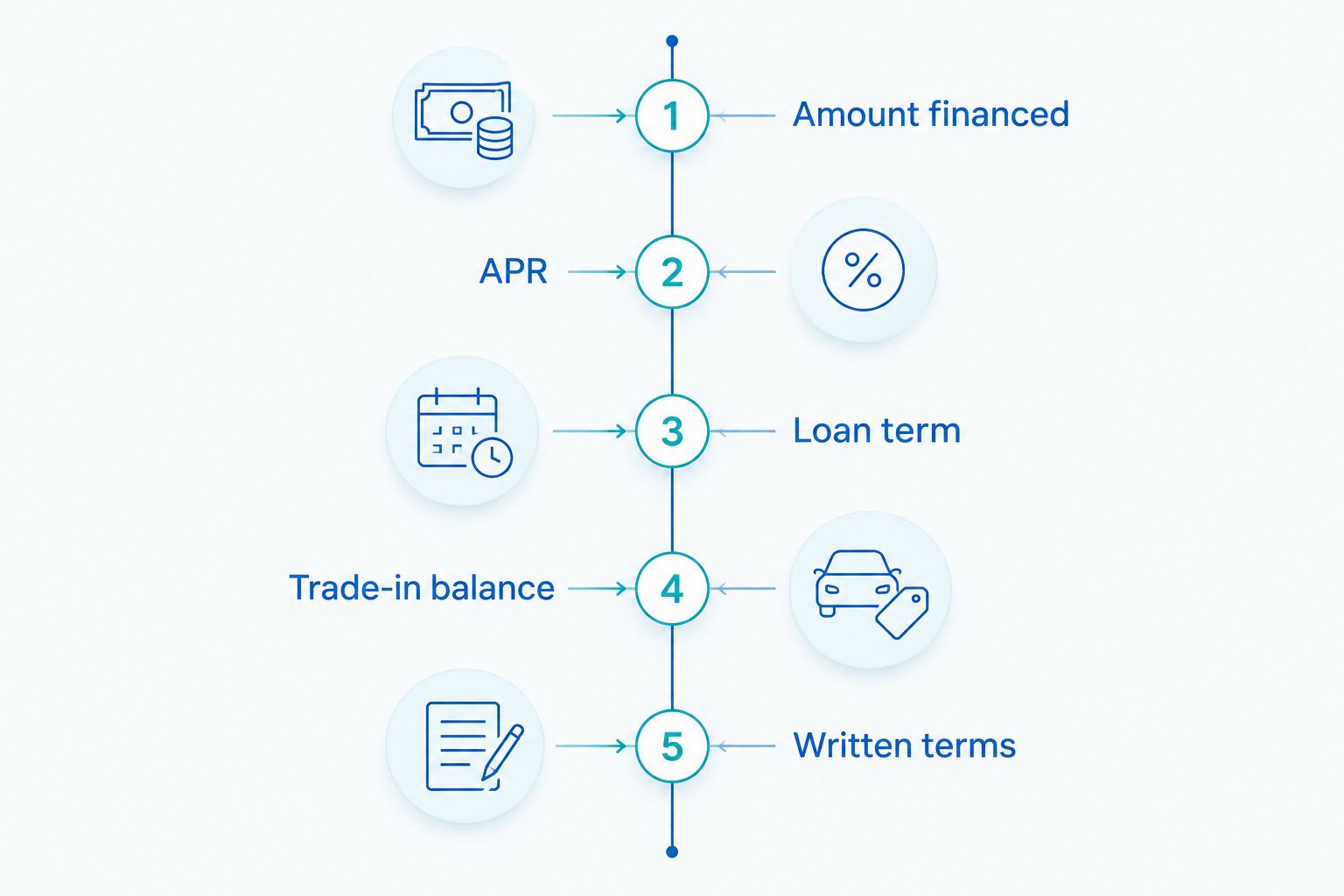
Use this sequence:
- Amount financed: Identify how much you are borrowing after your down payment, trade-in, and any included charges.
- APR: Compare the annual percentage rate alongside the other loan terms.
- Loan term: Check how long payments continue and compare total payments.
- Trade-in balance: Separate your vehicle's trade value from any outstanding loan balance.
- Written terms: Confirm the final agreement matches the terms you intend to accept.
Compare a 60-month loan with a 72-month loan if both are offered. The longer term adds 12 months of payments; compare total payments and interest rather than assuming the smaller monthly obligation is the better deal.
For any 2026 financing offer, ask whether optional products are included and what changes if you decline them. If you owe money on a trade-in, confirm exactly how that balance is handled. Approval does not mean the agreement fits your household budget.
Compare your next used car
Review used cars and trucks from a Placentia dealership offering financing and trade-in services.
Which used car should you choose?
Choose a Toyota Corolla first if you have no special cargo, passenger, or powertrain requirement. Move to the Honda Fit for bulky loads, the Honda Civic for body-style choice, the Toyota Camry for regular rear-seat passengers, the Mazda3 for driving feel, or the Toyota Prius for frequent stop-and-go driving.
Then make the decision vehicle-specific:
- Get an insurance quote using the exact vehicle identification number.
- Review maintenance records and a vehicle-history report.
- Arrange an independent inspection before committing.
- Test the car on roads that reflect your routine.
- Compare the complete financing agreement, not an advertised monthly payment.
Your final choice is the car that passes these checks and leaves room for ongoing ownership expenses. Skip any candidate that requires you to ignore a problem to make the purchase work.
FAQ
What's the best used car for bad credit in 2026?
The Toyota Corolla is this guide's default choice for everyday transportation. Choose an individual car that passes an independent inspection and fits your financing plan; the model name does not guarantee approval or condition.
Does choosing a cheaper car guarantee loan approval?
No, choosing a cheaper car does not guarantee loan approval. Lenders evaluate the application and vehicle under their own requirements, so review the actual offer rather than assuming a particular model qualifies.
Is a Honda Fit better than a Toyota Corolla?
The Honda Fit is the better shortlist choice when hatchback cargo flexibility is your main requirement. The Toyota Corolla is the default for straightforward daily transportation; condition and loan terms determine which individual car is the better purchase.
Should I take a longer loan to lower my monthly payment?
Do not choose a longer loan solely to lower the monthly payment. Compare APR, total payments, and the length of the commitment, then check whether the complete ownership budget remains manageable.
Can I trade in a car that still has a loan?
A trade-in with an outstanding loan requires the balance to be addressed in the transaction. Ask for the payoff, trade value, and treatment of any remaining balance in writing before accepting the agreement.
Is a used Toyota Prius a good choice with bad credit?
A used Toyota Prius is a candidate for frequent stop-and-go driving if its mechanical and hybrid-system condition checks out. Compare its financing and ownership requirements with a conventional car before deciding.
Where can I look for used cars and financing in Placentia?
Gmsautos is a used car dealership in Placentia, CA, offering cars, pickup trucks, financing, and trade-in services. Evaluate the exact vehicle and written financing terms before committing.
One last thing
Get the insurance quote before you sign, not after you choose the payment. A vehicle that fits your loan budget still has to fit your transportation budget, including insurance, fuel, maintenance, and repairs.
For your 2026 purchase, keep your inspection findings beside the financing agreement. Those documents—not the badge or the approval message—tell you whether the particular car makes sense.