Best overall: Toyota Prius. Best for compact-sedan buyers: Toyota Corolla Hybrid. Best nonhybrid option: Honda Fit. This 2026 guide to the best fuel-efficient used cars compares practical choices by driving needs and inspection priorities; GMS Autos serves local used-car buyers in Placentia, CA.
- Toyota Prius leads the best fuel-efficient used cars shortlist for buyers who want hybrid efficiency and hatchback practicality.
- Toyota Corolla Hybrid suits compact-sedan buyers; Toyota Camry Hybrid suits drivers who need more passenger space.
- Hyundai Ioniq Hybrid offers a hatchback alternative; Honda Fit suits buyers who want a gasoline-only small car.
- Compare fuel economy for the exact configuration, then inspect condition, maintenance records, and hybrid-system health.
Why this matters
The most efficient model is not automatically the best used-car purchase. A neglected hybrid creates a different ownership decision from a well-maintained example of the same model. Your shortlist needs to account for condition as well as fuel consumption.
For a 2026 purchase, separate two questions: which vehicle design fits your driving, and which individual car deserves your money? The first question narrows your search. A vehicle-history review, test drive, and independent inspection answer the second.
GMS Autos is best for local used-car buyers who want a Placentia dealership with financing and trade-in services. The model recommendations below are a shopping shortlist, not a statement that the dealership carries each vehicle.
What makes the best fuel-efficient used cars?
Use these criteria before comparing badges. They explain why the shortlist includes both hybrids and a gasoline-only hatchback.
- Configuration-specific fuel economy: Compare the EPA city, highway, and combined ratings for the exact model year, engine, drivetrain, and trim. A model name alone does not establish its rating.
- Fit for your route: Prioritize city ratings for stop-and-go driving and highway ratings for freeway-heavy trips. Combined MPG is a useful starting point, not a promise about your commute.
- Mechanical condition: Look for consistent servicing, a clean inspection, and an explanation for any warning lights. Fuel efficiency does not excuse unresolved mechanical problems.
- Practical space: Check passenger comfort, cargo access, and seating flexibility. A car that forces you to borrow another vehicle for routine tasks is the wrong fit.
- Ownership complexity: Decide whether you want a hybrid powertrain or a gasoline-only car. Hybrids add battery and electrical-system inspection needs; gasoline-only cars still need a full mechanical review.
- Comparable evidence: Match the seller's claims to the vehicle identification number, documentation, and exact configuration. Compare cars on the same rating basis rather than mixing highway MPG with combined MPG.
Best fuel-efficient used cars at a glance
This 2026 shortlist assigns each vehicle a different job. No vehicle wins every category, and condition remains the final filter.
| Rank and model | Best for | Standout feature | Key limitation |
|---|---|---|---|
| 1. Toyota Prius | Overall hybrid hatchback choice | Hybrid powertrain with hatchback cargo access | Visibility, seating, and cargo layout vary by generation |
| 2. Toyota Corolla Hybrid | Compact-sedan commuters | Familiar compact-sedan format with hybrid propulsion | Less cargo flexibility than a hatchback |
| 3. Hyundai Ioniq Hybrid | Buyers comparing hatchback alternatives | Hybrid efficiency in a liftback layout | Transmission behavior and hybrid condition need careful evaluation |
| 4. Toyota Camry Hybrid | Drivers prioritizing passenger comfort | Midsize-sedan space with a hybrid powertrain | Larger footprint than the compact choices |
| 5. Honda Fit | Buyers avoiding a hybrid powertrain | Small gasoline-only hatchback with flexible seating | Less suited to buyers whose priority is hybrid-level city efficiency |
1. Toyota Prius: best fuel-efficient used car overall
The Toyota Prius combines a hybrid powertrain with a hatchback body. That combination makes it the default starting point for buyers who want low fuel consumption without giving up convenient cargo access.
Start with your daily use. Bring the items you regularly carry, check the rear opening, and sit in both rows before deciding that a particular Prius fits. Different generations have different interior layouts, so an impression from one example does not settle the decision for another.
Toyota Prius pros:
- Hybrid propulsion suits drivers comparing fuel-saving options for mixed routes.
- The hatchback opening makes bulky items easier to load than a sedan trunk opening.
- Folding rear seats support trips that require more cargo space.
Toyota Prius cons:
- Hybrid battery and electrical-system condition add inspection requirements.
- Rear visibility and seating position require an in-person check.
- A strong efficiency reputation does not establish the condition of a specific car.
Review maintenance records and request an inspection that includes the hybrid system. Do not accept the absence of dashboard warning lights as a substitute for diagnostic checks.
Best for: Buyers who want an efficient hybrid with everyday hatchback usefulness.
Verdict: Buy the Toyota Prius when the inspection, seating position, and cargo layout check out.
2. Toyota Corolla Hybrid: best for compact-sedan commuters
The Toyota Corolla Hybrid puts a hybrid powertrain into a compact sedan. It suits buyers who prefer a conventional trunk and sedan layout rather than a hatchback.
The Corolla Hybrid belongs on your shortlist when commuting is the main task and your usual cargo fits in a trunk. Test rear-seat access with your actual passengers or child seats instead of judging space from exterior dimensions.
Toyota Corolla Hybrid pros:
- Compact-sedan dimensions suit buyers who do not need a midsize car.
- Hybrid propulsion gives efficiency-focused commuters another option beyond the Prius.
- A separate trunk keeps cargo outside the passenger compartment.
Toyota Corolla Hybrid cons:
- The trunk opening limits the shapes of items you can load.
- Rear-seat comfort requires checking against your passengers' needs.
- Ratings differ by configuration; do not transfer one trim's MPG to another.
For your 2026 search, confirm that the listing actually identifies the hybrid version. Then compare the exact drivetrain and trim against their EPA ratings, rather than treating every Corolla as equivalent.
Best for: Commuters who want a compact hybrid sedan and carry ordinary trunk-sized luggage.
Verdict: Buy the Toyota Corolla Hybrid if compact-sedan space meets your daily needs.
3. Hyundai Ioniq Hybrid: best for a hatchback alternative
The Hyundai Ioniq Hybrid gives you another hybrid hatchback to compare with the Prius. Its liftback layout supports buyers who want cargo access without switching to a larger vehicle.
Confirm the powertrain before comparing listings. The Ioniq name also appears on plug-in hybrid and electric vehicles, which require different charging and ownership decisions. This recommendation concerns the Hyundai Ioniq Hybrid, not every vehicle carrying the Ioniq name.
Hyundai Ioniq Hybrid pros:
- A liftback opening provides practical access to the cargo area.
- Hybrid propulsion fits a fuel-efficiency-focused shortlist.
- It gives hatchback buyers a distinct alternative to evaluate alongside the Prius.
Hyundai Ioniq Hybrid cons:
- Similar naming makes powertrain verification essential.
- Its dual-clutch transmission needs evaluation during low-speed driving.
- Hybrid-system condition remains an inspection priority.
Include parking maneuvers and stop-and-go traffic in the test drive. Ask the inspecting technician to evaluate any hesitation, shudder, or unusual engagement rather than accepting a seller's explanation without checking it.
Best for: Buyers who want to compare a second hybrid hatchback before choosing a Prius.
Verdict: Buy the Hyundai Ioniq Hybrid only after transmission and hybrid-system checks are satisfactory.
4. Toyota Camry Hybrid: best for passenger comfort
The Toyota Camry Hybrid combines a midsize-sedan body with hybrid propulsion. It is the shortlist choice for buyers who need more passenger room than a compact car provides.
That extra space matters only if you use it. Put your regular passengers in the car, adjust the front seats to normal driving positions, and check rear legroom and entry before choosing the larger sedan.
Toyota Camry Hybrid pros:
- A midsize cabin suits buyers prioritizing passenger space.
- Hybrid propulsion provides an efficiency-focused alternative to a conventional gasoline sedan.
- A separate trunk keeps luggage apart from the cabin.
Toyota Camry Hybrid cons:
- Its larger footprint takes more space when parking.
- A sedan trunk does not offer the same opening as a hatchback.
- The hybrid badge does not establish identical efficiency across generations or trims.
Compare the Camry Hybrid against the Corolla Hybrid on your actual route and space requirements. Do not choose the larger car solely because it feels more substantial during a short test drive.
Best for: Drivers whose passengers need midsize-sedan space.
Verdict: Buy the Toyota Camry Hybrid when passenger comfort justifies the larger footprint.
5. Honda Fit: best for a gasoline-only small car
The Honda Fit is a small gasoline-only hatchback with flexible rear seating. It belongs on this list for buyers who want useful cargo space but do not want a hybrid powertrain.
The Fit is not the default choice for someone chasing the strongest hybrid fuel-economy rating. Its case rests on a different combination: compact size, hatchback access, and seating flexibility.
Honda Fit pros:
- A gasoline-only powertrain avoids hybrid-specific battery inspections.
- Flexible rear seating helps accommodate different cargo shapes.
- Its small footprint suits buyers who prioritize a compact vehicle.
Honda Fit cons:
- It does not offer the hybrid propulsion used by the other shortlisted cars.
- Cabin noise and ride comfort need evaluation on your regular roads.
- Small-car passenger space will not meet every household's needs.
Check which transmission the individual car has and review its service history. Test the seat-folding mechanisms yourself; practical features only help when they work and suit the items you carry.
Best for: Buyers who want a compact, gasoline-only hatchback rather than a hybrid.
Verdict: Buy the Honda Fit for its packaging; skip it if hybrid city efficiency is your main requirement.
Compare fuel use, not just MPG
MPG describes distance per gallon. To understand the difference between ratings, convert them into fuel used over the same distance.
For an illustrative 100-mile trip, a car achieving 50 MPG uses 2 gallons. At 40 MPG, it uses 2.5 gallons; at 30 MPG, it uses about 3.33 gallons. These are arithmetic examples, not ratings assigned to the vehicles above.
The example explains why an identical increase in MPG does not always remove the same amount of fuel consumption. Compare gallons used over your driving distance, then consider whether the difference justifies choosing a different car.
Actual consumption also depends on driving conditions, speed, climate control, and vehicle condition. For a 2026 buying decision, use the exact EPA rating as a consistent comparison point and treat your own route as the practical test.
Inspect the individual car before choosing the model
A model shortlist helps you search. An inspection helps you decide whether a specific vehicle belongs in your driveway.
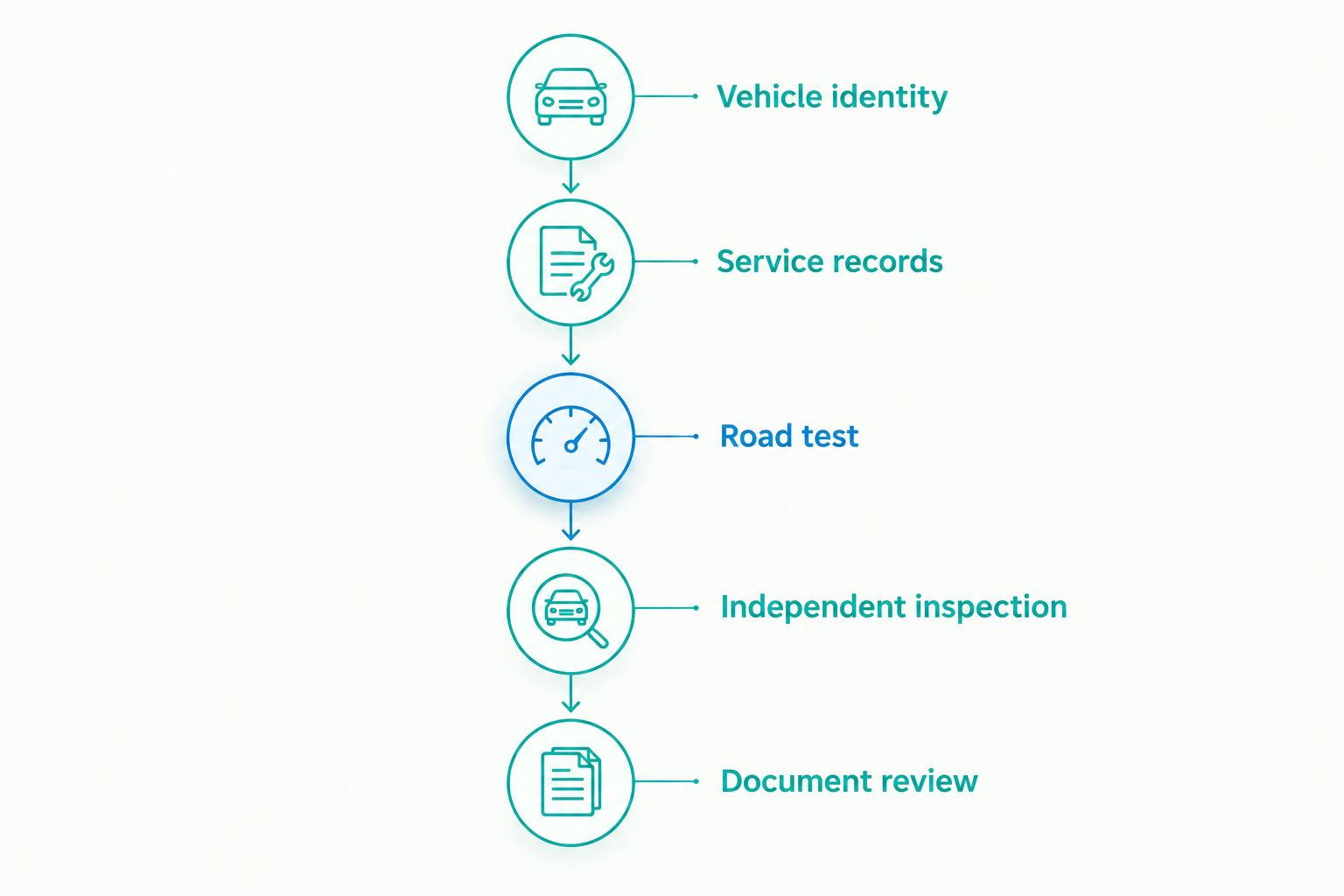
Use this sequence before committing:
- Vehicle identity: Match the VIN across the vehicle and paperwork. Verify the trim, drivetrain, and powertrain before comparing ratings.
- Service records: Review maintenance documentation and ask about gaps. Records support a condition assessment but do not replace one.
- Road test: Drive on the types of roads you use. Check braking, steering, acceleration, visibility, noise, and low-speed behavior.
- Independent inspection: Ask a qualified technician to check mechanical condition and scan relevant systems. Include hybrid-system assessment when applicable.
- Document review: Read the purchase and financing documents, and ask for an explanation of anything you do not understand before signing.
Do not let a clean cabin distract you from unresolved inspection findings. Ask for written clarification of repairs, warning lights, or discrepancies, and decide whether the explanation is supported by documentation.
GMS Autos offers financing and trade-in services. Keep those decisions separate from the vehicle assessment: first establish whether the car meets your needs, then review the transaction terms.
How the shortlist is ranked
This ranking prioritizes practical use cases rather than claiming a universal MPG winner. The Toyota Prius takes the overall slot because it combines hybrid propulsion with hatchback usefulness; the remaining choices address compact-sedan needs, an alternative hatchback, passenger space, and gasoline-only ownership.
The criteria are fuel-economy comparability, route fit, condition, cargo usefulness, and powertrain inspection needs. This is not a road-test report or a claim that every example of one model beats every example of another.
Which fuel-efficient used car should you choose?
Start with the Toyota Prius if you are undecided. Then compare the Toyota Corolla Hybrid if you prefer a compact sedan, or the Toyota Camry Hybrid if passenger space is the deciding factor.
Compare the Hyundai Ioniq Hybrid when you want another hatchback option. Choose the Honda Fit when gasoline-only ownership and flexible packaging matter more than maximizing hybrid efficiency.
In 2026, the final choice still belongs to the individual vehicle. A model that fits your needs but fails inspection is not the right purchase.
FAQ
What's the best fuel-efficient used car overall?
Toyota Prius is the default overall choice in this guide because it combines hybrid propulsion with hatchback practicality. Verify the exact configuration's fuel-economy rating and inspect the individual car before buying.
Is Toyota Corolla Hybrid better than Toyota Prius?
Toyota Corolla Hybrid is the better fit when you prefer a compact sedan and a separate trunk. Toyota Prius is the better starting point when hatchback cargo access matters more.
What's a good fuel-efficient used car without a hybrid battery?
Honda Fit is the gasoline-only choice on this shortlist. Its main strengths are a small footprint, hatchback access, and flexible seating rather than hybrid propulsion.
Should I avoid a used hybrid with high mileage?
Do not decide from mileage alone. Review service records and obtain an independent inspection that includes the hybrid system before judging the vehicle's condition.
Does every version of a car get the same MPG?
No, fuel-economy ratings can differ by model year, engine, drivetrain, and trim. Compare the exact configuration using the same EPA rating category.
Can I charge a regular hybrid at home?
A conventional hybrid does not use an external charging connection. Plug-in hybrids and battery-electric vehicles are different powertrain types, so verify which vehicle you are considering.
Where can I shop locally for a used car in Placentia?
GMS Autos is a used-car dealership in Placentia, CA, selling pre-owned cars and pickup trucks. It also offers financing and trade-in services.
One last thing
A tire check belongs in a fuel-efficient-car inspection. Incorrect tire pressure increases rolling resistance, and tire condition also affects safety. Use the vehicle's specified pressure from its placard or owner's manual, not the maximum pressure printed on the tire sidewall.
The recommendation is simple: choose the right vehicle, then check the details that affect how it drives. An efficiency-focused purchase needs both.