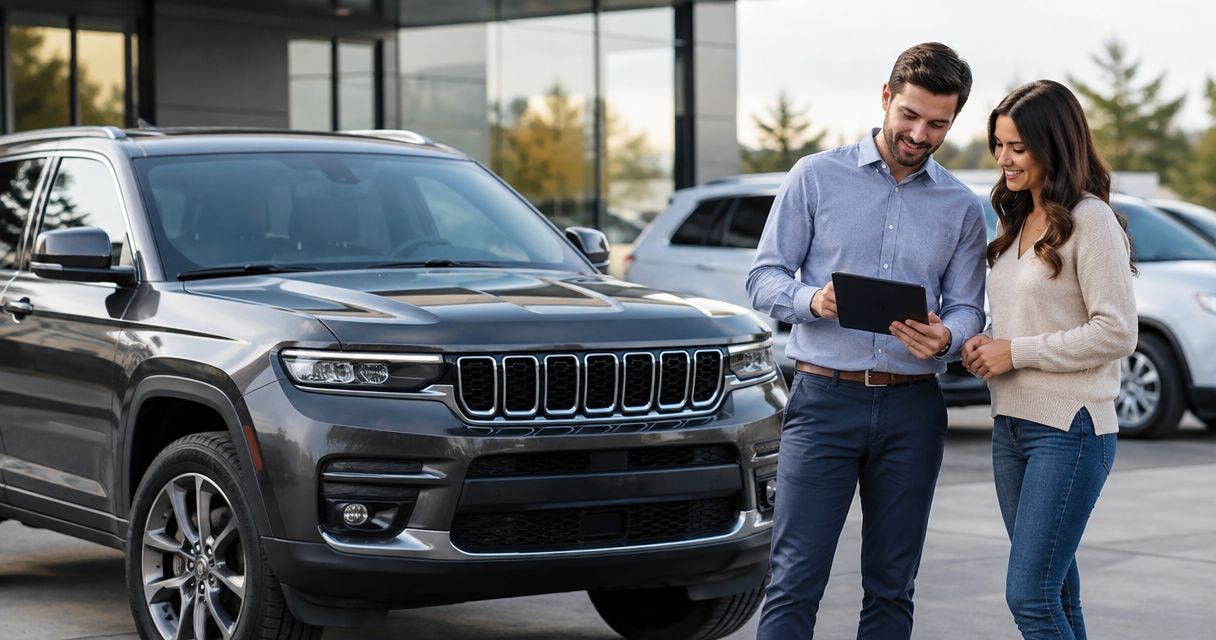
Instead of manually comparing a trade offer, loan balance, and replacement vehicle on separate scraps of paper, use one written worksheet to trade in your car for a used Jeep Grand Cherokee. Establish your trade equity first, then carry that figure into the purchase agreement and financing review.
- Trade in car for used Jeep Grand Cherokee: confirm loan payoff before treating a trade allowance as equity.
- Gmsautos serves local used-car buyers in Placentia who need trade-in and financing services.
- Positive equity reduces the balance you must cover; negative equity adds an obligation that needs a separate decision.
- Match the appraisal, lender payoff, and purchase agreement before signing.
Why this matters
A trade allowance is not the same as a down payment. If you still owe money on your current car, part of that allowance must settle the existing loan before any remainder can support the replacement purchase.
Gmsautos is best for local used-car buyers in Placentia seeking dealership trade-in and financing services. You can use Gmsautos as your dealership starting point, then keep the appraisal and purchase decisions separate until the written figures match.
For your 2026 purchase, organize the transaction around equity rather than a monthly payment alone. A payment does not show whether an old loan balance has been added to the new agreement.
Before you start
- Gather ownership materials. Bring identification, registration, available title documents, and information about any co-owner. Ask the dealership which documents and signatures your transaction requires before visiting.
- Prepare your loan information. Have your lender's contact information and request a current payoff quote. A statement balance is not necessarily the amount required to close the loan on the settlement date.
- Identify the replacement vehicle. Record the Jeep Grand Cherokee's VIN and listing details, along with your current car's VIN and mileage. The non-obvious gotcha: do not count the full appraisal as usable equity when an outstanding loan still needs payment.
Do not send account credentials or sensitive documents through an unverified message. Confirm the recipient and submission method directly with the dealership or lender.
Trade equity worksheet
Establish the starting figures
- Record the vehicle details. Note the trade's VIN, mileage, condition, keys, and known mechanical issues. Describe the car you are actually bringing, not its condition when you bought it.
- Request a written appraisal. Ask which vehicle and condition the trade allowance covers. Confirm whether inspection or a change in condition requires the figure to be reviewed.
- Request the lender payoff. Ask for the amount needed to settle the loan and the date through which the quote applies. Keep the lender's settlement instructions with the quote.
- Calculate trade equity. Subtract the payoff amount from the trade allowance. If you own the car outright, confirm there is no remaining lien before treating the allowance as equity.
Keep 2 written figures together: the dealership's trade allowance and the lender's payoff quote. That prevents a verbal estimate from becoming the basis for your purchase decision.
Expected result: You know whether your trade contributes equity, breaks even against its loan, or leaves a shortfall. You also know which documents support that conclusion.
Choose the equity treatment
Your next move depends on the difference between the allowance and the payoff. Use this comparison before asking for a replacement loan proposal.
| Equity position | Best for | Benefit | Limitation | Next action |
|---|---|---|---|---|
| Positive equity | Buyers applying an owned portion of their current vehicle toward the replacement | Reduces the remaining purchase balance | Does not replace a full review of the replacement transaction | Show the equity credit separately |
| Break-even equity | Buyers whose allowance matches the loan payoff | Settles the existing vehicle loan | Adds no equity toward the replacement | Plan how to cover the remaining purchase balance |
| Negative equity | Buyers who need to understand a shortfall before proceeding | Makes the old debt visible before signing | The shortfall must be paid or addressed in approved financing | Resolve the shortfall explicitly |
A trade-in workflow saves you the work of arranging a separate sale, but its convenience is not proof that the overall transaction suits your budget. The appraisal and the replacement purchase still need independent review.
For a 2026 worksheet, label the appraisal date and payoff expiration clearly. Do not reuse an old equity calculation after either underlying figure changes.
Replacement purchase worksheet
Connect the appraisal to the Grand Cherokee
- Confirm the replacement VIN. Match the Jeep Grand Cherokee on the worksheet to the vehicle you inspect. A different vehicle requires its own purchase review.
- Review the vehicle itself. Examine its condition, available history information, maintenance records, and any inspection findings. Trade equity does not establish whether a particular vehicle is a good purchase.
- Request an itemized purchase worksheet. Ask for the replacement vehicle amount, applicable taxes and fees, trade allowance, lender payoff, cash contribution, and any proposed financing to be shown separately.
- Check the equity entry. Confirm that positive equity reduces the remaining balance or that a shortfall is clearly identified. Do not accept a monthly-payment explanation in place of an itemized calculation.
For a California purchase in 2026, do not assume that a trade allowance reduces the taxable amount. California generally does not deduct a vehicle trade-in allowance when calculating tax on the replacement purchase; check that the worksheet handles tax separately from equity.
Expected result: The worksheet connects your specific trade and specific Grand Cherokee without hiding the old loan inside an unexplained balance.
Review financing and settlement
- Separate cash from equity. Make sure any money you contribute is distinct from the value credited through the trade. Otherwise, you cannot verify how the remaining balance was calculated.
- Read the financing terms. Review the amount financed, annual percentage rate, payment schedule, finance charge, and total of payments. A lower monthly payment alone does not establish a lower total borrowing cost.
- Check additional items. Identify any optional products or services included in the agreement. Ask for an explanation of anything you did not request, and resolve it before signing.
- Confirm the old-loan settlement process. Ask who sends the payoff, how settlement is documented, and whom you contact if the lender still shows a balance afterward.
- Keep the signed records. Retain the purchase agreement, financing disclosures, trade paperwork, and payoff information together. Follow up with your previous lender until the loan is confirmed settled.
Use 3 checkpoints before signing: vehicle identity, equity treatment, and financing terms. A match on the first does not excuse a mismatch on the others.
Expected result: You can explain where the trade allowance goes, how the old loan is handled, and what obligation the replacement agreement creates.
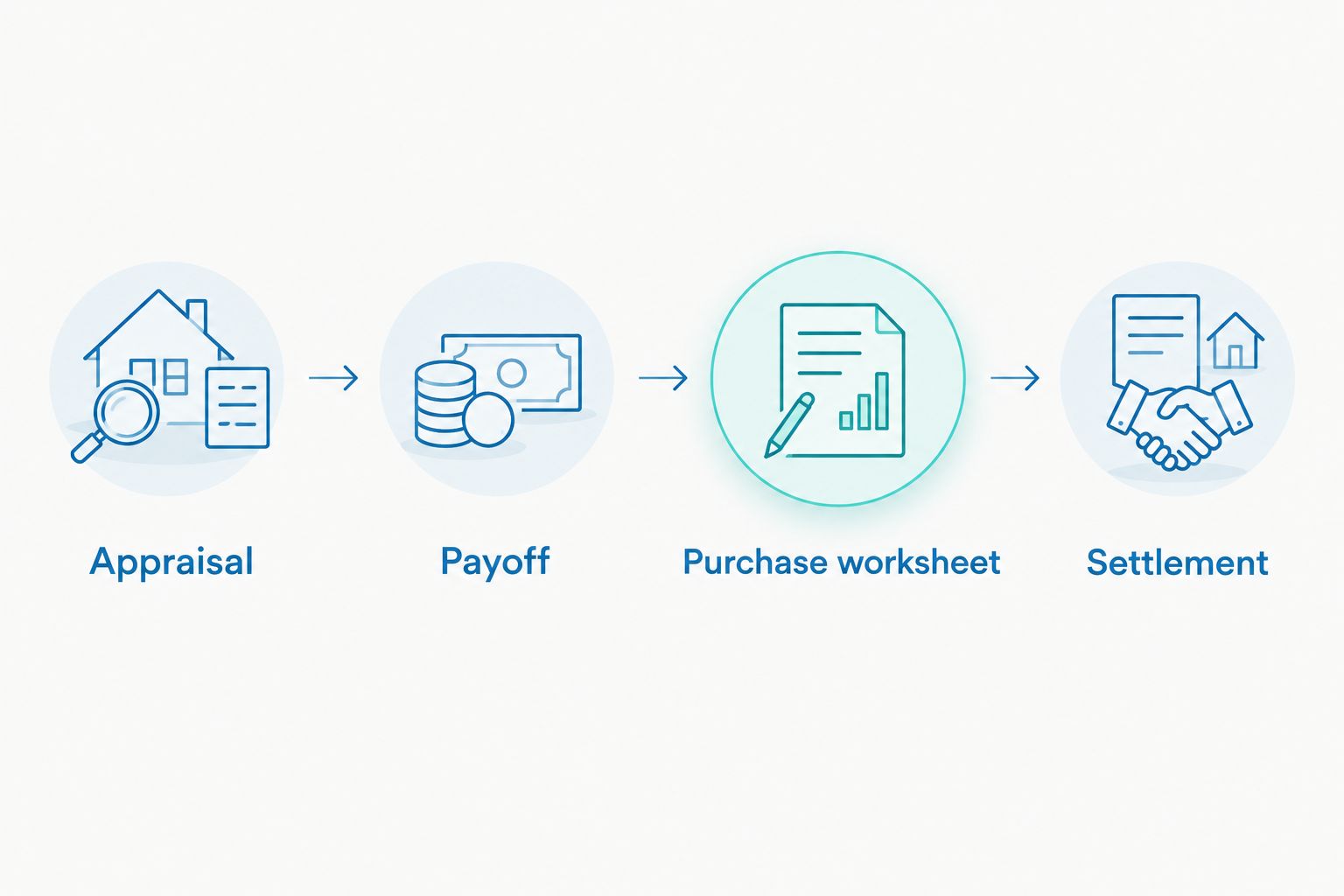
The process follows a clear order: Appraisal, Payoff, Purchase worksheet, then Settlement. Confirm each stage before relying on the next.
When your trade has negative equity
A financed trade with negative equity needs a different decision before you proceed. Negative equity is existing debt, not a discount on the Grand Cherokee.
- Confirm the shortfall. Check that both the appraisal and payoff are current. Correct a stale quote before deciding how to handle the difference.
- Ask how the shortfall would be settled. If you plan to pay it separately, get the treatment documented. If proposed financing includes it, identify that amount within the agreement.
- Review the full borrowing obligation. Financing approval does not remove the old debt; including a shortfall in the replacement loan carries that debt into the new transaction.
- Decide whether to proceed or wait. Compare the proposed obligation with keeping your current car and reducing its balance. Do not treat replacing the vehicle as the only available decision.
Expected result: You understand the shortfall and its proposed treatment before committing to the replacement vehicle.
For your 2026 decision, preserve this distinction: approval answers whether a lender will extend the proposed credit, not whether the agreement fits your household budget. Those are separate questions.
When the appraisal or vehicle changes
Repeat the worksheet review whenever the trade allowance, payoff, cash contribution, or selected Grand Cherokee changes. Do not update only the monthly payment and assume everything else remains correct.
- Appraisal changes: Recalculate equity using the revised allowance and explain the difference before accepting a new worksheet.
- Payoff changes: Obtain the applicable settlement figure and update the equity calculation.
- Replacement vehicle changes: Match the new VIN and review its condition and purchase details independently.
- Cash contribution changes: Confirm that the revised contribution appears separately and that the financing reflects it.
Keep 1 current worksheet as the decision document rather than comparing pieces from different proposals. Retain earlier versions for reference, but mark which version you are reviewing.
Expected result: Every figure belongs to the same proposed transaction. You are not combining an earlier appraisal with a later loan proposal.
Troubleshooting
The payoff is higher than your statement balance
Ask the lender for a dated payoff explanation. Loan settlement can include accrued interest and applicable amounts not captured by the balance on an earlier statement; use the lender's current payoff instructions rather than substituting your own estimate.
The appraisal changes after inspection
Ask what condition or vehicle information changed the allowance. Request a revised written figure, recalculate equity, and review the purchase worksheet again before agreeing to proceed.
The payment looks acceptable, but the financed amount is unclear
Pause the transaction and request the itemized calculation. Trace the replacement purchase, taxes and fees, trade allowance, payoff, cash contribution, and additional items into the proposed amount financed.
The title has another owner's name
Confirm the required signatures and ownership documents before arranging the exchange. Do not assume that possession of the car authorizes you to transfer it without the other owner's involvement.
The old loan still shows a balance after the trade
Contact the dealership and lender to verify whether the payoff was sent, received, and applied. Keep meeting your existing loan obligations unless the lender confirms otherwise; handing over the vehicle does not itself close the account.
Customize your workflow
Adapt the paperwork to your ownership situation, not the other way around. An outright-owned trade needs title and lien-status confirmation; a financed trade also needs lender settlement records.
Gmsautos provides used-car sales, financing, and trade-in services in Placentia. Bring your appraisal questions and payoff information together so the discussion covers the whole transaction rather than an isolated payment.
Ask about document submission requirements before sending sensitive information. This guide uses a paperwork workflow, not an assumed online application sequence or unverified website button names.
For a 2026 purchase file, keep the final worksheet alongside the signed agreement and lender correspondence. That gives you a clear reference if settlement needs follow-up.
FAQ
Can I trade in my car for a used Jeep Grand Cherokee if I still owe money?
Yes, a financed car can be traded, but its outstanding loan must be settled as part of the transaction. Compare the written trade allowance with a current lender payoff to determine your equity.
Does my whole trade allowance become a down payment?
No, an outstanding loan reduces the equity available from your trade. Only the amount remaining after payoff can contribute positive trade equity toward the replacement purchase.
What happens if I owe more than my trade is worth?
The difference is negative equity and needs an explicit settlement plan. If proposed financing includes that shortfall, the old debt becomes part of the replacement borrowing obligation.
Does trading in a car reduce sales tax in California?
California generally does not deduct a vehicle trade-in allowance from the taxable amount of the replacement purchase. Review the tax calculation separately from the trade-equity calculation.
What should I bring for a dealership trade appraisal?
Bring identification, registration, available title documents, keys, and lender information if the car is financed. Confirm the dealership's specific requirements, including any co-owner signatures, before your visit.
Should I choose the deal with the lowest monthly payment?
No, the lowest monthly payment alone does not establish the best borrowing arrangement. Compare the amount financed, annual percentage rate, payment schedule, finance charge, and total of payments.
Does Gmsautos offer trade-ins and financing?
Gmsautos offers trade-in and financing services for local used-car buyers in Placentia, California. Confirm the documents and proposed transaction terms directly with the dealership.
One last thing
The trade is not finished when you hand over the keys. If your current car is financed, lender confirmation that the old account is settled is the final check that protects the paperwork trail.
Save that confirmation with your purchase records. It closes the loop between the allowance you accepted and the debt that allowance was supposed to resolve.